Many people wonder whether offense or offence is the correct spelling. The short answer is simple: both are correct, but each follows a different variety of English.
Offense is the standard spelling in American English, while offence is preferred in British English and most Commonwealth countries. Because both words have the same meaning and pronunciation, many writers are unsure which spelling to use.
This guide explains the difference, when to use each spelling, and how to choose the right one confidently with clear examples and practical writing tips.
Quick Answer
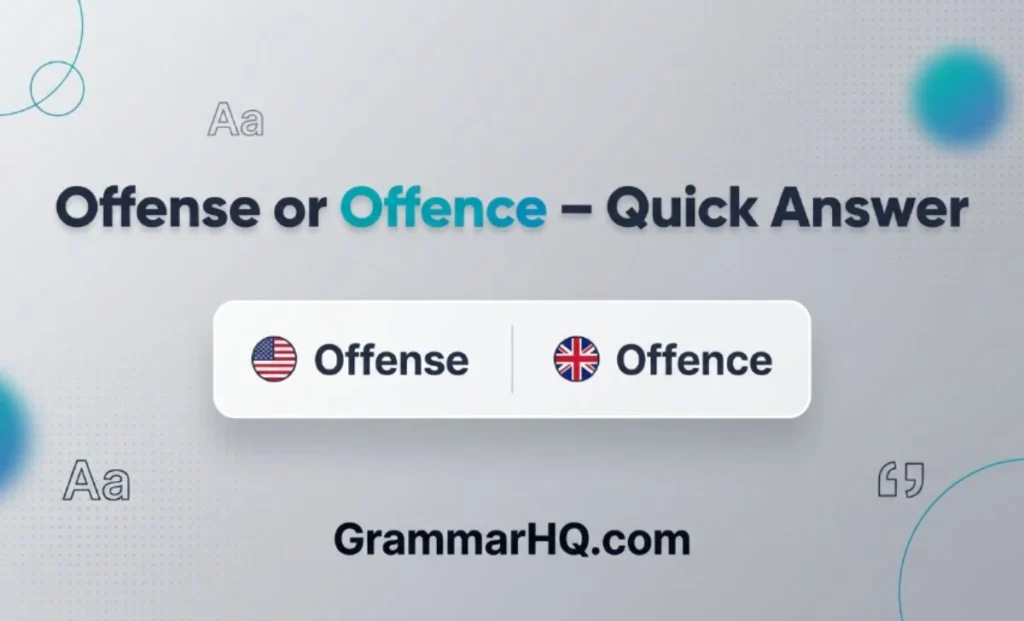
Offense and offence have the same meaning. The only difference is the spelling.
| American English | British English |
|---|---|
| Offense ✅ | Offence ✅ |
Examples
- 🇺🇸 His comment caused offense.
- 🇬🇧 His comment caused offence.
- 🇺🇸 The team played strong offense.
- 🇬🇧 The player was charged with a criminal offence.
Quick Tip: Match the spelling to your audience.
Pronunciation of Offense or Offence
Many English learners and even native speakers confuse offense and offence because they look different but have the same meaning and pronunciation. The confusion comes from regional spelling conventions rather than differences in definition.
The biggest reason is that American English prefers offense, while British English and most Commonwealth countries use offence. As people read books, news articles, websites, and social media from different parts of the world, they regularly encounter both spellings, making it difficult to know which one is correct.
Another common cause is language settings. Spell-check and writing tools automatically suggest offense or offence depending on whether your device is set to US English or UK English.
This spelling difference follows the same pattern as several other American and British English word pairs:
- Color vs Colour
- Favor vs Favour
- Defense vs Defence
- License vs Licence (British English noun)
The key point to remember is that both spellings are correct. The only difference is where you are writing and who your audience is.
Easy Trick to Remember Offense or Offence
Here’s an easy memory trick:
- S = States = Offense 🇺🇸
- C = Commonwealth = Offence 🇬🇧
Another simple rule:
If you write for an American audience, choose offense.
If you write for the UK, Australia, New Zealand, or Canada (often depending on style), choose offence.
The Origin of Offense or Offence
The words offense and offence share the same origin. They come from the Latin word offendere, which means “to strike against,” “to hurt,” or “to offend.” The term later entered Old French as offense before becoming part of Middle English.
For centuries, offence was the standard spelling throughout the English-speaking world. However, during the spelling reforms of Noah Webster in the early 19th century, American English simplified many words ending in -ce to -se.
As a result, offense became the preferred spelling in the United States, while offence remained the standard in British English and most Commonwealth countries.
Although the spellings differ today, both words have the same meaning. The only real difference is the regional spelling convention.
British English vs American English Spelling
Many English words have different spellings in the UK and the US.
| American English | British English |
|---|---|
| Offense | Offence |
| Defense | Defence |
| License (noun) | Licence (noun) |
| Practice (noun & verb) | Practice / Practise |
| Color | Colour |
| Favor | Favour |
Examples
American English
- The player has a strong offense.
- No offense was intended.
British English
- The player committed a serious offence.
- She took offence at the remark.
Which Spelling Should You Use?
Choose the spelling based on your readers.
| Audience | Recommended Spelling |
|---|---|
| United States | Offense |
| United Kingdom | Offence |
| Australia | Offence |
| New Zealand | Offence |
| Most Commonwealth countries | Offence |
| International audience | Match your chosen English style consistently |
If you’re writing for school, work, or publishing, stay consistent throughout the document.
Common Mistakes with Offense or Offence
Here are mistakes many writers make.
| Incorrect | Correct |
|---|---|
| Using offense in a British essay | Use offence |
| Using offence in American business writing | Use offense |
| Mixing both spellings in one article | Pick one style and keep it consistent |
| Thinking they have different meanings | Both mean the same thing |
Correct examples:
✅ No offense was meant. (US)
✅ No offence was meant. (UK)
Offense or Offence in Law
In legal language, offense (US) and offence (UK) both refer to an act that breaks the law and may result in punishment.
The meaning is exactly the same—the spelling changes only with the type of English being used.
American courts and legal documents use offense, while courts in the United Kingdom and many Commonwealth countries use offence.
Whether the crime is minor or serious, always match the spelling to the legal system and audience you are writing for.
Offense or Offence in Everyday Examples
- No offense was intended by my earlier message.
- No offence was intended by my previous email.
News
- The suspect was charged with a serious offense. (US)
- The suspect was charged with a serious offence. (UK)
Social Media
- Please don’t take offense.
- Please don’t take offence.
Formal Writing
- The company has a zero-tolerance policy for criminal offenses.
- The company has a zero-tolerance policy for criminal offences.
Google Trends & Usage Data
Search and usage patterns show a clear regional preference.
| Country | Common Spelling |
|---|---|
| United States | Offense |
| United Kingdom | Offence |
| Australia | Offence |
| New Zealand | Offence |
| Ireland | Offence |
Overall trends:
- Offense receives more searches from the United States.
- Offence is more common in British English-speaking countries.
- Both spellings are widely recognized online.
- Search interest changes mainly because of regional spelling preferences.
Offense vs Offence Comparison Table
| Feature | Offense | Offence |
|---|---|---|
| Correct spelling | ✅ Yes | ✅ Yes |
| Meaning | Same | Same |
| Pronunciation | Same | Same |
| American English | ✅ Preferred | Rare |
| British English | Rare | ✅ Preferred |
| Commonwealth countries | Sometimes | ✅ Common |
| Formal writing | Yes | Yes |
FAQs
Is offense or offence correct?
Yes. Both are correct. The right choice depends on whether you use American or British English.
Is offense American English?
Yes. Offense is the standard American spelling.
Is offence British English?
Yes. Offence is the standard British spelling.
Do offense and offence have different meanings?
No. They have the same meaning. Only the spelling changes.
Which spelling should I use for SEO?
Use the spelling your target audience searches for. For US readers, use offense. For UK readers, use offence.
Can I use both spellings in one article?
No. Choose one spelling style and stay consistent throughout the content.
Why do spell checkers change offense to offence?
Your device or software is likely set to British English instead of American English.
Conclusion
Choosing between offense and offence is easier than many people think. Both spellings are correct, have the same pronunciation, and carry the same meaning.
The only real difference is regional spelling. If your audience is in the United States, write offense. If you’re writing for readers in the United Kingdom or most Commonwealth countries, use offence.
Always keep your spelling consistent throughout your document, website, or email. Understanding this simple difference will make your writing look more professional and help you match your readers’ expectations.
Whenever you’re unsure, think about where your audience is located first, then choose the spelling that fits their version of English.
Read More Blogs:
- Sung or Sang: What’s the Difference and Which One Is Correct?
- Curtesy or Courtesy: Which Spelling Is Correct?

Hi, I’m Amelia Parker, a grammar enthusiast and writer at GrammarHQ.com. I specialize in explaining spelling differences, confusing words, and common English mistakes through simple, practical, and easy-to-understand guides.