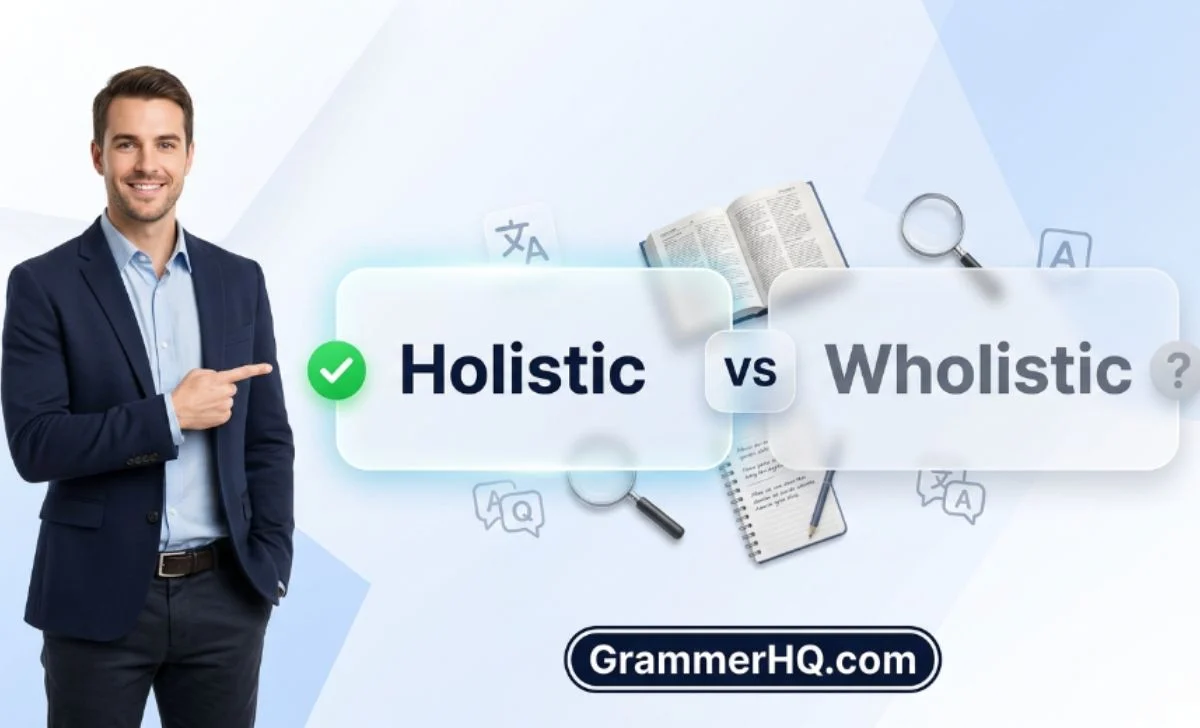
Have you ever come across both holistic and wholistic and wondered whether one of them is a typo? You’re not alone.
These two words appear in books, health articles, business websites, educational resources, and everyday conversations, leaving many English learners and even native speakers unsure which spelling is considered correct.
The confusion exists because both words refer to the same core idea—looking at something as a complete whole rather than focusing on individual parts.
However, one spelling is far more widely accepted in modern English, while the other survives mainly as an alternative form in specific contexts.
Understanding the difference can help you write more confidently, avoid common spelling mistakes, and choose the form that best fits professional, academic, or everyday communication.
Quick Answer

Holistic is the standard and preferred spelling in modern English. Wholistic is a recognized variant spelling that emphasizes the word whole, but it is much less common.
Most dictionaries, style guides, academic publications, and professional editors recommend using holistic unless a specific organization or brand intentionally prefers wholistic.
What Does Holistic Mean?
Holistic is an adjective that describes an approach that considers the whole rather than focusing only on individual parts.
The word is commonly used across many fields, including:
- Holistic health
- Holistic medicine
- Holistic education
- Holistic nutrition
- Holistic business strategy
- Holistic management
- Holistic learning
- Holistic development
- Holistic marketing
- Holistic design
- Holistic thinking
In each case, the emphasis is on understanding how different parts work together as one complete system.
Examples
A holistic approach to healthcare considers a patient’s physical, emotional, mental, and social well-being.
The company adopted a holistic marketing strategy instead of focusing on advertising alone.
Teachers encouraged holistic learning, helping students develop academic, emotional, and social skills together.
What Does Wholistic Mean?
Wholistic has the same meaning as holistic. It is simply an alternative spelling used by some writers, wellness practitioners, educational organizations, and businesses to highlight the idea of wholeness.
Although many people assume wholistic is more accurate because it resembles the word whole, it is not the standard spelling in contemporary English.
Most trusted dictionaries—including Merriam-Webster, Cambridge Dictionary, Collins Dictionary, and The American Heritage Dictionary—list holistic as the primary spelling, while wholistic is treated as a less common variant or is mentioned only as an alternative.
Examples
✅ Some wellness centers describe their services as wholistic healing.
✅ A few organizations promote wholistic education to emphasize complete personal development.
Even in these contexts, many professional editors would still prefer holistic.
Holistic or. Wholistic Comparison Table
| Feature | Holistic | Wholistic |
|---|---|---|
| Standard English | ✅ Yes | ⚠ Variant |
| Dictionary Preference | Preferred | Alternative |
| Meaning | Considering the whole | Same meaning |
| Academic Writing | Recommended | Rare |
| Professional Writing | Recommended | Usually avoided |
| Health & Wellness | Very common | Occasionally used |
| Business Communication | Preferred | Rare |
| Editorial Style Guides | Preferred | Rarely recommended |
Bottom line: Both words are understood, but holistic is the spelling you should use in almost every situation.
Pronunciation
One reason people become confused is that holistic and wholistic are pronounced exactly the same.
IPA (American English)
/hoʊˈlɪstɪk/
IPA (British English)
/həˈlɪstɪk/
Notice that adding the W does not change the pronunciation.
Examples:
- holistic healthcare
- holistic therapy
- holistic approach
- wholistic healing
All are pronounced the same way.
Why Do People Confuse Holistic and Wholistic?
The confusion comes from the relationship between the words whole and holistic.
Many people naturally assume that because holistic refers to treating something as a whole, the spelling should also begin with “wh.” This assumption seems logical at first glance.
Several factors contribute to the confusion:
The Meaning Suggests “Whole”
People often connect the concept of wholeness with the spelling wholistic, making it appear more intuitive.
Marketing and Branding
Some wellness clinics, holistic therapists, nutrition coaches, and alternative health practitioners intentionally choose wholistic because they believe it visually reinforces the idea of complete wellness.
Online Content
Blogs, social media posts, and personal websites frequently use both spellings interchangeably, leading readers to think they are equally common.
Lack of Awareness
Many English learners have never checked trusted dictionaries or editorial style guides, so they assume both spellings are equally preferred.
Despite these reasons, modern English overwhelmingly favors holistic in professional writing, academic publications, journalism, and business communication.
Which Spelling Is Correct?
The direct answer is simple:
✅ Holistic is the correct and standard spelling for almost all writing.
Wholistic is not incorrect, but it is a much less common variant that survives mainly in certain wellness communities, educational organizations, and brand names.
If you’re writing:
- Academic papers
- Professional emails
- Business reports
- Blog posts
- School assignments
- IELTS or TOEFL essays
- Research articles
choose holistic.
Using the standard spelling aligns your writing with accepted English conventions and the recommendations of major dictionaries and editorial standards.
Is Wholistic a Real Word?
Yes. Wholistic is a real word, but it is not the preferred spelling.
Most language experts classify it as a variant spelling rather than the standard form. It carries exactly the same meaning as holistic, and readers will generally understand either version.
However, because holistic is overwhelmingly more common in published books, newspapers, academic journals, educational materials, and professional writing, it remains the safer choice for nearly every audience.
The Grammar Rule
There is no grammatical difference between holistic and wholistic.
The distinction is purely one of spelling preference and usage frequency.
To remember the rule:
- Holistic → Standard English spelling recommended by dictionaries and editors.
- Wholistic → Less common variant used mainly for stylistic or branding purposes.
Whenever you’re unsure, choose holistic. It is the spelling most readers expect and the one accepted across academic, professional, editorial, and international English contexts.
Word Origin and Etymology
Holistic traces its roots to the Greek word holos, meaning “whole,” “entire,” or “complete.” The English noun holism was introduced in 1926 by the South African philosopher and statesman Jan Smuts in his book Holism and Evolution.
He used the term to describe the idea that systems should be understood as integrated wholes rather than as separate, independent parts.
The adjective holistic developed from holism and quickly became the standard spelling in English.
The variant wholistic appeared later. It was created to make the connection with the English word whole more obvious, especially in health and wellness communities. Although the intention is understandable, holistic remains the accepted standard in dictionaries, academic writing, and professional communication.
Timeline
| Year | Development |
|---|---|
| Ancient Greek | Holos means “whole” or “complete.” |
| 1926 | Jan Smuts introduces holism. |
| Mid-1900s | Holistic becomes the standard adjective. |
| Later years | Wholistic emerges as a less common variant. |
| Today | Holistic is overwhelmingly preferred worldwide. |
British vs American English
Unlike pairs such as color/colour or organize/organise, the difference between holistic and wholistic is not a British-versus-American spelling issue.
Both American English and British English overwhelmingly prefer holistic.
| English Variety | Preferred Spelling |
|---|---|
| American English | ✅ Holistic |
| British English | ✅ Holistic |
| Canadian English | ✅ Holistic |
| Australian English | ✅ Holistic |
| International English | ✅ Holistic |
The spelling wholistic appears occasionally in both regions, but mainly in marketing materials, wellness businesses, coaching programs, or organization names—not because one variety of English officially prefers it.
Holistic vs. Wholistic in Real-Life Examples
Seeing words in context is one of the best ways to remember them.
Everyday Conversation
✅ Correct: I’m looking for a holistic solution instead of a quick fix.
✅ Correct: The doctor recommended a holistic approach to improving my health.
⚠ Less Common: Some clinics advertise wholistic healing services.
School and Education
✅ Our school promotes holistic education by encouraging creativity, teamwork, and critical thinking.
✅ Teachers use a holistic assessment instead of grading only test scores.
Business Communication
✅ The company developed a holistic business strategy that combines marketing, finance, and customer service.
✅ Managers need a holistic view of the organization before making important decisions.
Healthcare
✅ Modern hospitals often combine traditional treatments with holistic care.
✅ A holistic nutrition plan focuses on long-term wellness rather than short-term dieting.
Professional Emails
✅ We recommend taking a holistic approach to project planning.
❌ We recommend taking a wholistic approach to project planning. (Understandable but less preferred in professional writing.)
Academic Writing
✅ Researchers adopted a holistic framework to analyze the entire system.
❌ Researchers adopted a wholistic framework for the study. (Not incorrect, but most journals prefer holistic.)
Social Media
✅ Self-care means taking a holistic approach to your physical and mental health.
⚠ Some wellness influencers intentionally write wholistic wellness to emphasize the idea of “whole-person” care.
IELTS and TOEFL Writing
If you’re taking an English proficiency exam, always choose holistic. Examiners expect standard English spelling unless you’re intentionally quoting a source or referring to a brand name.
Correct vs. Incorrect Usage
| Sentence | Correct? | Why? |
|---|---|---|
| She believes in holistic medicine. | ✅ | Standard spelling. |
| The company adopted a holistic strategy. | ✅ | Preferred in business writing. |
| The university uses a holistic admissions process. | ✅ | Common academic usage. |
| We offer wholistic healing sessions. | ✅ | Acceptable if it’s the organization’s preferred branding. |
| Holistic and wholistic have different meanings. | ❌ | They have the same meaning. |
| British English uses wholistic. | ❌ | Both varieties mainly use holistic. |
Common Mistakes
1. Thinking “Wholistic” Is More Correct
Why it happens
People see the word whole and assume the spelling should also begin with wh.
Correct understanding
The standard English spelling is holistic, even though the meaning relates to “the whole.”
2. Assuming the Words Have Different Meanings
Why it happens
The extra W makes people think the words describe different concepts.
Correct understanding
Both words express the same idea of considering the complete person, system, or situation.
3. Using Wholistic in Academic Writing
Why it happens
Writers copy the spelling from websites or marketing materials.
Better choice
Use holistic in essays, research papers, university assignments, and scholarly publications.
4. Believing One Is American and the Other Is British
Why it happens
Many English learners are familiar with spelling pairs like color/colour and assume the same rule applies here.
Correct understanding
Both American and British English strongly prefer holistic.
5. Switching Spellings in the Same Article
Why it happens
Writers don’t notice they’re using both forms interchangeably.
Better choice
Pick one spelling and stay consistent. For almost every audience, that spelling should be holistic.
Easy Memory Trick
Think of the Letter H
H in Holistic can remind you of:
- Health
- Harmony
- Human
- Highly preferred spelling
If you’re ever unsure, remember:
“Holistic is the standard. Wholistic is the variant.”
Another simple way to remember it:
Nearly every major dictionary starts with “Holistic,” so your writing should too.
Why This Matters in Real Life
Choosing the right spelling isn’t just about passing a spelling test. It also affects how professional and credible your writing appears.
Professional Emails
Using holistic reflects standard editorial practice and helps your message look polished.
Job Applications
Resumes, cover letters, and personal statements benefit from standard English spelling, especially when applying to international employers.
Academic Writing
Universities, researchers, and academic publishers almost always expect holistic, making it the safest choice for essays and research papers.
Business Communication
Companies often talk about holistic planning, holistic management, or a holistic customer experience. Using the standard spelling ensures consistency with professional writing conventions.
Native English Conversations
Most native speakers recognize both spellings, but they encounter holistic far more often in books, newspapers, journals, educational resources, and workplace documents.
Health and Wellness
If you visit wellness clinics, counseling centers, or alternative medicine websites, you may occasionally see wholistic. In many cases, it’s a branding decision rather than a grammatical preference.
Practice Quiz
Test your understanding of holistic and wholistic with these quick exercises.
Multiple Choice
1. Which spelling is the standard form in modern English?
A. Wholistic
B. Holistic
C. Both are equally preferred
D. Neither
Answer: B. Holistic
2. Which sentence is best for an academic paper?
A. The study used a wholistic approach.
B. The study used a holistic approach.
C. Both are equally recommended.
D. Neither is acceptable.
Answer: B. The study used a holistic approach.
3. Which statement is true?
A. Holistic and wholistic have different meanings.
B. Wholistic is the preferred spelling worldwide.
C. Holistic is the standard spelling, while wholistic is a less common variant.
D. British English uses wholistic.
Answer: C
4.Our university takes a ________ approach to student development.
Answer: holistic
5.Most dictionaries list ________ as the preferred spelling.
Answer: holistic
Correct the Sentenc
6.❌ The company adopted a wholistic marketing strategy.
✅ Corrected: The company adopted a holistic marketing strategy.
7.❌ British English prefers wholistic.
✅ Corrected: Both British and American English generally prefer holistic.
True or False
8.Wholistic has a different meaning from holistic.
Answer: False
Both words express the same idea. The difference lies in spelling preference, not meaning.
FAQ,s
Is holistic or wholistic correct?
Both spellings exist, but holistic is the standard and preferred form in modern English. It is the spelling recommended by major dictionaries, editors, and style guides.
Is wholistic a real word?
Yes. Wholistic is a legitimate variant spelling. However, it is much less common than holistic and is mostly found in wellness, coaching, and branding contexts.
Why do some people spell it wholistic?
Many writers use wholistic because it visually emphasizes the word whole. Although this makes intuitive sense, it is a stylistic preference rather than the standard English spelling.
Do holistic and wholistic mean different things?
No. Both words mean considering something as a complete whole rather than focusing only on individual parts.
Should I use holistic in professional writing?
Yes. For business emails, academic papers, job applications, research articles, and professional documents, holistic is the recommended choice.
Is wholistic wrong?
Not necessarily. It is an accepted variant spelling, but because it is uncommon, many editors will replace it with holistic for consistency and clarity.
Which spelling is better for SEO and blogging?
If your audience is broad, holistic is usually the better choice because it matches standard dictionary usage and aligns with what most readers expect. If you discuss the spelling difference itself, naturally include wholistic as the variant form.
Conclusion
Choosing between holistic and wholistic is easier once you know that the difference is about spelling not meaning.
While both forms refer to viewing something as a complete whole, holistic is the standard spelling accepted by major dictionaries, educational institutions, publishers, and professional editors.
Wholistic remains a valid but uncommon variant that appears mainly in branding and wellness-related contexts. If you want your writing to look polished, consistent, and professional, holistic is the spelling you should use in almost every situation.
Read More Bloogs:
- Molding or Moulding? Correct Spelling & Meaning Explained”
- Capital or Capitol: Which Word Is Correct and Why Does It Matter?

Hi, I’m Amelia Parker, a grammar enthusiast and writer at GrammarHQ.com. I specialize in explaining spelling differences, confusing words, and common English mistakes through simple, practical, and easy-to-understand guides.