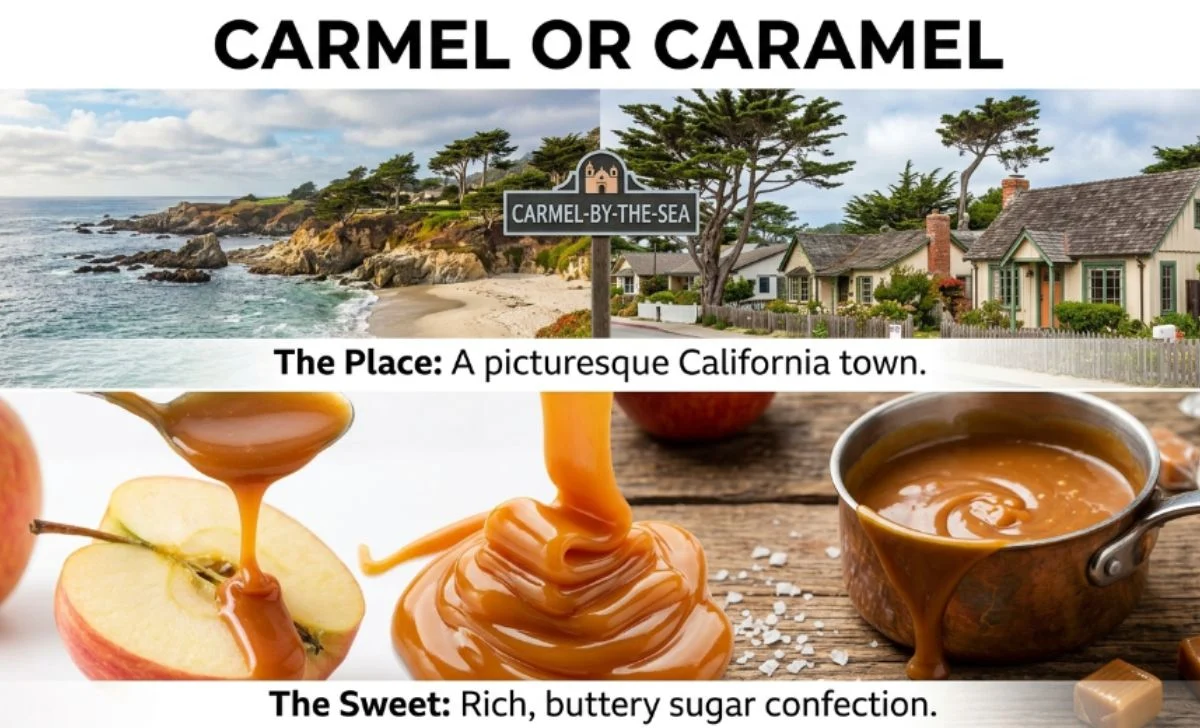
Many English learners and native speakers search for carmel or caramel because they often see both forms in writing or hear different pronunciations in everyday speech.
The confusion becomes even greater when people order coffee, read recipes, or write about desserts.
Is carmel simply a shorter spelling of caramel, or is it a mistake? In most cases, caramel is the correct spelling for the sweet confection made from heated sugar.
However, Carmel is also a real word with different meanings, including place names and personal names.
This guide explains the difference between carmel and caramel, their pronunciation, history, usage, and regional preferences so you can choose the correct form confidently in any situation.
Quick Answer
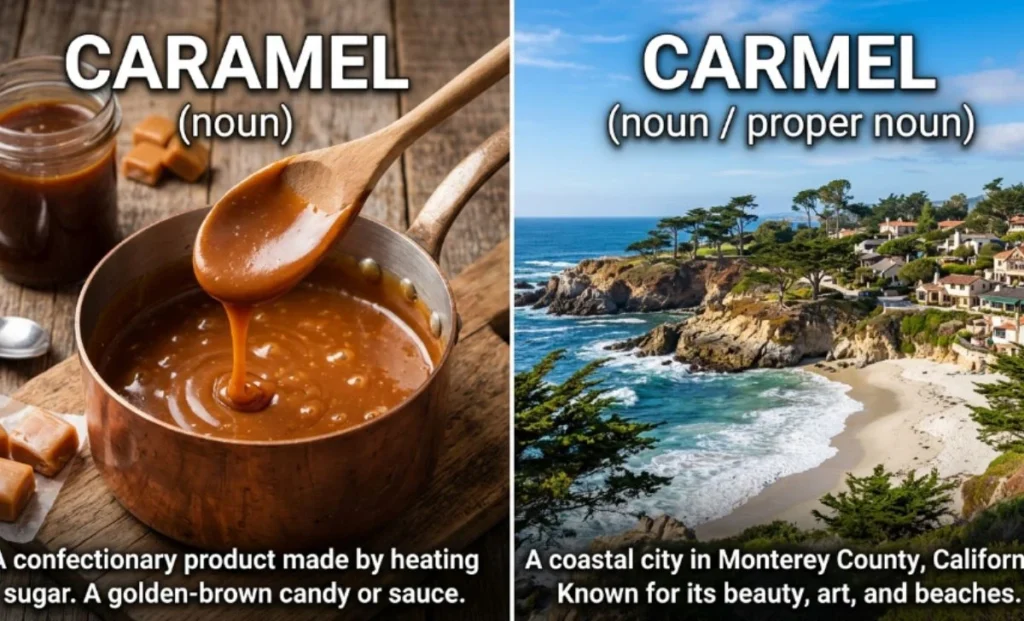
Caramel is the correct spelling when referring to the sweet food made by heating sugar. It can describe candy, sauce, dessert toppings, or flavorings.
Examples:
- Correct: I added caramel sauce to my ice cream.
- Correct: The bakery sells caramel candies.
- Incorrect: I bought carmel candies.
The word Carmel usually refers to a proper noun, such as Mount Carmel, a city, a surname, or a religious reference. It is generally not used as a spelling variation of the confection.
| Word | Meaning | Example |
|---|---|---|
| Caramel | Sweet confection made from heated sugar | Caramel popcorn |
| Carmel | Proper noun or place name | Mount Carmel in Israel |
Pronunciation of Carmel or Caramel
People often confuse these words because pronunciation varies widely.
Caramel is commonly pronounced in two ways:
- KAR-uh-mel (/ˈkær.ə.mel/)
- KAR-mel (/ˈkɑːr.məl/)
In casual American speech, many speakers drop the middle syllable and say “KAR-mel.” This shortened pronunciation leads some people to write carmel instead of caramel.
In formal writing, dictionaries such as Merriam-Webster and Cambridge Dictionary still list caramel as the standard spelling.
Spoken examples:
- Would you like caramel syrup in your coffee?
- The caramel cheesecake tastes amazing.
Although some speakers pronounce it as “carmel,” the spelling remains caramel when discussing food.
Why People Confuse Carmel or Caramel
Several factors cause confusion.
1. Similar Pronunciation
Many people pronounce caramel as “KAR-mel.” Because they hear only two syllables, they assume the word is spelled carmel.
2. Regional Speech Patterns
Pronunciation differs across regions in the United States. Some dialects naturally omit the middle vowel sound.
3. Familiarity With Proper Nouns
People may already know names such as Mount Carmel, Carmel-by-the-Sea, or personal names like Carmel. Seeing these names can reinforce the incorrect spelling when referring to food.
4. Fast Typing and Informal Writing
Social media, texting, and casual communication often encourage abbreviated spellings, increasing the frequency of carmel.
Easy Trick to Remember Carmel or Caramel
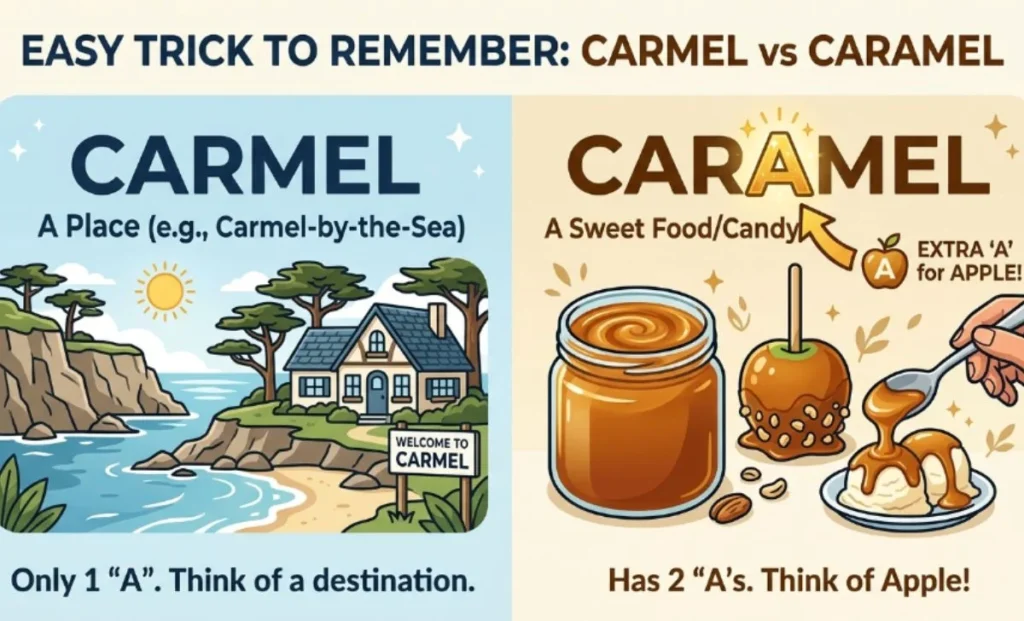
A simple memory trick can help.
CaramEL has an extra “a” because sweet treats deserve an extra letter.
Think:
CARA + MEL = Sweet dessert
Whenever you talk about candy, sauce, coffee flavors, desserts, or confectionery, remember that caramel contains three vowel sounds.
Another trick:
- Caramel = Candy
- Both words contain multiple syllables.
If you mean a place, person, or religious name, use Carmel.
The Origin of Carmel or Caramel
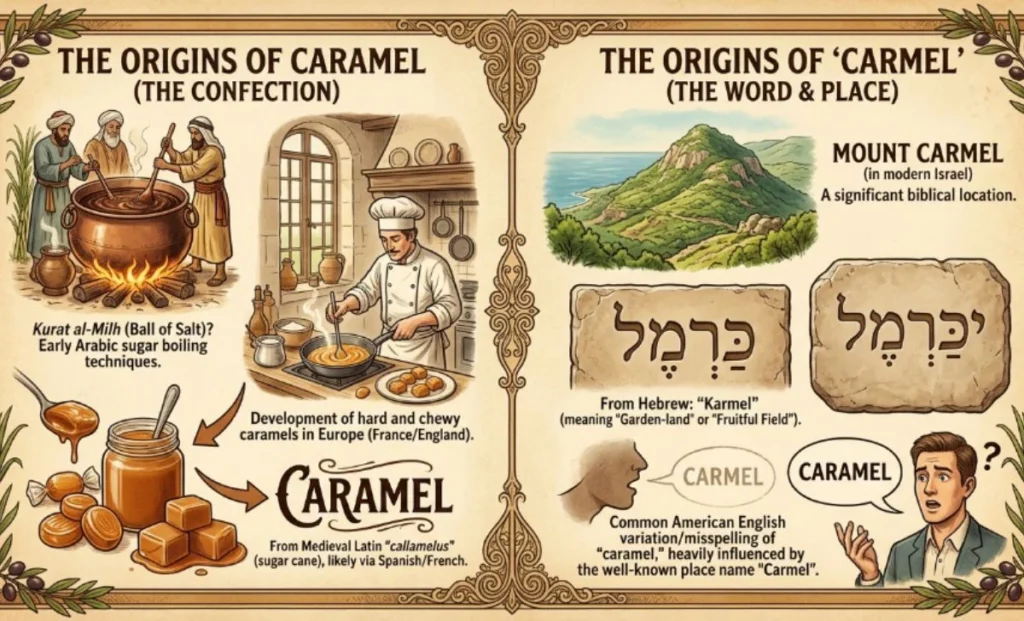
The word caramel has a long linguistic history.
English borrowed caramel through French and Spanish forms. Linguists trace it back to Medieval Latin and ultimately to terms related to sugar cane and cooked sugar.
Over centuries, the spelling remained remarkably stable because dictionaries standardized the form as caramel.
The spelling Carmel developed independently as a proper noun. It comes from the Hebrew phrase meaning “garden land” or “fertile land.” This origin gave rise to names such as Mount Carmel, an important geographical and religious site in Israel.
Because these words evolved from different linguistic roots, they should not be used interchangeably.
British English vs American English Spelling
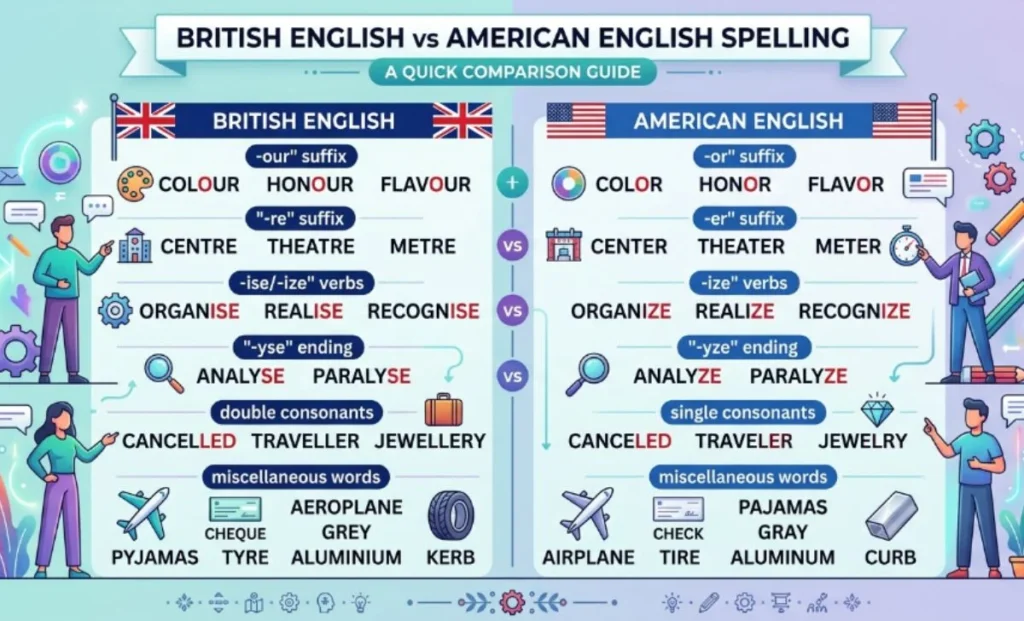
Unlike words such as color/colour or center/centre, caramel does not have separate British and American spellings.
Both British English and American English prefer caramel.
However, pronunciation differs among speakers.
| Feature | American English | British English |
|---|---|---|
| Standard spelling | caramel | caramel |
| Alternate spelling | Not standard | Not standard |
| Common pronunciation | KAR-uh-mel or KAR-mel | KAR-uh-mel |
| Accepted in formal writing | caramel | caramel |
Examples:
- American English: She ordered a caramel latte.
- British English: The pudding contains caramel sauce.
Writers in the United Kingdom, Canada, Australia, and New Zealand also generally use caramel.
Which Spelling Should You Use?
Your audience determines many spelling choices in English, but this is not one of them.
For United States Audiences
Use caramel in recipes, blogs, menus, and professional writing.
For United Kingdom Audiences
Use caramel.
For Commonwealth Countries
Writers in Canada, Australia, South Africa, and New Zealand should also use caramel.
For Global Audiences
Choose caramel because it is internationally recognized and accepted.
For Academic and Professional Writing
Always use dictionary-approved spellings. In this case, the correct choice is caramel.
Common Mistakes with Carmel or Caramel
Below are frequent mistakes and corrections.
❌ I bought carmel syrup.
✅ I bought caramel syrup.
❌ The recipe calls for melted carmel.
✅ The recipe calls for melted caramel.
❌ Please add carmel drizzle to my coffee.
✅ Please add caramel drizzle to my coffee.
❌ Caramel is spelled carmel in British English.
✅ Caramel is the standard spelling in both British and American English.
Writers should also avoid confusing the dessert with proper nouns.
❌ I love eating Carmel.
✅ I love eating caramel.
Carmel or Caramel in Everyday Examples
“Please bring caramel cupcakes to tomorrow’s office meeting.”
News Headline
“Local bakery launches new caramel-flavored pastries.”
Social Media
“Just tried a salted caramel latte, and it was delicious!”
Academic Writing
“Caramelization occurs when sugars are heated to high temperatures.”
Professional Communication
“The product contains natural caramel coloring.”
Everyday Conversation
“Would you like caramel sauce on your ice cream?”
These examples show that caramel appears in many contexts, including food science, cooking, hospitality, and marketing.
How to pronounce caramel in the south
- In many parts of the American South, caramel is commonly pronounced as “KAR-muhl” (two syllables), though some speakers also say “CARE-uh-mel” (three syllables).
- Both pronunciations are correct, but “KAR-muhl” is especially common in Southern speech. Regional accents and family traditions often influence which version people use.
- Learning both pronunciations will help you understand native speakers from different parts of the United States.
- Listening to real Southern speakers is the best way to become familiar with the natural pronunciation.
Examples:
- My grandma always says “KAR-muhl” when making caramel pie.
- In the South, many people pronounce caramel with two syllables.
- You may hear both “KAR-muhl” and “CARE-uh-mel” depending on the speaker.
Caramel pronunciation american
- Caramel pronunciation (American English) is most commonly pronounced as “KAR-uh-mel”, although many Americans also say “KAR-mel” in everyday speech.
- Both pronunciations are widely accepted in the United States, with the shorter version being especially common in casual conversation.
- Learning both forms helps you understand native speakers in different regions. If you’re studying American English, “KAR-uh-mel” is the clearest pronunciation to start with.
- Listening to native speakers and repeating the word aloud will improve your accuracy and confidence.
Examples:
- I ordered a caramel latte this morning.
- She loves caramel ice cream with chocolate chips.
- The cake is topped with warm caramel sauce.
Comparison Table: Carmel vs Caramel
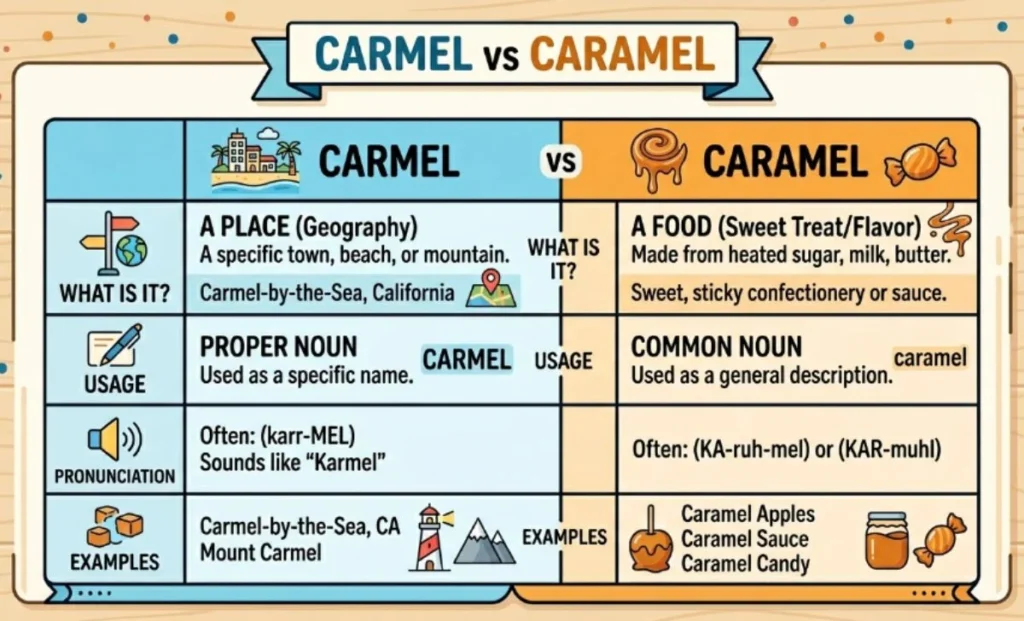
| Feature | Carmel | Caramel |
|---|---|---|
| Part of speech | Proper noun | Common noun |
| Refers to food | Usually no | Yes |
| Standard dictionary spelling for confection | No | Yes |
| Used in recipes | Rarely | Frequently |
| Accepted in formal writing for dessert | No | Yes |
| Example | Mount Carmel | Caramel candy |
FAQs
Is carmel an acceptable spelling of caramel?
No. In formal writing, caramel is the accepted spelling for the confection.
Why do people pronounce caramel as carmel?
Many dialects shorten the pronunciation by dropping the middle syllable.
Is caramel spelled differently in British English?
No. Both British and American English use caramel.
Is Carmel a real word?
Yes. Carmel is a proper noun used in place names, surnames, and religious references.
Which dictionaries recognize caramel?
Major dictionaries, including Merriam-Webster, Cambridge, Collins, and Oxford, recognize caramel as the standard spelling.
Can I write carmel in informal texts?
People may understand it, but using caramel is still recommended.
Why does my spell checker flag carmel?
Because most spell checkers recognize caramel as the standard spelling for food.
Conclusion
Choosing between carmel or caramel becomes easy once you understand the difference.
When referring to candy, sauces, dessert toppings, coffee flavors, or cooked sugar, caramel is the correct spelling in both British and American English.
The form Carmel is generally reserved for proper nouns, including locations, personal names, and religious references such as Mount Carmel.
Much of the confusion comes from pronunciation differences, especially in American speech, where speakers often shorten the word to “KAR-mel.”
Regardless of pronunciation, formal, academic, and professional writing should always use caramel for the confection.
Following dictionary standards will help you communicate clearly and avoid common spelling mistakes.
Read More Blogs:
- Ballot or Bullet: Why It Still Matters
- Insite or Insight? Correct Spelling, Meaning & Usage Explained

Hi, I’m Amelia Parker, a grammar enthusiast and writer at GrammarHQ.com. I specialize in explaining spelling differences, confusing words, and common English mistakes through simple, practical, and easy-to-understand guides.