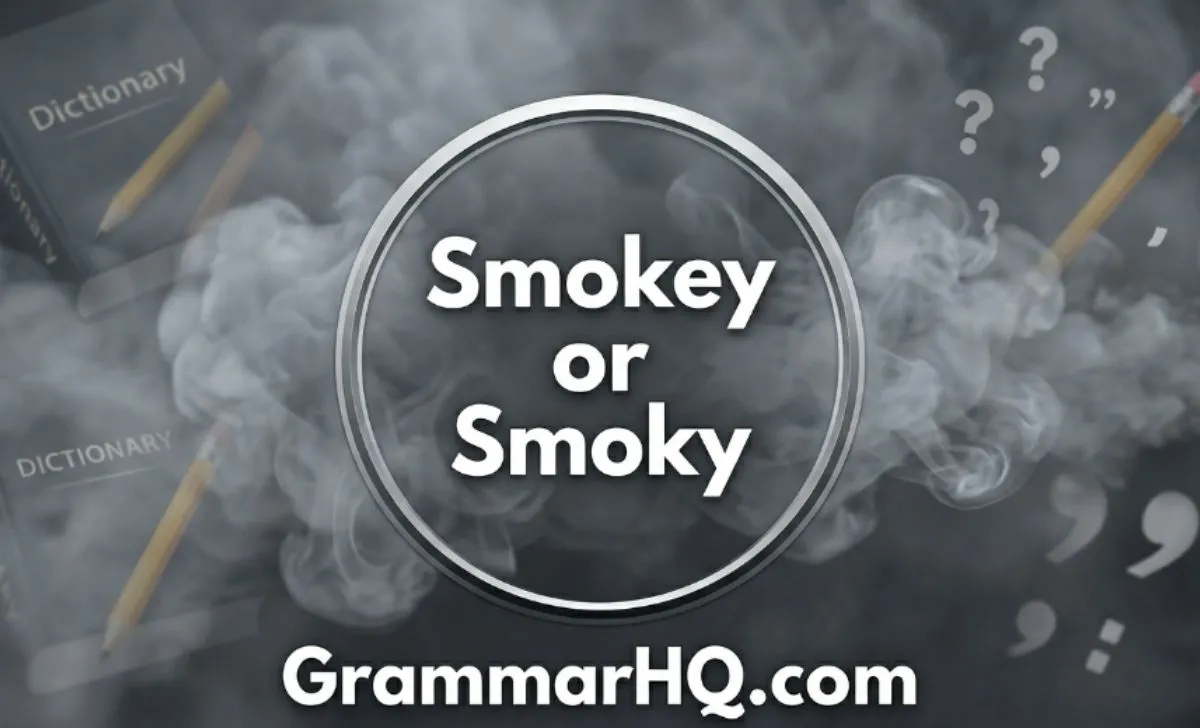
Many people get confused between “smokey” and “smoky” because both look correct and are often seen online.
This confusion happens in grammar learning, food descriptions, and travel writing. However, only one form is standard in English.
The word is commonly used to describe smoke-filled air, flavor, or atmosphere.
In this guide, you will clearly learn the correct spelling, meaning, and usage of both forms so you can write accurately in school, business, and SEO content without mistakes or confusion.
Quick Answer
The correct spelling in standard English is “smoky,” while “smokey” is usually incorrect or informal.
- Smoky
- Smokey
In simple terms:
- Smoky = correct adjective
- Smokey = informal / incorrect spelling
Correct Example
The room had a smoky smell after the fire.
Incorrect Example
The room was very smokey after cooking.
What Does Smokey or Smoky Mean?
The word “smoky” describes something that contains smoke, looks like smoke, or has a burnt flavor or atmosphere.
Common Meanings
- Filled with smoke
- Having a burnt or grilled flavor
- Foggy or hazy environment
- Dark or unclear visual condition
Simple Usage Examples
- The kitchen became smoky while cooking.
- The barbecue had a smoky flavor.
- The mountains looked smoky in the distance.
The Origin of Smokey or Smoky
Word History
The word “smoky” comes from “smoke,” which originates from Old English “smoca,” meaning vapor or burning fumes. The adjective form developed to describe smoke-like conditions.
Why the Confusion Happens
Confusion occurs because:
- English language
- Adjective formation
- “Smokey” appears in informal writing and brand names
British English vs American English
There is no regional difference here. Only “smoky” is considered correct in both British and American English.
Comparison Table
| Word | Usage Type | Meaning |
| Smoky | Correct | Filled with smoke |
| Smokey | Incorrect | Non-standard form |
Smokey or Smoky vs Other Variations
Spelling Comparison Table
| Term | Status | Usage Context | Region |
| Smoky | Correct | Grammar, writing | Global |
| Smokey | Incorrect | Informal/nickname | Global |
| Smoke | Root word | Noun (substance) | Global |
Which Spelling Should You Use?
US Audience
Always use “smoky” in formal and SEO writing.
UK Audience
Same rule: “smoky” is correct.
International Writing
Stick to “smoky” for clarity and correctness.
Academic Writing
Use “smoky” only, as it follows standard grammar rules.
Social Media Usage
“Smokey” may appear in usernames or branding but not in formal content.
Smokey or Smoky Meaning
- Smoky means filled with smoke or having the color, smell, or flavor of smoke. It is the correct adjective used to describe things like smoky air, smoky mountains, or smoky barbecue.
- Smokey, on the other hand, is usually a proper name or nickname, such as Smokey Bear.
- Understanding this difference helps you choose the correct spelling in everyday English and professional writing.
Common Mistakes with Smokey or Smoky
Frequent Errors
- Using “smokey” in formal writing
- Mixing both spellings in one article
- Confusing it with names or brands
Corrected Examples
- Incorrect: The grill was smokey and hot.
- Correct: The grill was smoky and hot.
Smokey or Smoky Quartz
- The correct gemstone name is smoky quartz, not smokey quartz. Smoky describes the crystal’s grayish-brown, smoke-like color, while Smokey is generally used as a proper name or nickname.
- Although some online stores use “smokey quartz,” smoky quartz is the standard spelling accepted in gemology and dictionaries.
- For accurate writing, product descriptions, and educational content, always use smoky quartz.
Smokey or Smoky in Everyday Examples
Emails
The factory area was smoky after the incident.
Social Media
Love this smoky BBQ flavor! 🔥
News Writing
The city experienced smoky conditions due to wildfires.
School Writing
Students learn how smoke creates a smoky environment.
Business Writing
The product has a smoky aroma profile.
Why People Search This Keyword
- Grammar confusion
- Food flavor descriptions
- SEO writing corrections
- English learning
- Spelling accuracy checks
Related Grammar Rules
Similar Spelling Mistakes
- Happy vs Happi
- Funny vs Funy
- Easy vs Eazy
Helpful Grammar Tips
- Always check dictionary spelling
- Avoid informal variations in academic writing
- Use root word rules for adjective formation
FAQs
- 1. Which is correct: Smokey or Smoky?
- Smoky is the standard spelling when describing something filled with smoke or having the flavor, smell, or appearance of smoke. Smokey is usually a proper name or nickname, such as Smokey Bear.
- 2. What is the difference between Smokey and Smoky?
- Smoky is an adjective used in everyday English, while Smokey is most commonly used as a name, title, or nickname for a person, character, or place.
- 3. Is Smokey a real word?
- Yes. Smokey is a real word, but it is mainly used as a proper noun or personal name rather than a descriptive adjective.
- 4. Can I use Smokey to describe food or the smell of smoke?
- No. When describing food, drinks, air, or anything with the taste, smell, or appearance of smoke, the correct word is smoky.
- 5. Why do people confuse Smokey and Smoky?
- People often confuse them because they are pronounced almost the same. The extra “e” in Smokey makes little difference in pronunciation, leading to spelling mistakes.
- 6. Is Smoky used in both British and American English?
- Yes. Smoky is the standard adjective in both British and American English. There is no regional spelling difference.
- 7. Which spelling should I use in professional writing?
- Use smoky for descriptions in articles, emails, reports, and other professional writing. Use Smokey only when referring to a specific name or title, such as Smokey Bear or a person’s nickname.
Conclusion
The correct spelling is “smoky,” while “smokey” is generally incorrect in standard English.
Both American and British English use “smoky” for describing smoke-filled air, flavor, or atmosphere. The confusion comes from informal writing and similar pronunciation.
For SEO, academic, and professional writing, always use “smoky” to maintain clarity and correctness.
Understanding this small difference improves grammar accuracy and helps you write more polished, search-friendly content.
Read More Blogs:
- Signer or Signor: Which Word Should You Use in Writing?
- Flutist or Flautist: Quick Grammar Guide You Can Trust

Hi, I’m Amelia Parker, a grammar enthusiast and writer at GrammarHQ.com. I specialize in explaining spelling differences, confusing words, and common English mistakes through simple, practical, and easy-to-understand guides.