Many people get confused between “neighbor” and “neighbour” because both spellings look correct at first glance. The truth is simple: both words are correct, but their usage depends on the type of English you’re following.
“Neighbor” is the standard American English spelling, commonly used in the United States and Canada. On the other hand, “neighbour” follows British English rules and is widely used in the UK, Australia, India, Pakistan, and other Commonwealth countries.
This difference comes from a broader pattern where American English drops the extra “u” found in many British words, such as color/colour and favor/favour. Choosing the right spelling depends on your target audience, writing style guide, or regional preference.
Understanding this distinction helps improve clarity, consistency, and professionalism in your writing, whether for blogs, academic work, or business communication.
Quick Answer
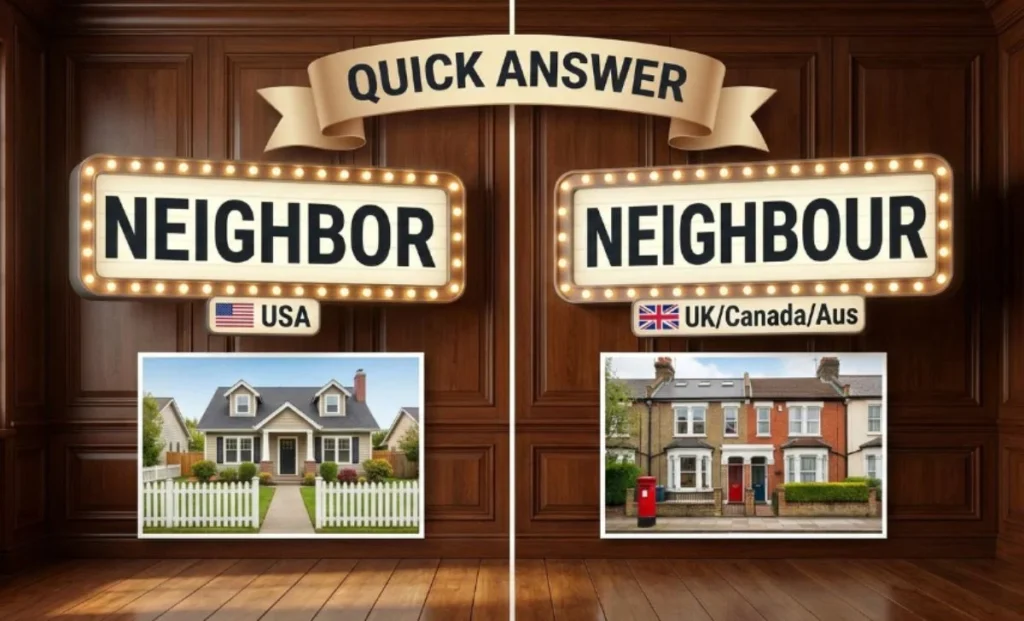
The difference between neighbor and neighbour is only the spelling.
- Neighbor is the standard spelling in American English.
- Neighbour is the standard spelling in British English, Canadian English, Australian English, and New Zealand English.
- Both words mean a person who lives near you or someone living close by.
- The pronunciation and meaning are exactly the same.
Examples
- My neighbor helped me carry the groceries. (American English)
- Our neighbour invited us to dinner. (British English)
- She has friendly neighbors who always help each other.
- Their neighbours decorated the street for the festival.
Quick Tip: Choose neighbor if you’re writing for a U.S. audience. Choose neighbour if you’re writing for readers in the UK or most Commonwealth countries.
Pronunciation of Neighbor or Neighbour
Both neighbor and neighbour are pronounced exactly the same. The extra “u” in the British spelling does not change the sound.
Pronunciation
IPA: /ˈneɪ.bər/
Simple pronunciation: NAY-bur
Syllables
Neigh-bor (2 syllables)
Why pronunciation causes confusion
Many English learners think the British spelling with “ou” should sound different. It does not. The pronunciation stays the same in American and British English.
Spoken Examples
- “My neighbor is very kind.”
- “Our neighbour has a beautiful garden.”
- “Every neighbor joined the community meeting.”
- “The neighbour called to check if we were home.”
Remember: The spelling changes, but the pronunciation remains identical.
Why People Confuse Neighbor or Neighbour
People often confuse these spellings because they represent the same word in different varieties of English.
1. American vs British spelling rules
American English usually removes the silent “u” from words ending in -our.
Examples include:
- Neighbor → Neighbour
- Color → Colour
- Favor → Favour
- Honor → Honour
2. Identical pronunciation
Since both spellings sound exactly alike, many writers assume only one is correct.
3. Mixed online content
The internet contains articles from the United States, the United Kingdom, Canada, Australia, and other English-speaking countries. Seeing both spellings online often creates confusion.
4. Automatic spell check
Your writing software may suggest a different spelling depending on the language setting selected on your device.
5. International communication
People writing for a global audience often encounter both spellings in books, websites, emails, and social media, making it difficult to know which one to choose.
The important point is simple: both spellings are correct. The right choice depends on the English style you are following.
Easy Trick to Remember Neighbor or Neighbour
A simple memory trick can help you remember which spelling to use.
Trick 1: Think of the country
- United States = Neighbor (No “u”)
- United Kingdom = Neighbour (With “u”)
The “u” reminds you of the United Kingdom.
Trick 2: Remember the spelling pattern
Many British English words keep “our”, while American English uses “or.”
Examples:
- Colour → Color
- Favourite → Favorite
- Honour → Honor
- Neighbour → Neighbor
Trick 3: Stay consistent
If you’re writing an article, essay, email, or business document, choose one variety of English and use it throughout.
Quick Memory Formula
- 🇺🇸 USA = Neighbor
- 🇬🇧 UK = Neighbour
Following this simple rule will help you avoid spelling mistakes and keep your writing consistent.
The Origin of Neighbor or Neighbour
The word neighbor (British spelling: neighbour) has a long history that dates back to Old English. It comes from the Old English word nēahgebūr, which combines:
- nēah = near
- gebūr = dweller, farmer, or resident
Together, the word originally meant “someone who lives nearby.”
Over time, English spelling changed in different parts of the world.
Why the spellings became different
In the late 1700s and early 1800s, American English began simplifying many spellings. The American lexicographer Noah Webster promoted shorter spellings to make written English more consistent.
As a result:
- Neighbour remained the standard spelling in British English.
- Neighbor became the preferred spelling in American English.
Although the spellings differ, the meaning has never changed.
British English vs American English Spelling
The only difference between neighbor and neighbour is the spelling. Both words have the same pronunciation and meaning.
| Feature | American English | British English |
|---|---|---|
| Correct spelling | Neighbor | Neighbour |
| Pronunciation | NAY-bur | NAY-bur |
| Meaning | Person living nearby | Person living nearby |
| Formal writing | ✅ Neighbor | ✅ Neighbour |
| Everyday use | United States | United Kingdom and most Commonwealth countries |
More examples of the same spelling pattern
| American English | British English |
|---|---|
| Neighbor | Neighbour |
| Color | Colour |
| Honor | Honour |
| Favor | Favour |
| Labor | Labour |
| Behavior | Behaviour |
Example sentences
American English
- My neighbor is a doctor.
- Every neighbor attended the meeting.
- The new neighbor moved in yesterday.
British English
- My neighbour is a doctor.
- Every neighbour attended the meeting.
- The new neighbour moved in yesterday.
Key takeaway: Use the spelling that matches the English style of your document.
Which Spelling Should You Use?
The correct choice depends on who will read your writing.
Use Neighbor if your audience is:
- Readers in the United States
- American schools and universities
- U.S. businesses
- American newspapers and websites
- Content written in American English
Use Neighbour if your audience is:
- Readers in the United Kingdom
- Canada (commonly preferred in Canadian English)
- Australia
- New Zealand
- Ireland
- Most Commonwealth countries
What about international websites?
If your website follows American English, consistently use neighbor.
If your website follows British English, consistently use neighbour.
Consistency is more important than choosing one spelling over the other.
Professional advice
Before writing, decide which English variety you are using and keep that spelling throughout your article, email, report, or presentation. Mixing neighbor and neighbour in the same document can make your writing look inconsistent.
Common Mistakes with Neighbor or Neighbour
Here are some mistakes writers frequently make and how to correct them.
Mistake 1: Mixing both spellings
❌ My neighbor invited our neighbour to dinner.
✅ My neighbor invited our neighbor to dinner. (American English)
✅ My neighbour invited our neighbour to dinner. (British English)
Mistake 2: Thinking one spelling is wrong
❌ Only neighbor is correct.
✅ Both neighbor and neighbour are correct. The choice depends on whether you’re using American or British English.
Mistake 3: Changing spelling because of pronunciation
❌ Neighbour must sound different from neighbor.
✅ Both spellings are pronounced exactly the same.
Mistake 4: Using the wrong spelling for your audience
If you’re writing for an American audience, use neighbor.
If you’re writing for a British or Commonwealth audience, use neighbour.
Mistake 5: Ignoring language settings
Many spelling “mistakes” happen because your computer or phone is set to American English or British English. Check your language settings if your spell checker keeps suggesting a different spelling.
Neighbor or Neighbour in Everyday Examples
Both spellings fit naturally into everyday communication. The only difference is the English variety.
In emails
American English
Our new neighbor stopped by to introduce himself yesterday.
British English
Our new neighbour stopped by to introduce himself yesterday.
In news writing
- Local neighbors helped firefighters during the emergency.
- Several neighbours gathered to support the community event.
On social media
- My neighbor surprised me with homemade cookies today!
- Our neighbour decorated the street for the holidays.
In formal writing
- Every neighbor has the right to attend the community meeting.
- Each neighbour should receive a copy of the notice.
In everyday conversation
- We asked our neighbor to water our plants while we were away.
- Our neighbour always waves when we pass by.
Writing Tip: Whether you choose neighbor or neighbour, stay consistent throughout your document to maintain a professional and polished style.
Spell Neighbour
- Spell Neighbour is the correct British English spelling of the word meaning a person who lives near you.
- In American English, the same word is spelled neighbor, but both forms have the same meaning and pronunciation.
- Use neighbour when writing for audiences in the UK, Australia, New Zealand, and most other Commonwealth countries.
- If you’re writing for the United States, use neighbor to match American spelling conventions.
- Choosing the correct spelling depends on your target audience, not on a difference in meaning.
Examples:
- My neighbour helped me carry the groceries home.
- Our neighbour invited us to a weekend barbecue.
- She has been my neighbour for more than ten years.
- We always greet our neighbour every morning.
Neighbor vs Neighbour Comparison Table
| Feature | Neighbor | Neighbour |
|---|---|---|
| Correct in American English | ✅ Yes | ❌ No |
| Correct in British English | ❌ No | ✅ Yes |
| Meaning | Person living nearby | Person living nearby |
| Pronunciation | NAY-bur | NAY-bur |
| Formal writing | ✅ Yes | ✅ Yes |
| Everyday writing | ✅ Yes | ✅ Yes |
| Spelling difference | No “u” | Includes “u” |
| Best for | United States | UK & Commonwealth |
Quick Summary
| If your audience is… | Use |
|---|---|
| United States | Neighbor |
| United Kingdom | Neighbour |
| Canada | Neighbour |
| Australia | Neighbour |
| New Zealand | Neighbour |
| Global audience | Follow one English style consistently |
Neighbour spelling in American English
- Neighbour spelling in American English uses the American form neighbor, while neighbour is the standard spelling in British English.
- If you are writing for a U.S. audience, schools, businesses, or American publications, neighbor is the correct choice.
- The meaning is exactly the same in both versions—they both refer to a person who lives nearby.
- The difference exists because American English simplified many spellings by removing the “u” from words such as colour → color and neighbour → neighbor.
- Choosing the correct spelling based on your audience makes your writing more natural and professional.
Examples:
- My neighbor helped me fix my fence. (American English)
- Our neighbor has a beautiful garden. (American English)
- She invited her neighbor over for dinner. (American English)
- The new neighbor moved in last week. (American English)
Neighbour Plural
The plural of neighbour is neighbours. In British English, neighbour is the correct spelling, while American English uses neighbor, with the plural neighbors.
Both words have the same meaning and refer to people who live near you. Choose the spelling that matches the English style you are using. The plural form is used when talking about two or more nearby people.
Examples:
- Our neighbours invited us to dinner last night.
- All the neighbours helped clean the street after the storm.
- My neighbours are always friendly and helpful.
- The neighbours gathered to celebrate the local festival.
Neighbour and Friend
A neighbour is someone who lives near you, while a friend is someone you trust and enjoy spending time with. A neighbour can become a friend over time, but not every neighbour is a friend.
The phrase “neighbour and friend” is often used to describe someone who is both nearby and personally close to you. Good neighbours and good friends make life easier by offering support, kindness, and companionship.
The meaning stays the same in both British and American English, although the spelling differs: neighbour (UK) and neighbor (US).
Examples:
- My neighbour and friend helped me move into my new house.
- She is not just my neighbour but also my best friend.
- We invited our neighbour and friend to our family dinner.
- A good neighbour and friend is always there when you need help.
How Do Americans Say “Neighbour”?
Americans say and write neighbor, which is the American English spelling of the British English word neighbour.
Both words have exactly the same meaning and refer to someone who lives nearby. The only difference is the spelling:
British English keeps the “ou”, while American English uses only “o”. If you are writing for a US audience, use neighbor. If you are writing for a UK audience, use neighbour.
Examples:
- My neighbor brought me homemade cookies yesterday.
- Our neighbor helped us fix the fence.
- She introduced me to her new neighbor.
- Every neighbor on the street joined the community event.
FAQs
Is neighbor or neighbour correct?
Both are correct. Neighbor is the American English spelling, while neighbour is the British English spelling.
What is the difference between neighbor and neighbour?
There is no difference in meaning or pronunciation. The only difference is the spelling used in different varieties of English.
How do you pronounce neighbor and neighbour?
Both are pronounced NAY-bur (/ˈneɪ.bər/).
Which spelling should I use in the United States?
Use neighbor for American English writing, schools, businesses, and publications.
Which spelling should I use in the United Kingdom?
Use neighbour in British English, including most official, academic, and everyday writing.
Is neighbour used in Canada?
Yes. Canadian English generally prefers neighbour, although some American spellings also appear in informal contexts.
Can I use both spellings in one article?
No. Choose either American English or British English and use it consistently throughout your writing.
Conclusion
- Choosing between neighbor and neighbour is simple once you know your audience. Neighbor is the correct spelling in American English, while neighbour is the standard form in British English and most Commonwealth countries.
- Both words share the same meaning, pronunciation, and grammatical use, so neither is more correct than the other. The key is consistency. If you are writing for readers in the United States, use neighbor.
- If your audience is in the United Kingdom, Canada, Australia, or New Zealand, use neighbour. By following the appropriate spelling style and keeping it consistent throughout your writing, you will communicate clearly and professionally.
Read More Blogs:
- Then or Than: What’s the Difference?
- Gray or Grey: American vs British English Made Simple?
- Donut or Doughnut: One Word, Two Spellings Here’s Why