Many English learners and even native speakers pause when writing sentences like, “She sang beautifully” or “She has sung beautifully.” The confusion is common because both sang and sung come from the same verb: sing.
People search for “sung or sang” because they want to know which word is correct in a specific sentence.
Using the wrong verb form can make writing sound awkward or grammatically incorrect. The good news is that the rule is simple once you understand how English verb tenses work.
This guide explains the difference between sang and sung, when to use each one, common mistakes to avoid, and easy tricks to remember the correct form forever.
Sung or Sang – Quick Answer
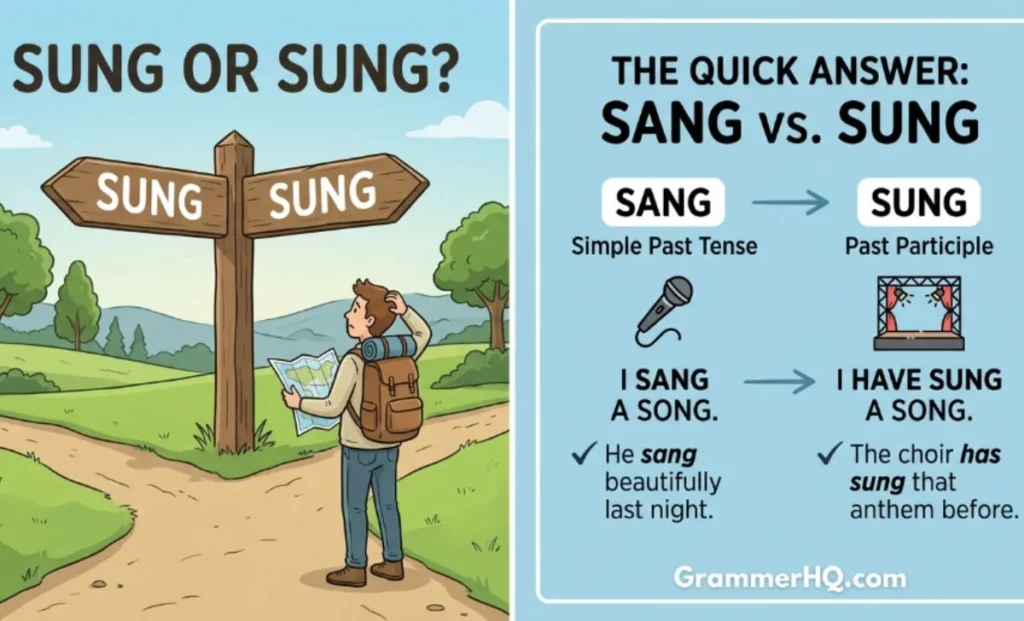
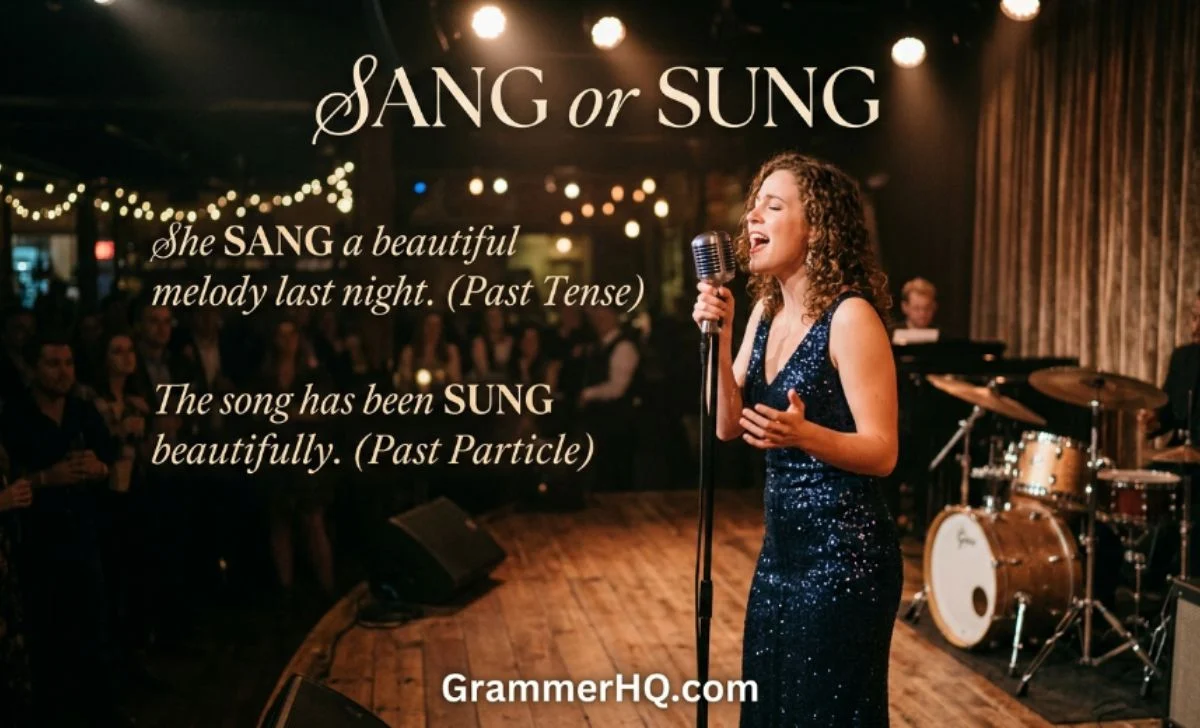
Sang is the simple past tense of sing.
Sung is the past participle of sing and usually needs a helping verb such as has, have, or had.
Examples:
✅ I sang at the concert yesterday.
✅ She has sung in many competitions.
❌ She has sang in many competitions.
Think of it this way:
- Yesterday = sang
- Has/Have/Had = sung
Pronunciation of Sung or Sang
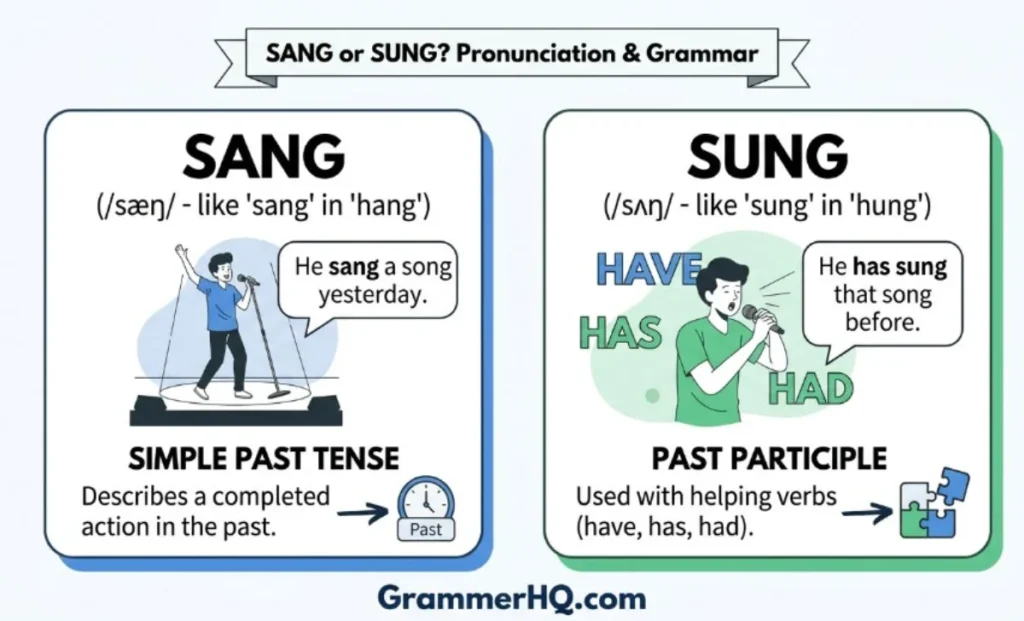
Although the words look similar, they sound different.
| Word | Pronunciation | Sounds Like |
|---|---|---|
| Sing | /sɪŋ/ | “sing” |
| Sang | /sæŋ/ | “sang” with short “a” |
| Sung | /sʌŋ/ | “sung” with “uh” sound |
Pronunciation Tips
- Sang rhymes with rang and bang.
- Sung sounds similar to hung and rung.
In everyday speech, some accents make these sounds very close. This often causes confusion, especially among English learners.
What Is the Difference Between Sang and Sung?
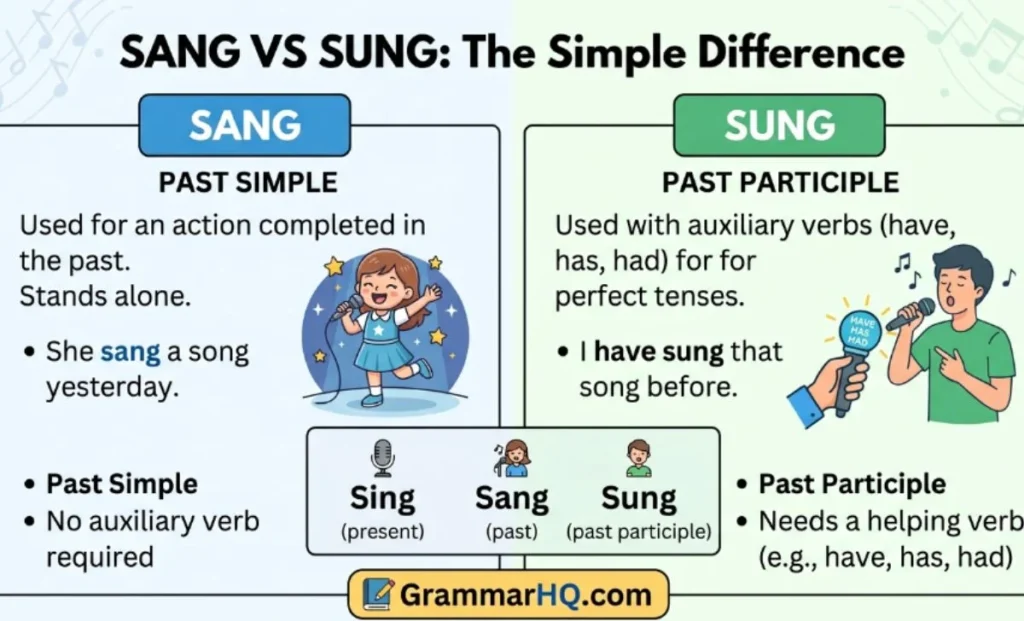
The main difference is grammatical.
Sang
Sang is used when talking about an action completed in the past.
Examples:
- The children sang in school yesterday.
- He sang his favorite song last night.
- We sang during the ceremony.
Sung
Sung is the past participle form. It works with auxiliary verbs.
Examples:
- She has sung professionally for years.
- They had sung before the guests arrived.
- The anthem was sung beautifully.
Quick Comparison
| Feature | Sang | Sung |
|---|---|---|
| Verb Type | Simple past | Past participle |
| Needs Helping Verb | No | Yes |
| Example | I sang yesterday. | I have sung before. |
Understanding the Verb Forms of Sing
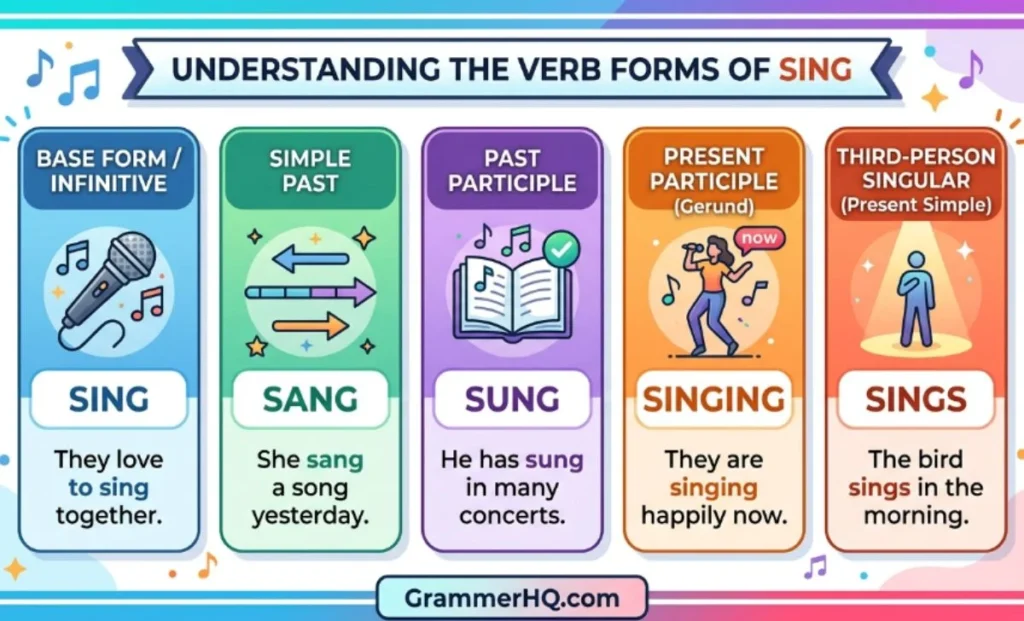
The verb sing is an irregular verb. Irregular verbs do not follow the usual “-ed” pattern.
Complete Verb Chart
| Tense | Form | Example |
|---|---|---|
| Present | Sing | I sing every day. |
| Simple Past | Sang | I sang yesterday. |
| Past Participle | Sung | I have sung before. |
| Present Participle | Singing | I am singing now. |
Sentence Examples
Present Tense
- I sing in the church choir.
Simple Past Tense
- I sang at the festival.
Present Perfect Tense
- I have sung many songs.
Past Perfect Tense
- They had sung before dinner.
Understanding verb conjugation helps writers avoid grammar mistakes.
Why People Confuse Sung or Sang

Several reasons explain why people mix these words.
1. Similar Spelling
The words differ by only one letter.
- sang
- sung
This small change can be easy to miss.
2. Similar Pronunciation
Many English accents pronounce these words similarly.
3. Irregular Verb Patterns
English contains many irregular verbs.
Examples:
- sing → sang → sung
- ring → rang → rung
- drink → drank → drunk
Because these patterns are irregular, learners often apply the wrong form.
4. Informal Speech
People sometimes say incorrect phrases in casual conversation.
Examples:
❌ I have sang that song.
Repeated exposure to incorrect speech creates confusion.
5. Lack of Grammar Knowledge
Many learners do not fully understand the difference between simple past and past participle forms.
Sang vs Sung: Grammar Rules Explained
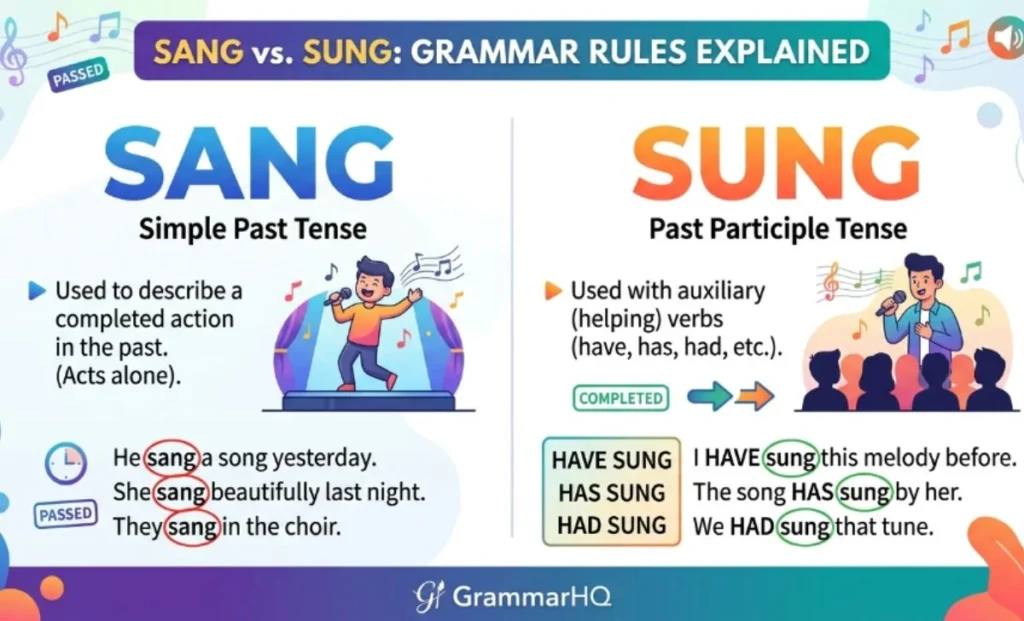
Learning a few grammar rules solves the confusion immediately.
Rule 1: Use Sang for Simple Past Actions
Use sang when the action happened and finished in the past.
Examples:
- She sang at school.
- We sang together last weekend.
- They sang loudly.
Time expressions often appear:
- yesterday
- last week
- last night
- in 2024
Rule 2: Use Sung with Helping Verbs
Use sung after:
- has
- have
- had
- was
- were
- be
- been
Examples:
- She has sung in many events.
- They had sung before sunset.
- The song was sung beautifully.
Rule 3: Never Use “Have Sang”
This mistake is extremely common.
❌ I have sang.
✅ I have sung.
Simple Past vs Past Participle: Why It Matters
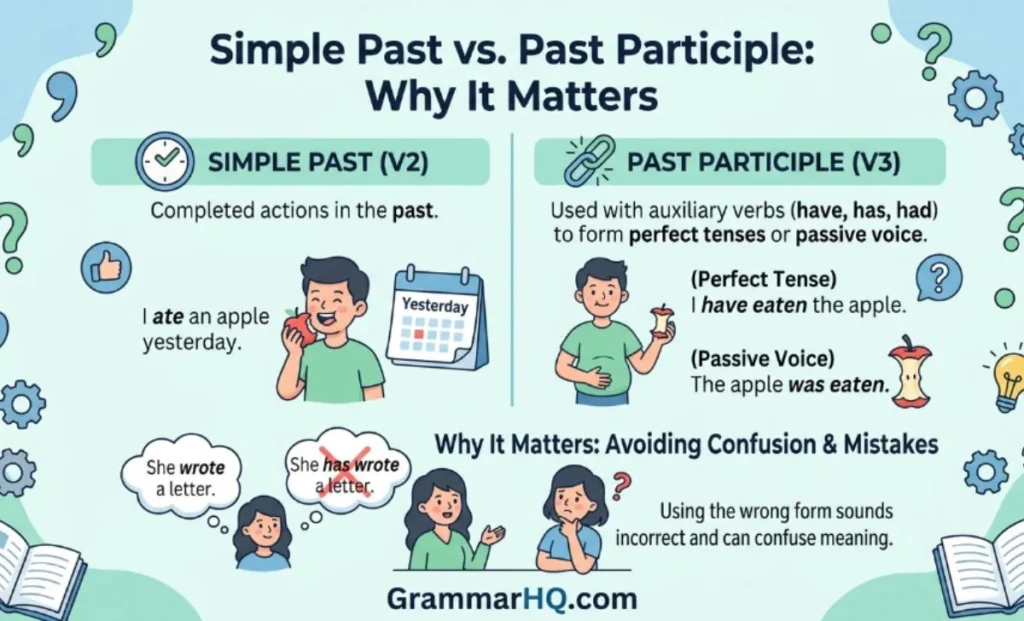
English sentence structure depends heavily on tense.
Simple Past
The simple past shows an action completed in the past.
Examples:
- John sang beautifully.
- The choir sang yesterday.
Past Participle
The past participle works with helping verbs to create perfect tenses and passive voice.
Examples:
- John has sung beautifully.
- The anthem was sung perfectly.
Comparison Table
| Sentence Type | Correct Example |
|---|---|
| Simple Past | She sang yesterday. |
| Present Perfect | She has sung before. |
| Past Perfect | She had sung already. |
| Passive Voice | The song was sung. |
Using the wrong form changes grammatical accuracy.
Easy Trick to Remember Sung or Sang
Remember this simple formula:
Yesterday = Sang
If you can add yesterday, use sang.
Example:
I sang yesterday.
Has/Have/Had = Sung
If the sentence includes:
- has
- have
- had
use sung.
Example:
She has sung before.
Memory Trick
A = Alone
Sang usually stands alone.
U = Under a Helper
Sung works under a helping verb.
This mnemonic helps many learners remember the difference instantly.
The Origin of Sung or Sang
The verb sing has ancient roots.
It comes from the Old English word singan, meaning “to make musical sounds with the voice.”
Over centuries, English developed different verb forms.
Historical forms included:
- singan
- sang
- sungon
- sungen
English preserved these forms instead of adopting regular endings like “-ed.”
This history explains why modern English still uses:
- sing
- sang
- sung
Many Germanic languages follow similar patterns.
Examples:
- ring → rang → rung
- spring → sprang → sprung
These historical developments created today’s irregular verb system.
British English vs American English Usage
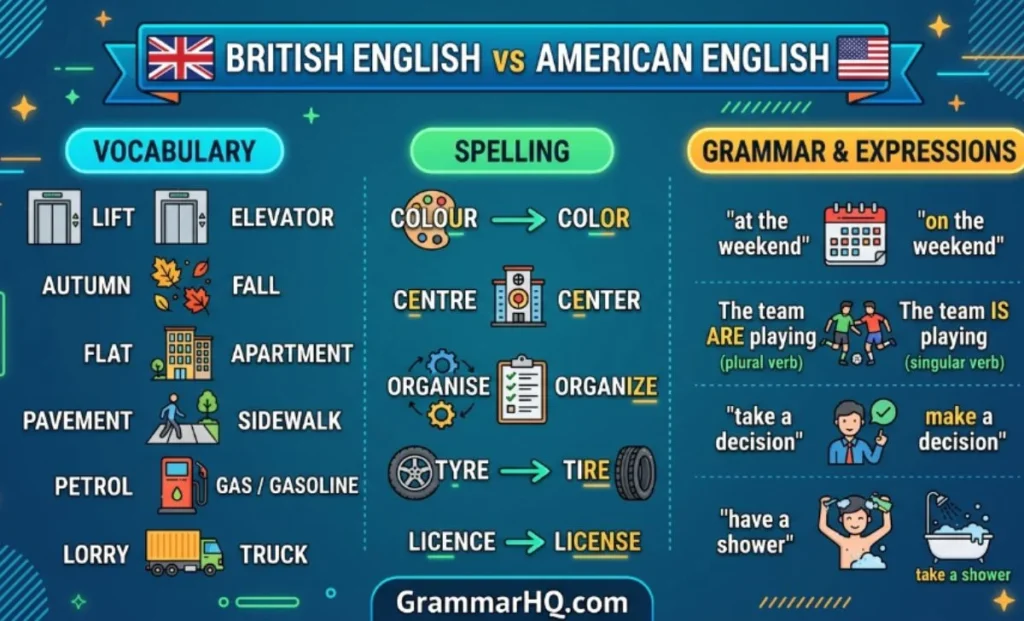
Unlike some spelling differences such as color/colour or organize/organise, there is no difference between British and American English for sang and sung.
Both varieties follow exactly the same grammar rules.
Comparison Table
| Feature | British English | American English |
|---|---|---|
| Simple Past | sang | sang |
| Past Participle | sung | sung |
| Grammar Rule | Same | Same |
| Accepted Usage | Same | Same |
Examples
British English:
- She sang in London.
American English:
- She sang in New York.
Both are equally correct.
Which Form Should You Use?
The correct choice depends on grammar rather than audience.
Academic Writing
Use precise grammar.
Example:
- The choir sang during graduation.
- The students have sung in several ceremonies.
Business Writing
Professional communication requires correct verb forms.
Example Email:
“The team has sung the company anthem at every annual event.”
Casual Writing
Informal messages still benefit from correct grammar.
Example:
“I sang karaoke last night.”
Global Audiences
Because both British and American English use identical rules, global readers will understand either form when used correctly.
Common Mistakes with Sung or Sang
Writers frequently make these errors.
Common Mistakes Table
| Incorrect | Correct |
|---|---|
| I have sang. | I have sung. |
| She had sang. | She had sung. |
| They sung yesterday. | They sang yesterday. |
| We was sung. | We were sung. |
| He has sang beautifully. | He has sung beautifully. |
Mistake 1
❌ They sung yesterday.
✅ They sang yesterday.
Mistake 2
❌ She has sang.
✅ She has sung.
Mistake 3
❌ I had sang.
✅ I had sung.
Always check whether a helping verb appears in the sentence.
Sung or Sang in Everyday Examples

Real-life examples make grammar easier to understand.
In Emails
“Maria sang at the company celebration.”
“The CEO has sung at previous events.”
In News Writing
“The national anthem was sung before the match.”
“The artist sang three new songs.”
On Social Media
“I sang karaoke all night!”
“I’ve sung this song a hundred times.”
In Formal Writing
“The students had sung before the ceremony began.”
In Conversation
Friend: Did you perform yesterday?
You: Yes, I sang at the festival.
Friend: Have you sung there before?
You: Yes, many times.
Sung or Sang – Google Trends & Usage Data
Search interest for sung vs sang remains strong because grammar learners regularly seek clarification.
Popular searches include:
- sang vs sung
- difference between sang and sung
- is it sang or sung
- have sung or have sang
- past tense of sing
English learners from countries where English is taught as a second language often search these terms frequently.
Students, writers, teachers, and professionals commonly look for guidance when preparing essays, emails, and academic assignments.
The confusion appears across global English-speaking communities because irregular verbs challenge learners at every level.
Sang vs Sung Comparison Table
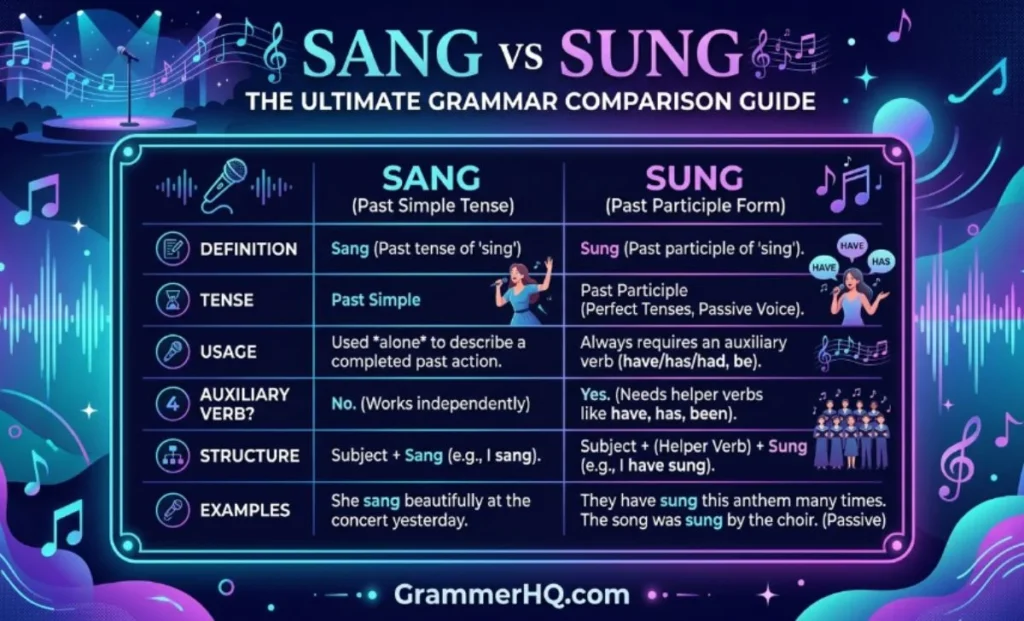
| Aspect | Sang | Sung |
|---|---|---|
| Verb Form | Simple Past | Past Participle |
| Requires Helper | No | Yes |
| Tense | Past | Perfect/Passive |
| Example | I sang yesterday. | I have sung before. |
| Common Signal Words | yesterday, last night | has, have, had |
FAQs
Is it sang or sung?
Both are correct, but they are used in different grammatical situations.
What is the difference between sang and sung?
Sang is simple past. Sung is the past participle.
Is sung past tense or past participle?
Sung is the past participle form of sing.
Is “I have sang” correct?
No. The correct sentence is “I have sung.”
Why do we say “has sung”?
Because the present perfect tense requires a past participle.
When should I use sang?
Use sang for completed past actions without helping verbs.
When should I use sung?
Use sung after has, have, had, or in passive constructions.
What are the three forms of sing?
Sing, sang, and sung.
Conclusion:
The confusion between sung and sang disappears once you remember one simple rule. Use sang as the simple past tense when describing an action that happened and finished in the past.
Use sung as the past participle after helping verbs such as has, have, and had. Since sing is an irregular verb, these forms do not follow normal grammar patterns, which is why many writers make mistakes.
Fortunately, practice makes the rule easy to remember. If the sentence includes a helper verb, choose sung. If the action simply happened in the past, choose sang.
Following these grammar rules will make your writing clearer, more professional, and grammatically correct in every situation.
Read More Blogs:
- Honor or Honour: Which Spelling Is Correct In 2026
- Is It Tying or Tieing? The Correct Spelling Explained Simply

Hi, I’m Amelia Parker, a grammar enthusiast and writer at GrammarHQ.com. I specialize in explaining spelling differences, confusing words, and common English mistakes through simple, practical, and easy-to-understand guides.