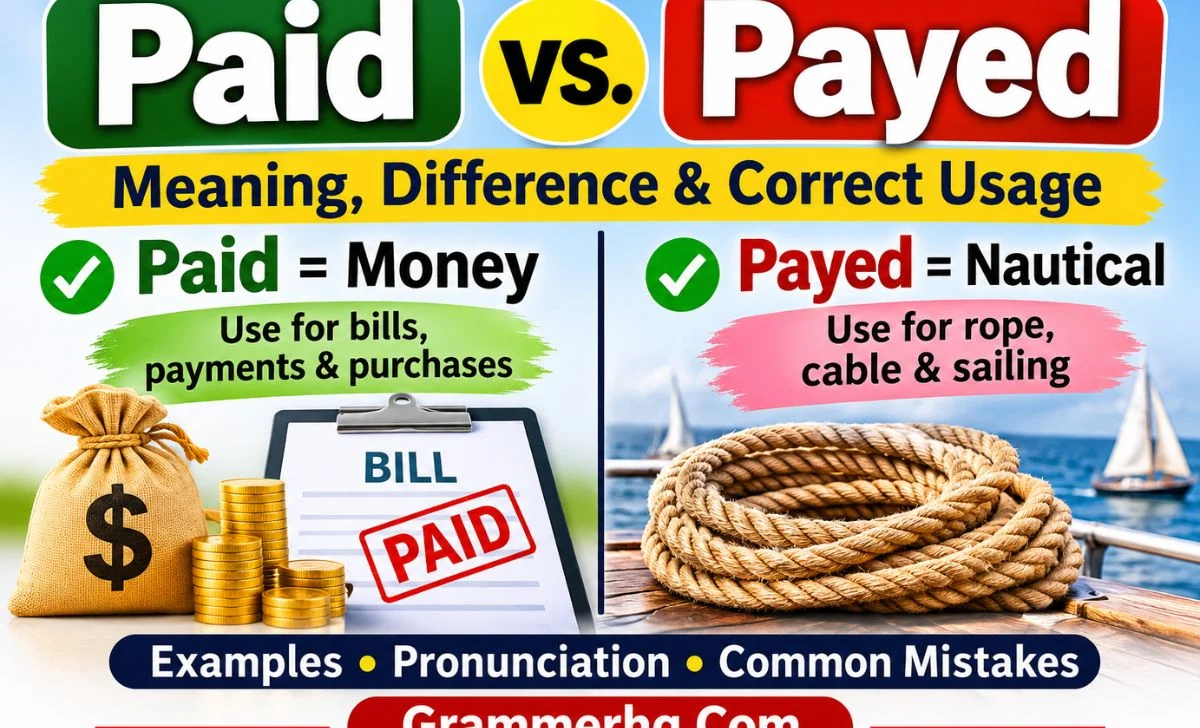
Paid vs. payed can be confusing because both spellings exist in English. However, they do not have the same meaning or everyday use.
In normal English, paid is the correct form when you mean giving or receiving money. Payed, on the other hand, has a limited specialized use, mainly in nautical language.
So, if you are talking about a bill, salary, fee, debt, purchase, or other financial payment, choose paid.
Quick answer:
- Paid ✅ — the standard past tense and past participle of pay when money or payment is involved.
- Payed ✅ — a specialized nautical word used mainly for letting out or handling rope, cable, or chain.
- “I payed the bill.” ❌
- “I paid the bill.” ✅
What Is the Difference Between Paid and Payed?
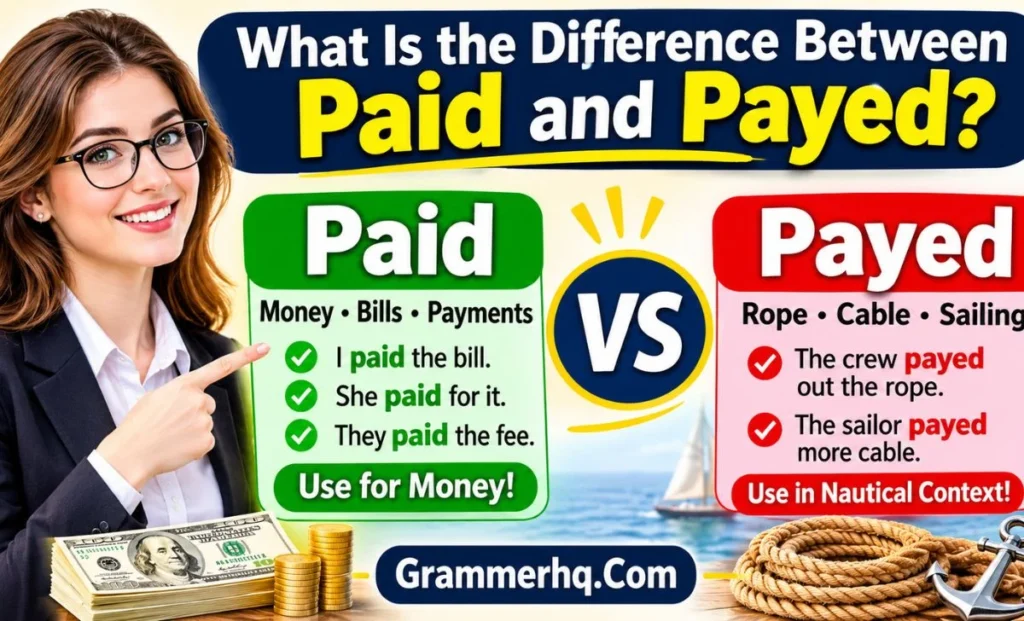
The main difference comes down to meaning and context.
First, paid is the normal past tense and past participle of pay when the verb refers to money.
For example:
- I paid the bill yesterday.
- She paid for the tickets.
- They paid their employees on Friday.
By contrast, payed has a much narrower meaning. In particular, sailors and nautical writers can use it when they talk about letting out or handling rope, cable, or chain.
For example:
- The crew payed out the cable.
- The sailor payed out more rope.
Therefore, the easiest everyday rule is:
If you are talking about money, use “paid.”
What Does “Paid” Mean?
Paid is the past tense and past participle of pay when pay means giving money, receiving money, settling a debt, or making another type of financial payment.
For instance:
- I paid the electricity bill.
- She paid for dinner.
- We paid $50 for the tickets.
- He paid his rent on time.
- The company paid its employees yesterday.
- Have you paid the invoice?
- They have already paid the fee.
In addition, paid appears in several common expressions:
- I got paid today.
- The position is paid.
- She took a paid vacation.
- He has paid his debt.
- We need to make sure the account is paid in full.
Pay → Paid
The ordinary verb forms are:
| Verb form | Word |
|---|---|
| Base form | pay |
| Past tense | paid |
| Past participle | paid |
| -ing form | paying |
| Third-person singular | pays |
You can see the forms in these sentences:
- I pay my bills every month.
- I paid my bill yesterday.
- I have paid my bill.
- I am paying my bill now.
- She pays her bills online.
What Does “Payed” Mean?
Payed is also a real English word. However, you should not normally use it as the past tense of pay when you mean a financial payment.
Instead, payed appears mainly in specialized nautical language. In that context, it can describe letting out, slackening, or handling rope, cable, or chain.
For example:
- The crew payed out the anchor cable.
- The sailor payed out more rope.
- The ship payed out the cable slowly.
As a result, payed is not simply a misspelling of paid in every situation. The context determines which word makes sense.
An important distinction
If a sentence talks about money, use paid.
If a specialized nautical sentence talks about letting out or handling rope, cable, or chain, payed may be correct.
That distinction prevents a common mistake: calling payed an incorrect word in every context.
When Should You Use “Paid”?
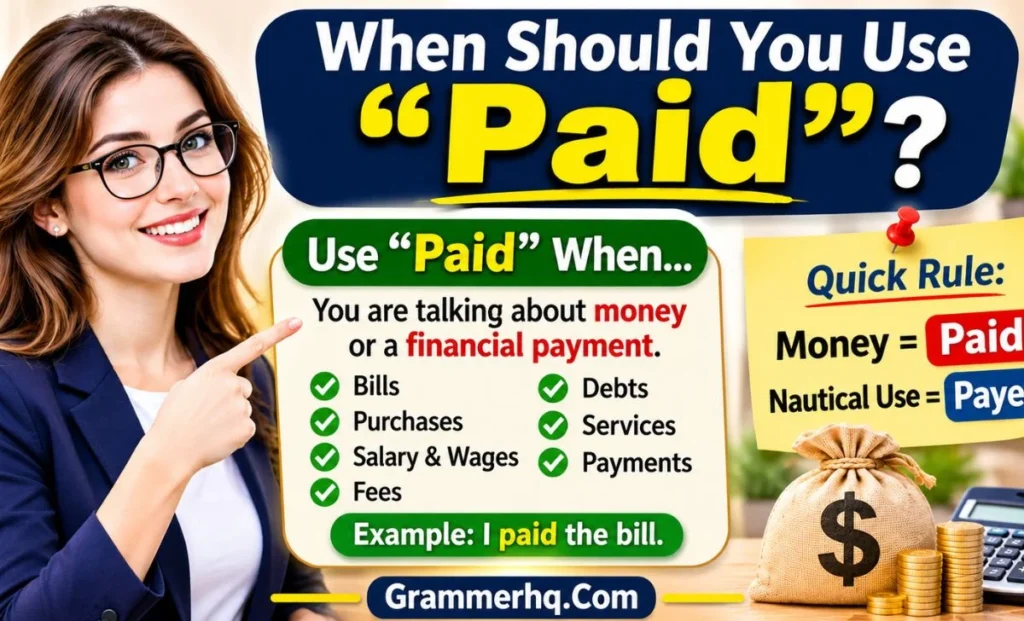
Use paid whenever pay refers to money or another financial payment.
For example, you can use paid when talking about:
Bills
- I paid the water bill.
- She paid the phone bill.
Purchases
- He paid for the shoes.
- We paid for our meal.
Salary and wages
- The company paid its workers.
- I get paid every Friday.
Fees
- She paid the registration fee.
- Have you paid the application fee?
Debts
- He paid his debt.
- They have paid the loan.
Services
- We paid the plumber.
- She paid for the repair.
In each case, the sentence involves money. Therefore, paid is the correct choice.
When Should You Use “Payed”?
Use payed only when the context calls for its specialized meaning. Most often, that means nautical or marine language involving rope, cable, or chain.
For example:
- The crew payed out the rope.
- The sailor payed out the cable.
This use is much less common than paid.
Consequently, if you are writing ordinary English, you will almost always need paid, not payed.
Paid vs. Payed Examples
The following examples make the difference clearer:
| Sentence | Correct? | Reason |
|---|---|---|
| I paid the bill. | ✅ | The sentence refers to money. |
| I payed the bill. | ❌ | Financial payment requires paid. |
| She paid for the food. | ✅ | The sentence refers to a purchase. |
| He paid his employees. | ✅ | The sentence refers to wages. |
| We have paid the fee. | ✅ | The sentence refers to a financial payment. |
| The sailor payed out the rope. | ✅ | The sentence uses the specialized nautical meaning. |
| The crew payed out the cable. | ✅ | The sentence describes a nautical action. |
| She payed for the tickets. | ❌ | Financial payment requires paid. |
Is “Payed” a Correct Word?
Yes, payed is a correct word in a limited context.
However, that does not mean you should use it as the ordinary past tense of pay.
When pay means giving or receiving money, English uses paid:
- I paid the bill. ✅
- She paid for the meal. ✅
- They paid the fee. ✅
By comparison, specialized nautical writing can use payed for certain actions involving rope, cable, or chain.
So, the accurate rule is:
“Payed” is a real word, but “paid” is the standard form for financial payments.
Why Do People Confuse Paid and Payed?
The confusion makes sense because many English verbs form their past tense with -ed.
For example:
- walk → walked
- work → worked
- call → called
- clean → cleaned
Because of that pattern, someone might naturally expect:
pay → payed
However, the ordinary past form of pay is irregular:
pay → paid
English has many verbs with irregular past forms, such as:
- go → went
- buy → bought
- bring → brought
- teach → taught
- think → thought
Therefore, payed may look logical, but paid is the standard financial form.
Paid or Payed for Something?
When you mean that someone spent money on something, use paid for.
For example:
- I paid for the meal.
- She paid for the tickets.
- We paid for the service.
- He paid for the repairs.
By contrast, these forms are incorrect in ordinary financial English:
- I payed for the meal. ❌
- She payed for the tickets. ❌
So, remember:
Money + “pay” = paid
Paid or Payed the Bill?
The correct sentence is:
I paid the bill. ✅
The incorrect everyday form is:
I payed the bill. ❌
The same rule applies to other financial situations:
- paid the invoice
- paid the rent
- paid the fee
- paid the debt
- paid the tax
- paid the price
In short, whenever the sentence describes a financial payment, choose paid.
Are Paid and Payed Pronounced the Same?
Yes. In standard English, paid and payed generally have the same pronunciation: /peɪd/.
Because they sound alike, you cannot rely on pronunciation to choose the spelling. Instead, you need to consider the meaning of the sentence.
For example, when you hear a sentence about paying a bill, the spelling should be paid. However, a specialized nautical context may require payed.
Thus, paid and payed are homophones: they sound alike but have different spellings and meanings.
Is “Paid” Used in American and British English?
Yes. Both American English and British English use paid as the standard form when pay refers to money.
For example:
American English:
“I paid the bill.”
British English:
“I paid the bill.”
Therefore, there is no normal US-versus-UK spelling difference here.
Likewise, payed does not become the standard financial form in either variety of English.
Common Mistakes With Paid and Payed
Mistake 1: “I payed the bill.”
❌ Incorrect in ordinary financial English.
Instead, write:
✅ I paid the bill.
Mistake 2: “She has payed for it.”
❌ Incorrect when the sentence refers to a financial payment.
Instead, write:
✅ She has paid for it.
Mistake 3: “I payed my rent yesterday.”
❌ Incorrect.
Instead, write:
✅ I paid my rent yesterday.
Mistake 4: “Payed is always wrong.”
❌ This statement is too broad.
Although payed is uncommon, specialized nautical writing can use it correctly.
Therefore, the better rule is:
Use “paid” for money. Use “payed” only when the specialized nautical context requires it.
A Simple Way to Remember Paid vs. Payed
Think about money first.
If money is involved, choose:
PAID
For example:
- paid the bill
- paid the rent
- paid the fee
- paid the debt
- paid for dinner
- got paid
On the other hand, if you see payed in specialized writing, check whether the sentence involves ships, sailing, rope, cable, or similar nautical equipment.
This simple distinction will help you avoid almost every everyday mistake.
Paid vs. Payed: Quick Comparison
| Word | Main meaning | Everyday use |
|---|---|---|
| Paid | Gave or received money; settled a payment | Very common |
| Payed | Specialized nautical use involving letting out or handling rope or cable | Rare |
The easiest rule:
Money = PAID
Nautical rope or cable context = PAYED
FAQs
Is “payed” ever correct?
Yes. Payed can be correct in specialized nautical usage, particularly when the sentence refers to letting out or handling rope, cable, or similar equipment.
Is “paid” or “payed” correct for money?
Paid is correct.
- I paid the bill. ✅
- I payed the bill. ❌
What is the past tense of “pay”?
For the ordinary financial meaning, the past tense is paid.
Pay → paid
What is the past participle of “pay”?
The past participle is also paid.
For example:
- I paid yesterday.
- I have paid already.
Are “paid” and “payed” homophones?
Yes. They generally have the same pronunciation, /peɪd/, even though their meanings and spellings differ.
Is “payed” a spelling mistake?
Not always. It is a spelling mistake when someone uses it as the ordinary financial past tense of pay. However, it can be correct in specialized nautical contexts.
Do Americans and British people spell it differently?
No. Both American and British English use paid for the ordinary financial meaning of pay.
Should I write “payed for” or “paid for”?
Use paid for when you mean spending money.
She paid for the meal. ✅
What is correct: “I paid” or “I payed”?
Use I paid when you mean that you made a financial payment.
Conclusion
Paid and payed are both real English words, but their uses are very different.
Use paid as the past tense and past participle of pay when you are talking about money, bills, salaries, fees, purchases, debts, or other financial payments.
However, payed has a limited specialized use, especially in nautical language involving rope, cable, or chain.
Therefore, the easiest rule is:
Paid = money
Payed = specialized nautical use
If you are unsure which word to use in an ordinary English sentence, choose paid.
Discover More Blogs:
- Toward vs Towards: What’s the Difference?
- Tear vs Tare: What’s the Difference?
- Seal vs Seel: Which Is Correct? Meaning, Spelling & Usage
- Apposed vs Opposed: Definitions, Differences & Examples?

Hi, I’m Amelia Parker, a grammar enthusiast and writer at GrammarHQ.com. I specialize in explaining spelling differences, confusing words, and common English mistakes through simple, practical, and easy-to-understand guides.