“In process” and “in progress” are not always interchangeable. In progress means that something is currently happening, continuing, or underway, while in process usually means that something is being handled as part of a particular process or procedure.
For example, a project is in progress, but an application may be in process. Understanding this small difference will help you choose the right phrase in everyday, professional, and formal English.
In Process vs. In Progress: Quick Answer
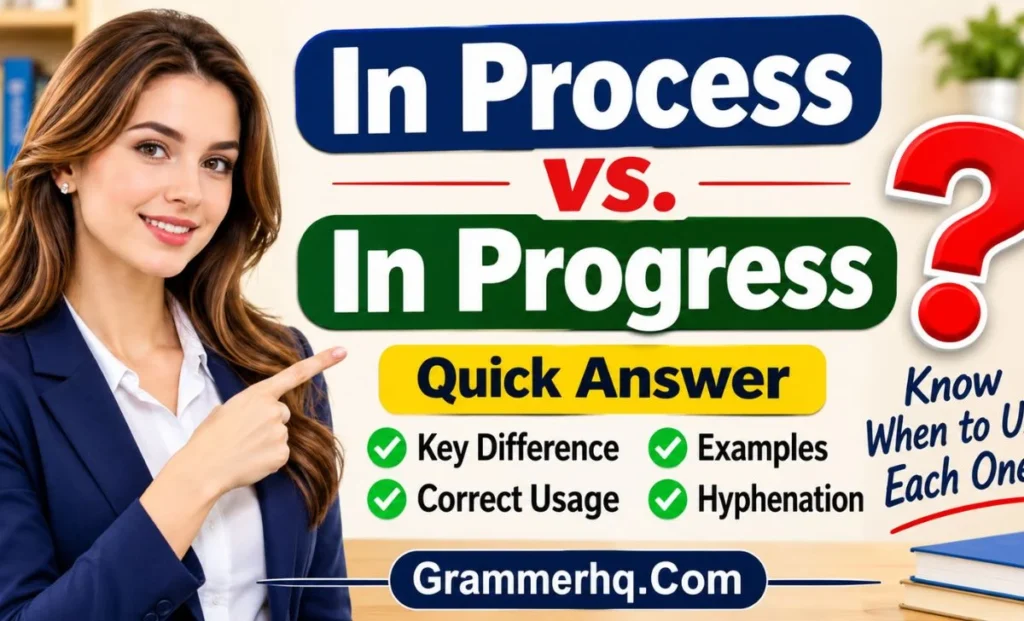
Use in progress when you mean that an activity, task, project, or event is ongoing or underway.
- The construction work is in progress.
- The meeting is in progress.
- The project is in progress.
Use in process when you mean that something is being processed or is going through a particular procedure.
- Your application is in process.
- The request is in process.
- The payment is in process.
In everyday English, in progress is generally the more common expression for something that is currently happening.
What Does “In Process” Mean?
In process means that something is being handled as part of a process or procedure. It can suggest that an application, request, order, payment, or similar item is currently being processed.
For example:
- Your application is in process.
- The refund is in process.
- Your request is in process.
- The order is in process.
Here, the focus is not simply on an activity happening. Instead, the thing is moving through a specific process or administrative procedure.
However, in process can sound less natural than in progress in some everyday contexts. Depending on the sentence, being processed may also be a clearer choice.
Example
Your application is being processed.
This is often more direct than:
Your application is in process.
What Does “In Progress” Mean?
In progress means that something has started but has not yet finished. It is commonly used for work, activities, projects, events, construction, repairs, and other ongoing situations.
Examples:
- The project is in progress.
- Repairs are in progress.
- The investigation is in progress.
- The meeting is in progress.
- Construction is in progress.
The expression is closely related to words such as ongoing, underway, and continuing.
Simple way to remember it
If you can naturally replace the phrase with “ongoing” or “underway,” in progress is often the better choice.
The work is in progress.
The work is ongoing.
Construction is in progress.
Construction is underway.
What Is the Difference Between “In Process” and “In Progress”?
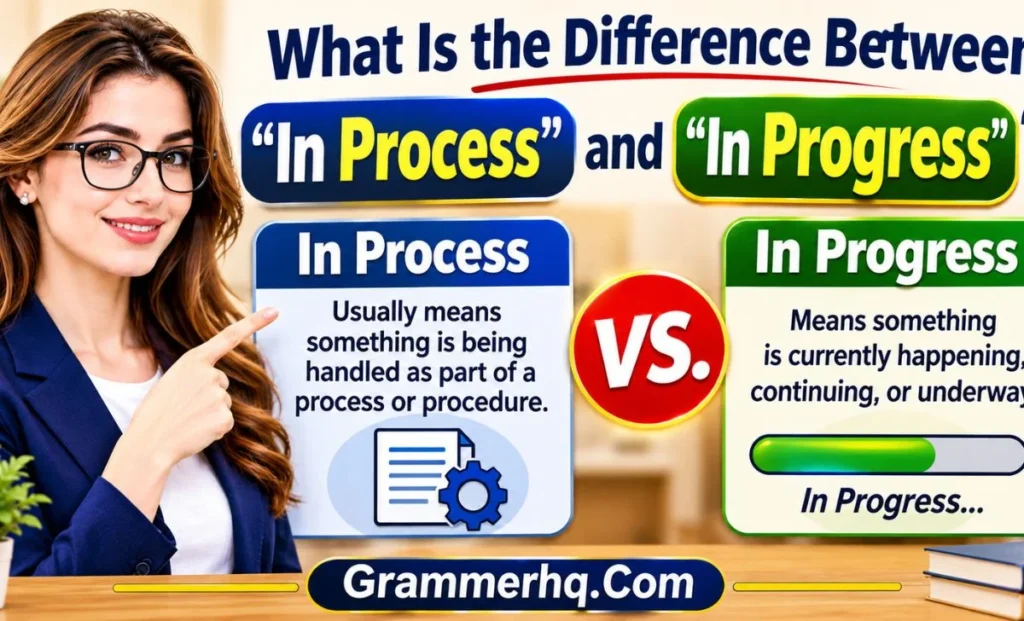
The main difference is what you are focusing on.
In process focuses on something being handled through a process or procedure.
In progress focuses on an activity or event that is currently happening and not finished.
| Phrase | Main meaning | Common use |
|---|---|---|
| in process | being handled through a process | applications, requests, orders |
| in progress | ongoing or underway | work, projects, activities |
| being processed | currently being handled | applications, payments, requests |
| ongoing | continuing | activities, situations, projects |
| underway | already started | events, projects, operations |
Compare these sentences:
Your visa application is in process.
This emphasizes the application going through a procedure.
The construction project is in progress.
This emphasizes that the construction has started and is still happening.
That distinction makes the choice much easier.
In Process or In Progress: Which Is More Common?
For general activities, in progress is usually the safer and more natural choice.
For example:
- The work is in progress.
- The project is in progress.
- The repair is in progress.
- The meeting is in progress.
If you are talking about something being handled through a specific procedure, in process can be appropriate.
For example:
- Your application is in process.
- The request is in process.
Still, English speakers may prefer being processed in some of these contexts.
Your application is being processed.
This wording clearly communicates that the application is currently under review or handling.
In-Process vs. In-Progress: Do You Need a Hyphen?
The hyphen creates another common point of confusion.
When in process or in progress is used as a normal phrase after a verb, it is generally written without a hyphen:
- The project is in progress.
- The application is in process.
When a phrase works together as a modifier before another noun, a hyphen may be used depending on the intended construction and style.
For example:
- an in-progress project
- an in-process review
However, hyphenation should not be added simply because a phrase appears before a noun. The exact grammatical construction matters.
For professional writing, it is best to follow the style used by the publication, organization, or field you are writing for.
“Work in Process” vs. “Work in Progress”
This is one of the most important distinctions.
Work in progress is the standard and widely recognized expression for work that has started but is not finished.
The website redesign is a work in progress.
It can also describe something that is developing or improving over time.
Work in process is possible in specialized contexts, but it does not carry the same everyday meaning as work in progress.
So if you mean unfinished work, choose:
work in progress
not:
work in process
“The Work Is In Process” or “The Work Is In Progress”?
For most situations, “The work is in progress” is the better choice.
Better:
The work is in progress.
This means the work has started and is continuing.
Possible but less natural in many contexts:
The work is in process.
This may suggest that the work is part of a particular process, but it is not normally the first choice when simply describing ongoing work.
If your meaning is that someone is actively handling the work, another natural option is:
The work is being processed.
The exact choice depends on the context.
In Process vs. In Progress Examples
Use “In Progress”
The renovation is in progress.
The renovation has started and is continuing.
The investigation is in progress.
The investigation is currently happening.
The meeting is in progress.
The meeting has started and has not ended.
The project is in progress.
The project is underway but unfinished.
Use “In Process”
Your application is in process.
The application is going through a procedure.
The request is in process.
The request is currently being handled.
The order is in process.
The order is moving through the relevant processing procedure.
Use “Being Processed” When It Is Clearer
Your payment is being processed.
The application is being processed.
The refund is being processed.
This form is often especially clear in customer-service and administrative writing.
Common Mistakes
Mistake 1: Using “in process” for every ongoing activity
Not every ongoing activity should be described as in process.
❌ The meeting is in process.
✅ The meeting is in progress.
❌ The construction is in process.
✅ The construction is in progress.
Mistake 2: Using “work in process” when you mean unfinished work
❌ This project is a work in process.
✅ This project is a work in progress.
Mistake 3: Assuming the two expressions are always interchangeable
They overlap in meaning, but their emphasis is different.
In progress = ongoing or underway.
In process = being handled within a process or procedure.
Mistake 4: Adding hyphens everywhere
Do not automatically write in-process or in-progress simply because the phrase appears in a sentence. First determine whether it is functioning as a compound modifier.
In Process vs. In Progress in American and British English
Both expressions can appear in American and British English. The basic distinction does not change significantly between the two varieties.
However, actual usage can depend on the context, industry, and writing style.
In general:
- in progress is widely used for ongoing activities.
- in process is more closely associated with something moving through a process.
- being processed can be a clearer alternative for applications, payments, requests, and similar items.
So the most important factor is meaning and context, not simply whether the writer is using American or British English.
Synonyms for “In Progress”
Depending on the sentence, you can replace in progress with:
- ongoing
- underway
- continuing
- happening
- taking place
- unfinished
- currently underway
- under development
For example:
The project is in progress.
You could also say:
The project is underway.
or:
The project is ongoing.
The best synonym depends on the type of activity.
Synonyms for “In Process”
Depending on the context, alternatives to in process include:
- being processed
- under processing
- being handled
- going through a process
- under review
- under consideration
- being evaluated
For example:
Your application is in process.
A clearer alternative may be:
Your application is being processed.
However, these alternatives are not exact replacements in every context.
How to Remember the Difference
A simple rule can help:
In progress → something is happening.
In process → something is going through a process.
Think of progress as movement toward completion and process as the procedure through which something is handled.
The project is in progress.
The application is in process.
Once you focus on that distinction, the choice becomes much easier.
FAQs
Is “in process” grammatically correct?
Yes. In process can be grammatically correct when it describes something being handled as part of a process or procedure. However, in progress is generally more natural for ordinary ongoing activities.
Is “in progress” grammatically correct?
Yes. In progress is a standard English expression meaning that something has started and is still happening or has not yet been completed.
Can “in process” and “in progress” be used interchangeably?
Not always. In progress normally describes an ongoing activity, while in process emphasizes something moving through a process or procedure.
Should I say “work in process” or “work in progress”?
Use work in progress when you mean unfinished work or something that is still developing.
Is “in-progress” hyphenated?
In-progress can be hyphenated when the phrase functions as a compound modifier, depending on the sentence and style. As a normal phrase after a verb, it is usually written in progress.
Is “in-process” hyphenated?
In-process may be used as a compound modifier in certain constructions. As a normal phrase, in process is written without a hyphen.
Which is better: “in process” or “in progress”?
For something that is ongoing or underway, use in progress. For something being handled through a specific process or procedure, in process may be appropriate.
Final Answer
In progress is the better choice when you mean that something is ongoing, underway, or unfinished.
In process is used when the focus is on something going through a process or procedure.
So:
The project is in progress. ✅
Your application is in process. ✅
When referring to unfinished work, the standard expression is work in progress.
The easiest rule to remember is: “progress” describes something continuing, while “process” describes something being handled through a procedure.
Discover More Blogs:
- Tacet or Tacit: Meaning, Difference, Pronunciation & Usage?
- Writing or Writting: Which Is Correct?
- Of Course or Ofcourse: Correct Spelling, Meaning & Usage?
- Weiner or Wiener: Meaning, Difference & Correct Spelling?