Losing or Loosing: Which spelling is correct? Losing is the correct word when you mean failing to win, misplacing something, or no longer having something.
Loosing is also a real English word, but it means releasing or setting something free. For example, you are losing weight, but an archer may be loosing an arrow.
Both words come from different base verbs: lose and loose. Understanding their meanings will help you choose the correct spelling in everyday writing.
Losing vs. Loosing: The Key Difference
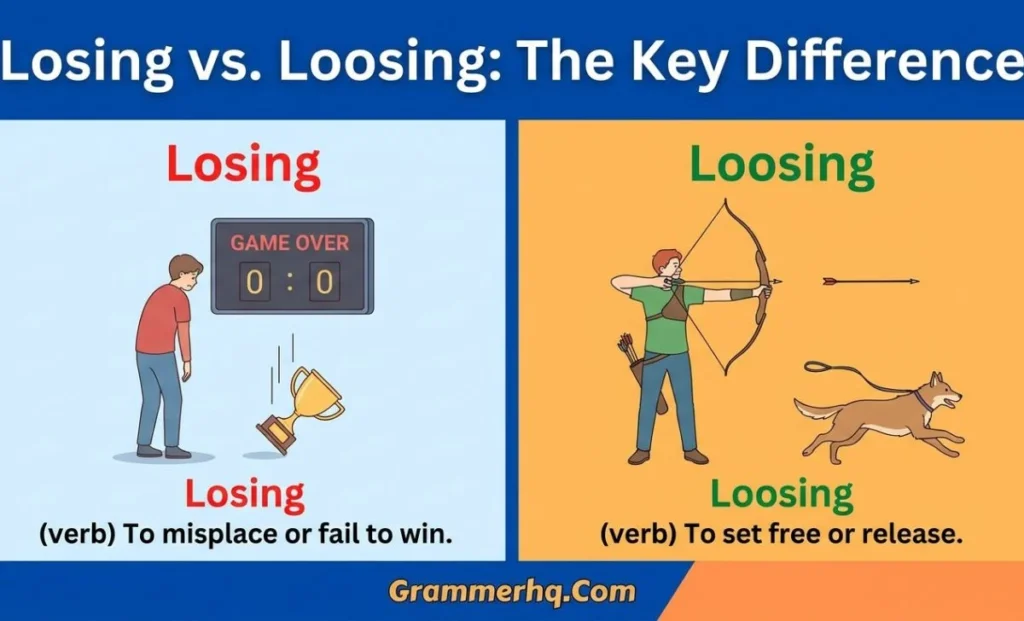
The main difference between losing and loosing is their meaning and the verb each word comes from.
| Word | Base verb | Meaning | Example |
|---|---|---|---|
| Losing | Lose | Failing to win or no longer having something | Our team is losing the match. |
| Loosing | Loose | Releasing or setting something free | The archer is loosing an arrow. |
Losing is the word you will need in most everyday situations. Use loosing only when you mean releasing something or setting it loose.
What Does Losing Mean?
Losing is the present participle and gerund of the verb lose. It describes an ongoing action or situation involving defeat, misplacement, or a reduction in something.
The meaning depends on the context.
1. Failing to win
Use losing when a person or team is not winning a competition, game, or contest.
- Our school team is losing the football match.
- She is losing the chess tournament after several mistakes.
2. Misplacing something
Losing can describe being unable to find something you had.
- I keep losing my house keys.
- He is losing important documents because he never organizes his desk.
3. Experiencing a reduction
The word also describes a decrease in weight, money, strength, confidence, or another quantity.
- She is losing weight through regular exercise.
- The business is losing money this month.
- He is losing confidence before his driving test.
4. No longer having something
Use losing when someone is gradually losing an opportunity, relationship, ability, or emotional connection.
- We are losing valuable time.
- She feels she is losing interest in the project.
In all these situations, losing comes from lose. Adding an extra o changes the word and does not express the intended meaning.
What Does Loosing Mean?
Loosing is the present participle and gerund of loose when it is used as a verb. It means releasing something, setting it free, or allowing it to move without restraint.
Although the word is grammatically correct, it is uncommon in modern everyday English.
Examples of loosing
- The archer was loosing arrows at the target.
- The hunter spoke of loosing the hounds into the field.
- The old story describes a prisoner loosing himself from his restraints.
In these examples, loosing involves releasing something rather than losing possession of it.
Remember that loose is also commonly an adjective meaning “not tight.”
For example:
- This screw is loose.
- My shoelace has come loose.
These sentences describe something that is not firmly attached or secured. They do not require loosing.
Why Is Losing Spelled With One O?
The spelling becomes easier to understand when you look at the base verbs.
Lose → Losing
The verb lose ends in a silent e. When you add the suffix -ing, you drop the final e.
- Lose → Losing
- Make → Making
- Write → Writing
Therefore, loosing is not the correct spelling when you intend to use the verb lose.
Loose → Loosing
The verb loose also ends in e, so that final letter is dropped before adding -ing.
- Loose → Loosing
- Loosen → Loosening
Notice that loosing comes from loose, not lose. The two forms follow the same general spelling pattern, but their meanings remain different.
Losing or Loosing: Examples in Sentences
The easiest way to remember the distinction is to look at the action described in each sentence.
| Sentence | Correct word | Why? |
|---|---|---|
| I am ___ weight before my holiday. | Losing | Describes a reduction in weight. |
| Our team is ___ the final game. | Losing | Describes failing to win. |
| She keeps ___ her phone. | Losing | Describes misplacing something. |
| The archer is ___ an arrow. | Loosing | Describes releasing an arrow. |
| The writer describes ___ a captive. | Loosing | Describes setting someone free. |
| We are ___ patience with the delays. | Losing | Describes a decline in patience. |
Common mistakes to avoid
Incorrect: I am loosing weight by walking every day.
Correct: I am losing weight by walking every day.
Incorrect: Our team is loosing the competition.
Correct: Our team is losing the competition.
Incorrect: I am loosing my keys again.
Correct: I am losing my keys again.
The incorrect versions use loosing where the intended meaning comes from lose. Unless the sentence specifically describes releasing or setting something free, losing is generally the right choice.
Lose vs. Loose vs. Losing vs. Loosing
These four words are closely related in appearance but perform different grammatical jobs.
| Word | Part of speech | Meaning | Example |
|---|---|---|---|
| Lose | Verb | To no longer have something or fail to win | Do not lose your ticket. |
| Loose | Usually an adjective; also a verb | Not tight, or to release | The handle is loose. |
| Losing | Verb form or gerund of lose | Experiencing loss or defeat | He is losing the race. |
| Loosing | Verb form or gerund of loose | Releasing or setting free | She is loosing the bird. |
Losing vs. loosening
These words are also easy to confuse, but they describe different actions.
- Losing: You are losing your grip on the rope.
- Loosening: You are loosening your grip on the rope.
The first describes a grip that is slipping away. The second describes deliberately making the grip less tight.
Likewise, loosing can describe releasing something, while loosening usually describes reducing tightness or restraint. The right choice depends on the action you want to communicate.
How to Remember Losing vs. Loosing
Use the base verb as your memory trick.
- Lose → Losing: Think of losing a game, losing money, or losing your keys.
- Loose → Loosing: Think of releasing an arrow or setting an animal free.
A simple question can help: Am I losing something, or am I releasing something?
If you mean defeat, misplacement, or reduction, choose losing. If you mean releasing or setting something loose, loosing may be appropriate.
FAQs
Is loosing a real word?
Yes. Loosing is a real but uncommon English word derived from the verb loose. It refers to releasing or setting something free. It is not a general alternative to losing.
Is it losing weight or loosing weight?
Losing weight is correct. The phrase describes a reduction in body weight, so it comes from the verb lose. Loosing weight does not express this intended meaning.
What is the difference between losing and loosening?
Losing describes loss, defeat, or a reduction. Loosening means making something less tight or less firmly held. For example, you might be losing your grip or loosening a knot.
Are losing and loosing pronounced the same?
No. Losing is pronounced with a /z/ sound, while loosing has an /s/ sound. Their base verbs, lose and loose, have the same distinction in pronunciation.
Is losing spelled differently in American and British English?
No. Losing is the standard spelling in both American and British English when the word comes from lose. The distinction between losing and loosing is about meaning, not regional spelling conventions.
What is the past tense of lose?
The past tense of lose is lost. For example, “I lost my wallet yesterday.” The past participle is also lost, as in “I have lost my wallet.”
Conclusion
Losing is the correct choice for defeat, misplacement, and reduction, while loosing refers to releasing or setting something free.
Both spellings exist, but they come from different base verbs: lose and loose. When writing about losing weight, money, a game, or your keys, use losing.
Remembering this simple distinction will help you choose the right word with confidence.
Read More Blogs
- Jewelry or Jewellery: Which Spelling Is Correct?
- Dependent or Dependant: Meaning, Spelling & Examples?