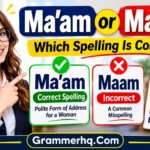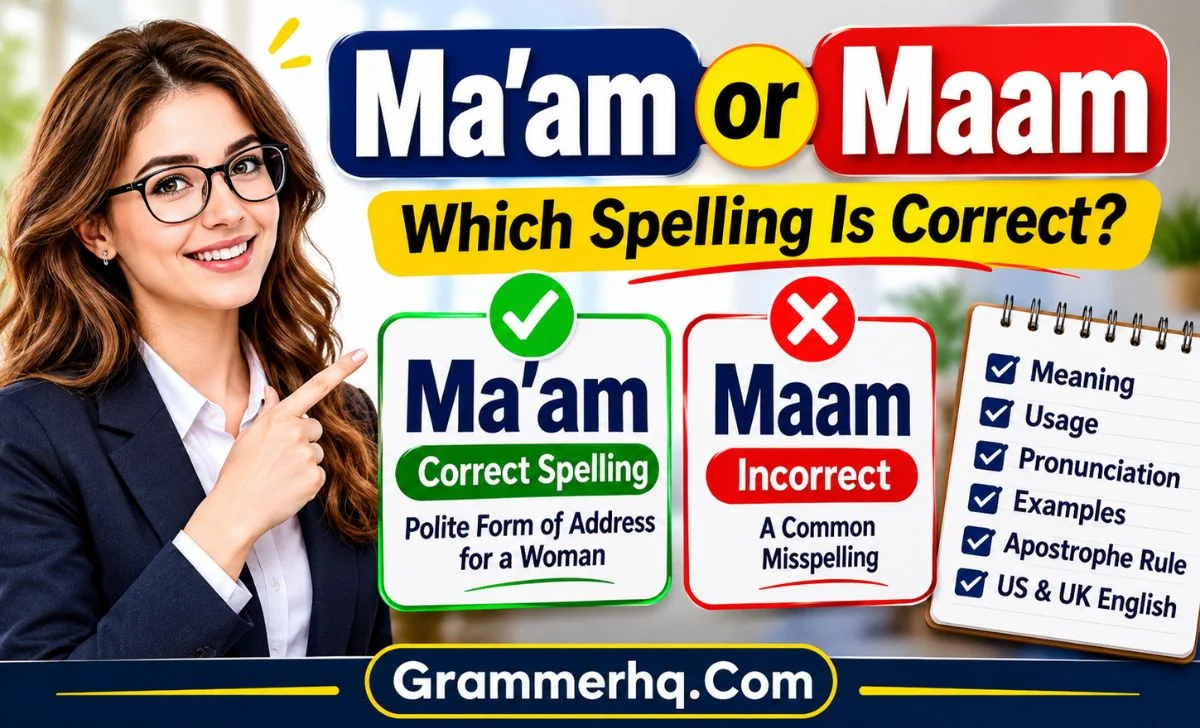
If you are wondering whether to write ma’am or maam, the correct spelling is ma’am, with an apostrophe. It is a shortened form of madam and serves as a polite way to address a woman in everyday and formal conversations.
Although many people type maam in informal messages, this spelling is nonstandard when used with this meaning.
So, which spelling should you use, what does ma’am mean, and why does it need an apostrophe? Let’s explore their differences, pronunciation, real-life examples, and usage in American and British English.
Quick Answer: Ma’am or Maam?
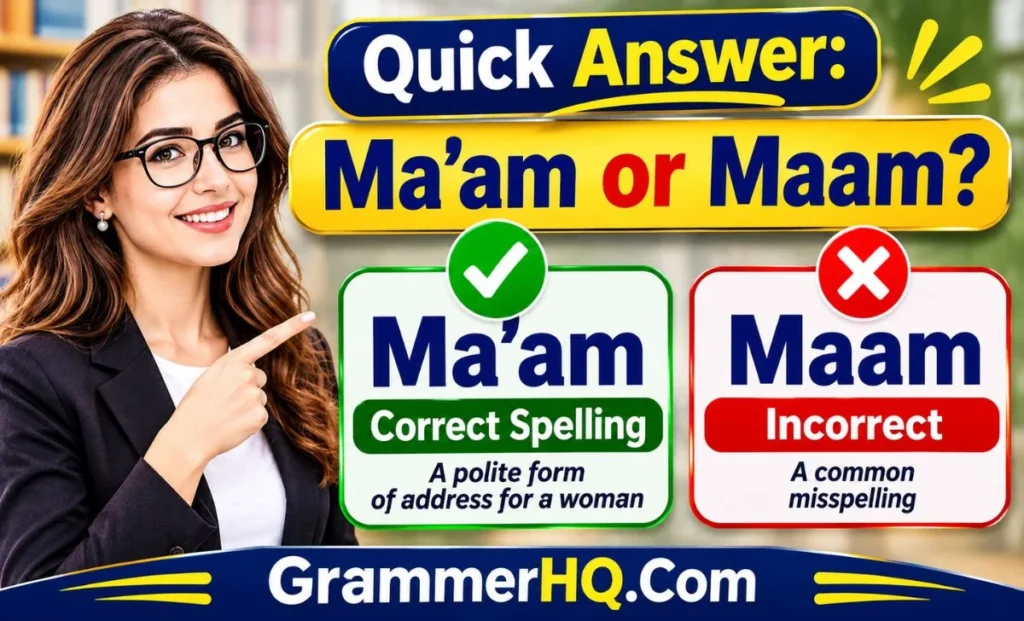
Ma’am is the correct spelling, whereas maam is a nonstandard spelling when you intend to address a woman politely.
The apostrophe represents letters omitted from the original word madam. Therefore, use ma’am in emails, professional conversations, school assignments, and everyday writing.
Example: Excuse me, ma’am. Could you please help me?
What Is the Difference Between Ma’am and Maam?
The main difference between these spellings is the apostrophe. Ma’am follows standard English spelling conventions, while maam leaves out an essential punctuation mark.
- Ma’am: A correct shortened form of madam that people use to address a woman respectfully.
- Maam: A nonstandard spelling that people commonly type when they forget the apostrophe.
Examples:
- Correct: Thank you, ma’am, for your assistance.
- Incorrect: Thank you, maam, for your assistance.
Therefore, always include the apostrophe when you address a woman with this expression.
Why Is Ma’am Correct and Maam Incorrect?
The word ma’am comes from madam, a traditional term for addressing a woman. Over time, English speakers shortened the original word for easier pronunciation and everyday conversation.
The apostrophe marks the omitted letters in this shortened form. Without it, maam does not follow the standard spelling convention.
For example:
- Correct: Yes, ma’am, I understand your instructions.
- Incorrect: Yes, maam, I understand your instructions.
Thus, the apostrophe plays an important role in preserving the correct spelling.
What Does Ma’am Mean in English?
Ma’am means a polite way to address a woman. People commonly use it when speaking to someone they do not know personally, a female teacher, a customer, or a woman in a position of authority.
Additionally, this expression can communicate respect and courtesy in professional and everyday situations.
Examples:
- Excuse me, ma’am, is this seat available?
- Yes, ma’am, I have completed the assignment.
- Thank you, ma’am, for your valuable advice.
- Good morning, ma’am. How may I assist you?
In simple English, ma’am means a respectful way to say madam when speaking directly to a woman.
How Do You Pronounce Ma’am?
The word ma’am has one syllable and sounds similar to the word mam. Although its spelling includes an apostrophe, its pronunciation remains short and simple.
- IPA: /mæm/
- Syllables: One
- Rhyming words: Ham, jam, and ram.
For example, you might say, “Yes, ma’am, I can help you.”
How Is Ma’am Used in Everyday English? (Examples)
People use ma’am in everyday conversations to show politeness and respect. For instance, you may hear it in schools, shops, offices, and customer service interactions.
Here are some natural examples:
- At a store: Excuse me, ma’am, can I help you find something?
- At school: Yes, ma’am, I have finished my homework.
- At work: Thank you, ma’am, for your valuable guidance.
- In conversation: Good afternoon, ma’am. How are you today?
- When asking for help: Ma’am, could you please explain this question?
- In customer service: Would you like anything else, ma’am?
These examples demonstrate how this expression makes conversations sound more courteous and respectful.
Why Does Ma’am Have an Apostrophe?
The apostrophe in ma’am indicates that the original word madam has lost some letters. English grammar uses this punctuation mark to show omitted letters in shortened forms.
For example:
- Madam: The original full form.
- Ma’am: The standard shortened form.
- Maam: A nonstandard spelling without the apostrophe.
Therefore, the apostrophe is an essential part of the conventional spelling, not merely a decorative mark.
Is Ma’am Used Differently in American and British English?
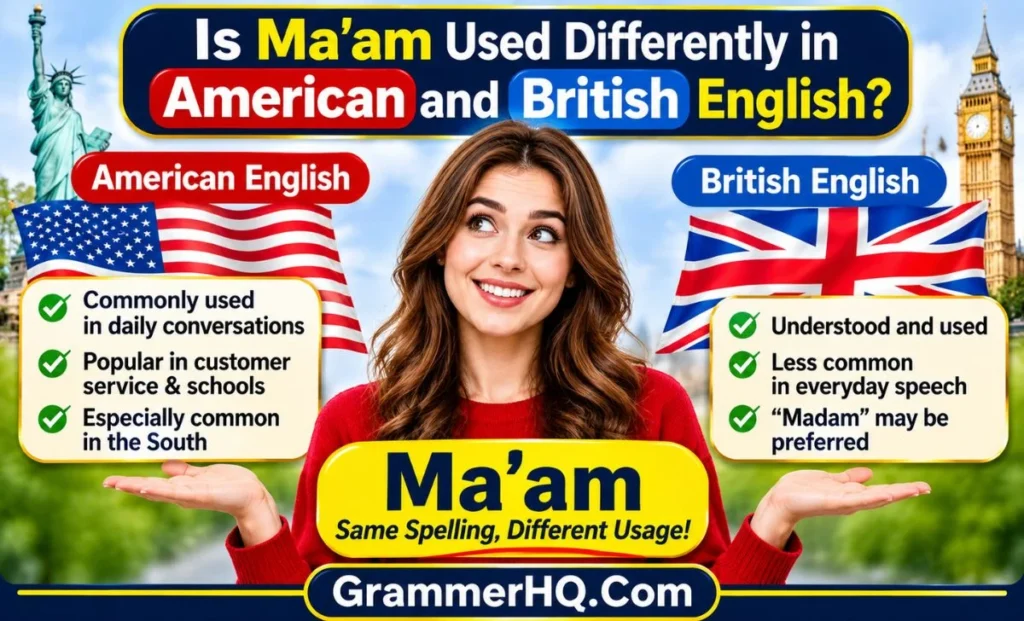
Both American and British English recognize the spelling ma’am. However, speakers in these regions do not use it with exactly the same frequency or in all the same situations.
American English:
In the United States, people commonly use ma’am in polite conversations, customer service, schools, and professional settings. The expression also appears frequently in the Southern United States, where speakers often use it to show respect.
Example: Excuse me, ma’am. You left your phone on the counter.
British English:
In the United Kingdom, people also understand and use ma’am, particularly in formal situations. However, everyday speakers generally use it less frequently than American speakers. Additionally, some formal contexts favor madam.
Example: Good morning, ma’am. May I speak with you?
Important: The spelling remains the same in both varieties. The main difference involves regional speaking habits and levels of formality.
Ma’am vs. Madam vs. Mam: Which Word Should You Use?
These three words may look or sound similar, but they serve different purposes. Therefore, understanding their meanings will help you choose the right expression.
| Word | Meaning | Usage |
|---|---|---|
| Ma’am | Polite shortened form of madam | Addressing a woman |
| Madam | Formal title or form of address | Formal communication |
| Mam | Mother in some regional varieties | Family conversations |
Examples:
- Ma’am: Excuse me, ma’am, may I ask a question?
- Madam: Dear Madam, I am writing to request further information.
- Mam: My mam is preparing dinner.
In particular, remember that mam can mean mother in some British and Irish regional varieties. However, it does not serve as the standard alternative spelling of ma’am.
Common Mistakes to Avoid When Writing Ma’am
Many English learners make small spelling and punctuation mistakes when using ma’am. Fortunately, you can avoid these errors by following a few simple rules.
| Incorrect | Correct |
|---|---|
| Thank you, maam. | Thank you, ma’am. |
| Yes maam. | Yes, ma’am. |
| Excuse me maam. | Excuse me, ma’am. |
| Good morning maam. | Good morning, ma’am. |
| No maam, I haven’t. | No, ma’am, I haven’t. |
To write this expression correctly, remember these three points:
- Always include the apostrophe in ma’am.
- Use a comma when directly addressing someone.
- Do not confuse ma’am with mam, which can mean mother in some regional varieties.
FAQs
Is Ma’am a Short Form of Madam?
Yes. Ma’am is a shortened form of madam. English speakers use it as a polite expression when addressing a woman.
Can You Spell Ma’am as Maam?
No, not in standard English when you intend to address a woman politely. The correct spelling requires an apostrophe because it represents omitted letters from madam.
Is Ma’am Polite or Too Formal?
Ma’am generally expresses politeness and respect. People use it in formal and everyday interactions. However, some women may prefer their names or other titles instead.
Should You Capitalize Ma’am in a Sentence?
Usually, write ma’am in lowercase unless it begins a sentence or appears in a heading or title.
Examples:
- Thank you, ma’am, for your help.
- Ma’am, may I ask you something?
Conclusion
When choosing between ma’am or maam, always write ma’am in standard English. It is the accepted shortened form of madam and provides a polite way to address a woman.
Although people sometimes omit the apostrophe in informal messages, that spelling does not follow standard English conventions.
Therefore, whether you are writing an email, speaking to a teacher, helping a customer, or having a professional conversation, choose ma’am to communicate clearly and respectfully.
Discover More Blogs:
- Offerring vs. Offering: Which Spelling Is Correct?
- Recurring vs. Reoccurring: What Is the Difference?
- Simular vs. Similar: Meaning, Difference & Correct Usage?
- Piqued vs. Peaked: Meaning, Difference & Examples?

Hi, I’m Amelia Parker, a grammar enthusiast and writer at GrammarHQ.com. I specialize in explaining spelling differences, confusing words, and common English mistakes through simple, practical, and easy-to-understand guides.