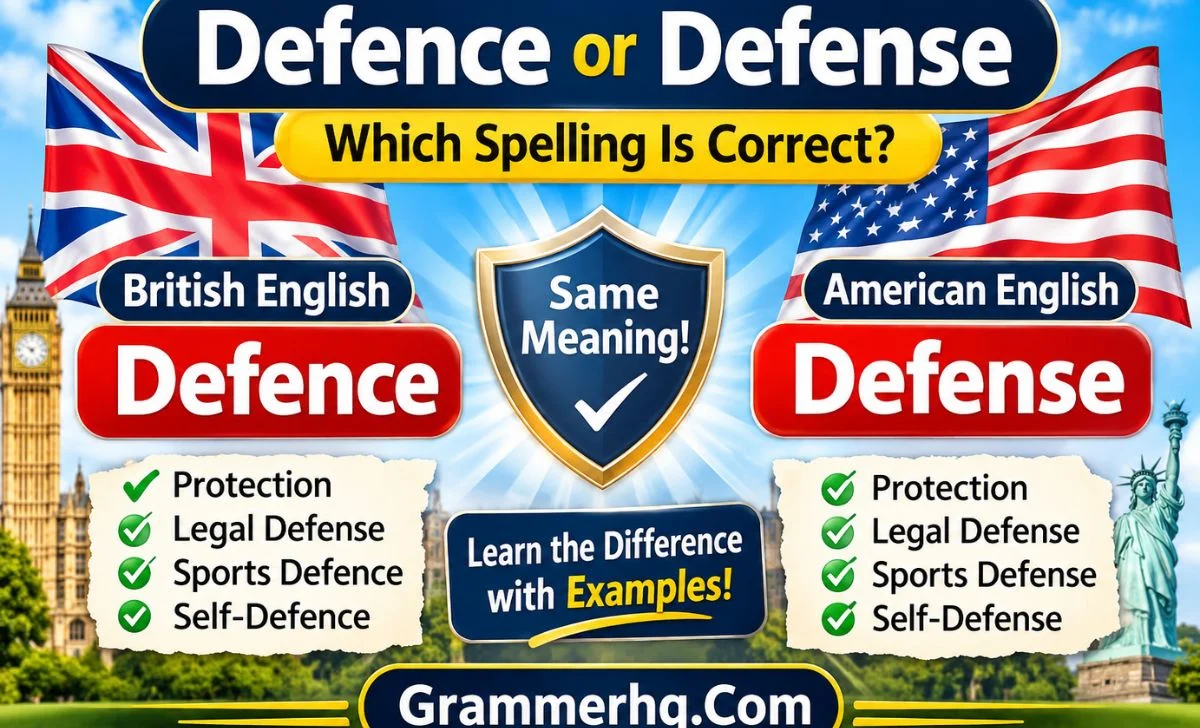
Both defence and defense are correct spellings of the same English word. The difference depends on regional spelling conventions.
Defence is the standard spelling in British English, while defense is the standard spelling in American English. Both words mean protection against attack, danger, criticism, or harm.
For example, British writers say, “The country needs stronger defence,” while American writers write, “The country needs stronger defense.”
Neither spelling is wrong. Choose the version that matches your intended audience and use it consistently throughout your writing.
Quick Answer:

Both defence (with a “c”) and defense (with an “s”) are correct spellings of the exact same word; the difference comes down to regional spelling standards.
- Defence (with a “c”): Standard in British English, used across the UK, Canada, Australia, Pakistan, and most Commonwealth nations.
- Defense (with a “s”): Standard in American English, used in the United States.
Quick Rules
- Meaning: Both share the exact same meaning—protection, safeguarding, legal arguments, or a sports position.
- Derivatives: When adding suffixes that start with the letter “i” (such as defensive, defensibility, or defensible), “s” is used universally in both British and American English.
What Is the Difference Between Defence and Defense?
The main difference between defence and defense is their spelling, not their meaning or pronunciation.
Defence is commonly used in British English and other varieties that follow British spelling conventions, including Australian and Canadian English. Defense is preferred in American English.
Both words are nouns and describe the act of protecting someone or something from an attack, threat, criticism, or harm.
Here is a simple comparison:
| Feature | Defence | Defense |
|---|---|---|
| English variety | British English | American English |
| Spelling | With C | With S |
| Part of speech | Noun | Noun |
| Meaning | Protection or resistance | Protection or resistance |
| Pronunciation | /dɪˈfens/ | /dɪˈfens/ |
| Example | National defence | National defense |
The spelling you choose should depend on your audience. If you are writing for readers in the United States, use defense. For readers in the United Kingdom, use defence.
What Does Defence or Defense Mean?
Defence or defense means protecting a person, country, place, idea, or organization against an attack, danger, accusation, or criticism.
In simple English, it describes an action or system that helps keep someone or something safe.
The word has several meanings depending on the context.
1. Protection Against an Attack
Defence or defense can describe protecting a country, community, building, or person from an enemy or physical threat.
Examples:
- The government is investing in national defence.
- The country needs a stronger defense system.
- Soldiers are responsible for the defence of their nation.
- The army improved its defense against possible attacks.
In these examples, the word refers to protection against physical threats or attacks.
2. Legal Protection
In law, defence or defense refers to the arguments, evidence, or legal representation used to protect someone accused of a crime or involved in a legal case.
Examples:
- The lawyer prepared a strong defence for his client.
- The defense presented new evidence in court.
- She hired an experienced lawyer for her legal defence.
- The attorney questioned the evidence presented by the prosecution.
Here, both spellings describe the legal process of defending an accused person or responding to a claim.
3. Protection in Sports
In sports, defence or defense refers to the players, strategies, or actions used to stop an opposing team or player from scoring.
Examples:
- Our team’s defence played exceptionally well.
- The coach wants to improve the team’s defense.
- Their strong defence prevented several goals.
- The team’s defense stopped the opponents from scoring.
This meaning is especially common in football, basketball, hockey, and other competitive sports.
4. Protection Against Criticism
Defence or defense can also mean supporting or justifying a person, decision, belief, or action when someone criticizes it.
Examples:
- She spoke in defence of her colleague.
- He offered a strong defense of his decision.
- The manager presented evidence in defence of the new policy.
- The writer published an article in defense of free speech.
In these examples, the word describes supporting something against criticism or disagreement.
Defence vs. Defense in American and British English
The spelling depends on the English variety you are following. American and British English use different spelling conventions for several words, including defence and defense.
Here is how the word is generally used in different English-speaking countries.
American English: Defense
Defense is the standard spelling in the United States.
American dictionaries, newspapers, schools, government publications, and professional organizations generally use this spelling.
Examples:
- The United States has a strong national defense system.
- The lawyer prepared a defense for the accused.
- Our team’s defense needs more practice.
- The company introduced new security defenses.
If your audience is primarily American, use defense in your writing.
British English: Defence
Defence is the standard spelling in the United Kingdom.
It follows the British spelling convention, which also appears in many other English-speaking countries.
Examples:
- The government announced a new defence policy.
- The lawyer prepared a defence for his client.
- The team’s defence was difficult to overcome.
- The country strengthened its national defence.
If you are writing for British readers, defence is the appropriate choice.
Is Defence or Defense Used in Canada and Australia?

Yes, both countries generally follow British spelling conventions for this word.
- Canada: Defence is the standard spelling in general Canadian English.
- Australia: Defence is the standard spelling in Australian English.
- New Zealand: Defence is the standard spelling in New Zealand English.
For example:
- Canada: The government reviewed its national defence policy.
- Australia: The defence forces protect the country.
- New Zealand: The country invests in national defence.
However, proper names, official organization names, and quoted material should retain their established spelling.
How to Use Defence and Defense in Sentences
Understanding the meaning is important, but knowing how to use these words naturally in everyday writing is equally useful.
The following examples show how both spellings work in different situations.
| British English | American English |
|---|---|
| The country needs better defence. | The country needs better defense. |
| The lawyer prepared a strong defence. | The lawyer prepared a strong defense. |
| Our defence stopped the opposing team. | Our defense stopped the opposing team. |
| She spoke in defence of her friend. | She spoke in defense of her friend. |
| The government announced a defence plan. | The government announced a defense plan. |
| He acted in self-defence. | He acted in self-defense. |
| The team improved its defensive strategy. | The team improved its defensive strategy. |
| National defence is an important responsibility. | National defense is an important responsibility. |
Notice that the meaning remains unchanged in every pair. Only the regional spelling changes.
Is It Self-Defence or Self-Defense?
Both self-defence and self-defense are correct. The choice depends on whether you are following British or American English.
Self-defence or self-defense means protecting yourself from physical harm, danger, or an attack.
For example:
- British English: He learned self-defence to protect himself.
- American English: He learned self-defense to protect himself.
The same spelling rule applies to other related expressions:
- British English: self-defence classes
- American English: self-defense classes
- British English: self-defence techniques
- American English: self-defense techniques
Remember that the hyphen is commonly used in the expression self-defence or self-defense.
Defence, Defenses, and Other Related Word Forms
Defence and defense are nouns, but several related words are used in everyday English. Understanding their spelling helps prevent common mistakes.
| Word | Usage |
|---|---|
| Defence | British singular noun |
| Defense | American singular noun |
| Defences | British plural noun |
| Defenses | American plural noun |
| Defenceless | British adjective |
| Defenseless | American adjective |
| Defensive | Same spelling in both varieties |
| Defensible | Same spelling in both varieties |
| Defensively | Same spelling in both varieties |
| Defend | Same spelling in both varieties |
| Defender | Same spelling in both varieties |
Is It Defensive or Defencive?
Defensive is the correct spelling in both American and British English.
It is an adjective that describes someone or something that protects against an attack, criticism, or threat.
Examples:
- The team played a defensive game.
- She became defensive when questioned about her decision.
- The country developed a defensive strategy.
Writing defencive is incorrect in standard English.
Is It Defenceless or Defenseless?
Both spellings are correct, but their regional usage differs.
- Defenceless: British English
- Defenseless: American English
Both mean unable to protect oneself against danger, attack, or harm.
Examples:
- The injured animal was defenceless.
- The defenseless child needed protection.
Is It Defensible or Defencible?
Defensible is correct in both British and American English.
It means capable of being justified, supported, or defended with reasonable arguments or evidence.
Example: Her decision was reasonable and defensible.
The spelling defencible is incorrect in standard English.
Common Mistakes When Using Defence and Defense
Writers sometimes confuse these words because both spellings are accepted in English. However, a few simple rules can help you avoid mistakes.
1. Thinking one spelling is always wrong
Defence is not incorrect, and defense is not incorrect. Each belongs to a different regional spelling convention.
2. Mixing American and British spellings
Avoid switching between defence and defense in the same article unless you are discussing spelling differences.
Choose one variety and maintain consistency.
3. Writing defencive instead of defensive
The correct adjective is defensive in both American and British English.
4. Confusing the noun with the adjective
Defence and defense are nouns, while defensive is an adjective.
For example:
- Noun: The team’s defense was excellent.
- Adjective: The team used a defensive strategy.
5. Using the wrong spelling for your audience
If your article targets American readers, prefer defense. If it targets British readers, prefer defence.
Following the appropriate spelling convention makes your writing more consistent and professional.
FAQs
1. Is It Defence or Defense?
Both are correct spellings. Defence is used in British English, while defense is used in American English. Both words have the same meaning.
2. What Is the Difference Between Defence and Defense?
The difference is regional spelling. Defence follows British English conventions, whereas defense follows American English conventions. Their meanings and pronunciations are the same.
3. Is Defense American or British English?
Defense is the standard American English spelling. It is commonly used in the United States in military, legal, sports, and everyday contexts.
4. Is Defence the Correct British Spelling?
Yes. Defence is the standard British English spelling. It is used in British newspapers, books, educational materials, and official writing.
5. Do Defence and Defense Have the Same Meaning?
Yes. Both words mean protection against an attack, threat, criticism, or harm. The only difference is their spelling.
6. Is Defence Used in Canada and Australia?
Yes. Defence is generally the preferred spelling in both Canadian and Australian English. It also follows standard New Zealand English spelling conventions.
7. Is It Self-Defence or Self-Defense?
Both are correct. Self-defence is the British spelling, while self-defense is the American spelling. Both refer to protecting yourself from harm or attack.
8. Is Defensive Spelled the Same in British and American English?
Yes. Defensive is spelled the same way in both varieties of English. The spelling does not change to defencive in British English.
9. Which Spelling Should I Use in Formal Writing?
Use defence when following British English and defense when following American English. For professional writing, academic assignments, and business documents, maintain the spelling convention required by your audience or style guide.
10. How Do You Pronounce Defence and Defense?
Both words are pronounced the same way: /dɪˈfens/. The spelling changes between British and American English, but the standard pronunciation remains the same.
Conclusion
Both defence and defense are correct spellings. The difference is regional: defence is used in British English, while defense is used in American English.
Both words have the same meaning: protection against attack, danger, criticism, or harm. Use the spelling that matches your audience and maintain consistency throughout your writing.
Discover More Blogs:
- Insue vs. Ensue: Which Spelling Is Correct?
- Other Than vs. Other Then: Correct Usage & Meaning?
- Lable or Label: Which Spelling Is Correct in English?
- Striping vs. Stripping: What’s the Difference? Meaning & Examples