Cocoon is the correct spelling, while cacoon is a misspelling. A cocoon is a protective covering made by certain insect larvae, such as silkworms, around themselves during the stage of development before becoming adults.
If you are unsure whether to write cocoon or cacoon, always use cocoon in standard English.
What Is the Difference Between Cocoon and Cacoon?
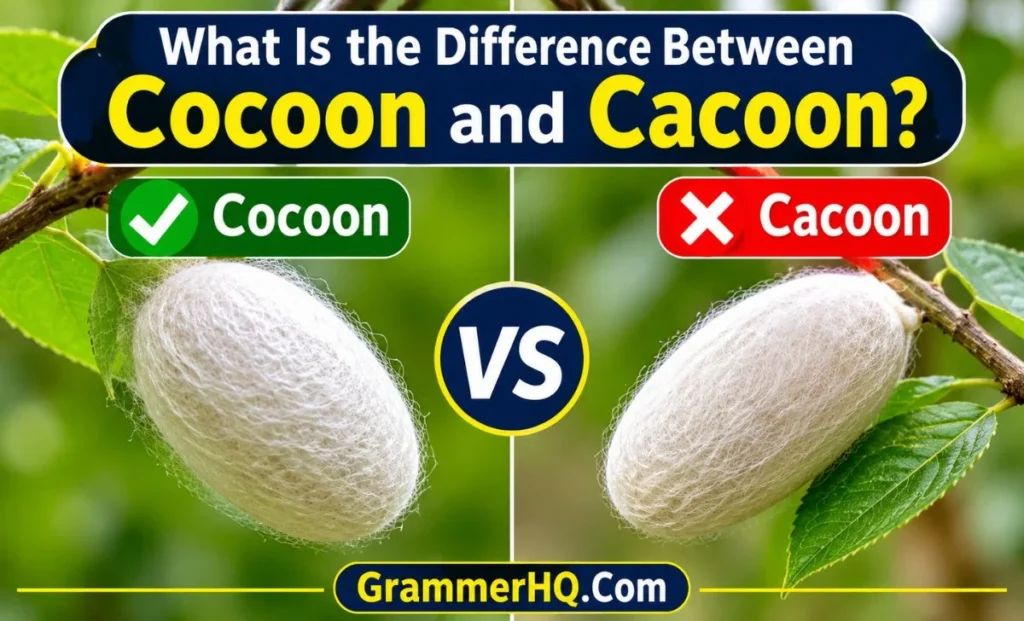
The main difference is spelling and usage. Cocoon is a correctly spelled English word, whereas cacoon is an incorrect spelling.
| Word | Correct or Incorrect? | Meaning |
|---|---|---|
| Cocoon | Correct | A protective covering made by certain insects |
| Cacoon | Incorrect | A common misspelling of cocoon |
What Does Cocoon Mean?
Cocoon is a noun and a verb. As a noun, it refers to a protective covering made from silk-like threads by certain insects during their development. As a verb, it means to surround or protect someone or something.
It also has a figurative meaning: a safe, comfortable, or protected place.
Examples:
- The silkworm spun a cocoon around itself.
- The caterpillar remained inside its cocoon.
- She enjoyed the warm cocoon of her home during winter.
- His family cocooned him from the outside world.
What Does Cacoon Mean?
Cacoon is not the standard spelling of the English word cocoon. People sometimes use it by mistake because the first syllable of cocoon sounds like “kuh,” which can cause spelling confusion.
If you are writing about an insect’s protective covering, the correct spelling is always cocoon.
Incorrect: The butterfly emerged from its cacoon.
Correct: The butterfly emerged from its cocoon.
One small qualification: cacoon can occur in specialized botanical names, but it is not an accepted alternative spelling of the ordinary English word cocoon.
Cocoon vs. Cacoon: Examples in Sentences
Here are some practical examples to help you understand the correct spelling.
Correct uses of Cocoon:
- The silkworm created a protective cocoon.
- Several cocoons were hanging from the tree branches.
- The insect developed inside its cocoon.
- She wanted to cocoon herself in a warm blanket.
- The baby slept peacefully in a comfortable cocoon.
Incorrect uses of Cacoon:
- The silkworm created a protective cacoon.
- Several cacoons were hanging from the tree branches.
- The insect developed inside its cacoon.
Remember that these incorrect examples should use cocoon and cocoons instead.
Cocoon, Cocoons, Cocooned, and Cocooning: Word Forms
Understanding the different forms of cocoon can help you use the word correctly in everyday writing.
| Word form | Usage | Example |
|---|---|---|
| Cocoon | Singular noun / base verb | The insect made a cocoon. |
| Cocoons | Plural noun / verb | The tree has several cocoons. |
| Cocooned | Past tense | She cocooned herself in blankets. |
| Cocooning | Present participle | He is cocooning at home. |
These are all standard forms of the word. None requires the spelling cacoon.
Is Cocoon Different in American and British English?

No. Cocoon has the same spelling in both American and British English. There is no regional spelling variation between the two varieties.
The standard pronunciation is also the same:
- American English: /kəˈkuːn/
- British English: /kəˈkuːn/
Pronunciation: kuh-KOON
The stress falls on the second syllable.
For example:
- American English: The caterpillar formed a cocoon.
- British English: The caterpillar formed a cocoon.
Therefore, whether you are writing for readers in the United States or the United Kingdom, use cocoon, not cacoon. Cambridge Dictionary+2
How to Remember the Correct Spelling
A simple way to remember cocoon is to focus on its two parts:
CO + COON = COCOON
Remember that the word contains:
- One C at the beginning.
- Two O letters in the first part.
- Two O letters together in the second part.
- One N at the end.
Whenever you are unsure, remember the spelling C-O-C-O-O-N.
FAQs
1. Is it cocoon or cacoon?
Cocoon is the correct spelling for the protective covering made by certain insects. Cacoon is a misspelling in this context.
2. What is the plural of cocoon?
The plural of cocoon is cocoons.
3. How do you spell cocoon?
The correct spelling is C-O-C-O-O-N.
4. Is cacoon a real English word?
Cacoon is not the standard spelling of the insect-related word. It can appear in specialized botanical names, but ordinary English writing requires cocoon.
5. What is the difference between a cocoon and a chrysalis?
A cocoon is a protective covering spun by certain insects, particularly moth larvae. A chrysalis refers to the pupal stage or casing of a butterfly.
6. What is the pronunciation of cocoon?
Cocoon is pronounced kuh-KOON (/kəˈkuːn/) in both American and British English.
Conclusion: Cocoon or Cacoon?
The correct spelling is cocoon, not cacoon, when referring to an insect’s protective covering or a figurative safe enclosure. Both American and British English use the same spelling and pronunciation.
Remember:
C-O-C-O-O-N to avoid this common spelling mistake in your writing.
Discover More Blogs:
- Take Effect or Take Affect: Which Phrase Is Correct?
- Simular vs. Similar: Meaning, Difference & Correct Usage?
- Long Term or Longterm: Meaning, Spelling & Usage?
- Insue vs. Ensue: Which Spelling Is Correct?