Have you ever wondered whether cringy or cringey is the correct spelling? You’re not alone. Many English learners, writers, and even native speakers get confused because both forms appear in dictionaries, social media posts, blogs, and everyday conversations.
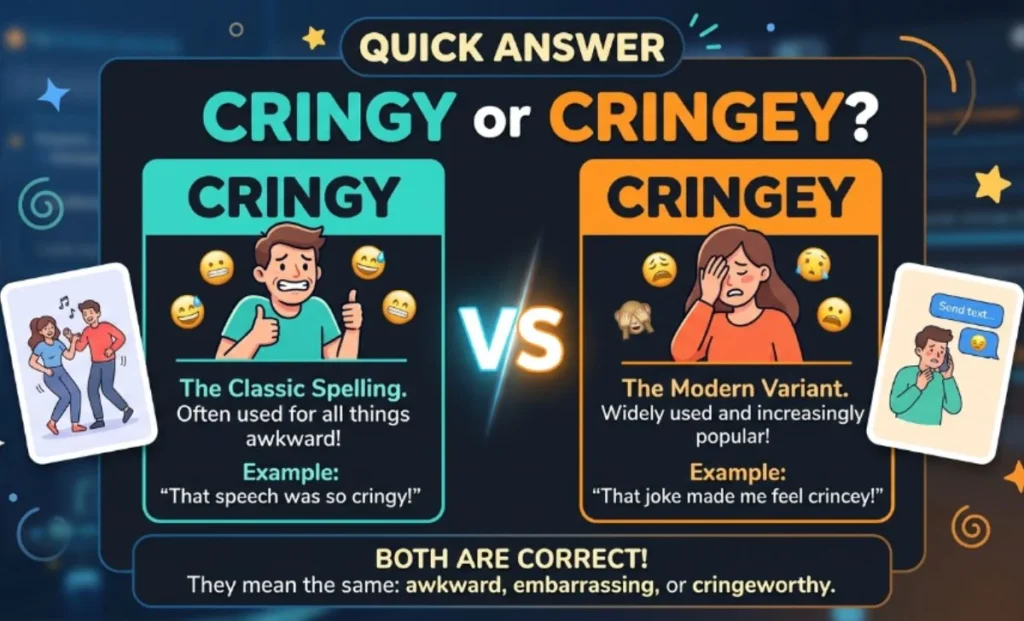
The good news is that both spellings are correct, but they are not equally preferred. Cringey is the more common spelling in modern English and is widely used in professional writing, while cringy remains an accepted variant that often appears in informal contexts.
In this guide, you’ll learn the meaning of both words, their pronunciation, how to use them correctly, what major dictionaries recommend, and which spelling is the best choice for different situations.
Quick Answer
If you’re choosing between cringy and cringey, the safest option is cringey.
- ✅ Both cringey and cringy are correct spellings.
- ✅ They have the same meaning.
- ✅ Cringey is the preferred spelling in modern English.
- ✅ Cringy is an accepted variant used mostly in informal writing.
- ✅ Both describe something that causes embarrassment, awkwardness, or secondhand discomfort.
Examples
- ✅ That speech was incredibly cringey.
- ✅ His old social media posts look cringy now.
Best Practice: If you’re writing for school, work, business, blogs, or professional communication, choose cringey because it is the spelling most readers, editors, and dictionaries prefer.
Cringy vs Cringey: Comparison Table
| Feature | Cringey | Cringy |
|---|---|---|
| Meaning | Something awkward or embarrassing | Same meaning |
| Correct Spelling | ✅ Yes | ✅ Yes |
| Dictionary Status | Preferred spelling | Accepted variant |
| Formal Writing | ✅ Recommended | Less preferred |
| Informal Writing | ✅ Common | ✅ Common |
| Social Media | Very common | Common |
| Professional Writing | Best choice | Usually avoided |
| Overall Recommendation | ⭐ Preferred | Alternative spelling |
Bottom line: Both spellings are correct, but cringey is the better choice because it is more widely recognized in modern English.
Which Spelling Is Correct?
Both cringey and cringy are legitimate spellings. The difference is not their meaning but how frequently each form is used.
The word comes from the verb cringe, which means to feel embarrassed, uncomfortable, or emotionally awkward. As the adjective became popular, two accepted spellings developed naturally.
Today, cringey is the preferred spelling because it keeps the final “e” from the base word cringe. It is also the form most commonly found in modern dictionaries, edited publications, and professional writing.
Cringy is still considered correct, but it appears more often in casual writing, online discussions, text messages, and social media.
Neither spelling changes the meaning of the word. The choice mainly depends on your audience and writing style.
Examples
- That commercial was incredibly cringey.
- His attempt to impress everyone felt cringy.
- The dialogue became cringey after the awkward joke.
- Many social media users still write cringy, especially in casual conversations.
Meaning of Cringey and Cringy
The words cringey and cringy share exactly the same meaning. Both describe something that makes people feel awkward, embarrassed, uncomfortable, or emotionally uneasy.
These words are commonly used when someone’s behavior, words, or actions create secondhand embarrassment—the uncomfortable feeling you get while watching someone else do something embarrassing.
People often use cringey or cringy to describe:
- Embarrassing behavior
- Awkward conversations
- Forced jokes
- Overacting
- Uncomfortable social situations
- Old photos or videos that feel embarrassing
- Poorly written dialogue
- Overly dramatic online content
Examples
- His fake accent sounded extremely cringey.
- Watching my old school videos feels cringey.
- Their conversation turned cringy within minutes.
- Some internet memes are intentionally cringy to make people laugh.
- The advertisement received criticism for being cringey rather than funny.
Why Do People Get Confused?
The confusion between cringey and cringy exists because both spellings are accepted in modern English.
Unlike many spelling mistakes where one form is incorrect, these two words are simply different spelling variants of the same adjective. As a result, people often see both versions and assume one must be wrong.
Several factors contribute to this confusion:
- Modern dictionaries generally prefer cringey.
- Social media platforms commonly use both spellings.
- Different writers and editors follow different style guides.
- Search engines return results for both forms.
- Autocorrect suggestions vary depending on the device, keyboard, or software.
Because both spellings are widely understood by native English speakers, the difference is one of preference, not correctness.
Easy Way to Remember
A simple trick is to remember the original word cringe.
Since cringey keeps the final “e” from cringe, it’s easier to recognize as the preferred modern spelling.
Think of it like this:
- Cringe → Cringey ✅ (keeps the original spelling)
- Cringe → Cringy ✅ (accepted shorter variant)
If you’re ever unsure which spelling to choose, use cringey. It’s the version most dictionaries, editors, and professional writers recommend, making it the safest option for almost every type of writing.
What Major Dictionaries Say
Leading English dictionaries recognize both cringey and cringy, but they generally treat cringey as the more common and widely accepted spelling. While cringy is also a correct variant, it appears less frequently in edited publications and professional writing.
Most modern style-conscious writers choose cringey because it stays closer to the original word cringe and has become the spelling many readers naturally expect.
Dictionary Summary
| Dictionary | Preferred Form | Notes |
|---|---|---|
| Merriam-Webster | Cringey | Lists cringey as the primary entry. |
| Cambridge Dictionary | Cringey | Uses cringey in its examples and definitions. |
| Collins Dictionary | Cringey | Recognizes cringey as the standard spelling. |
| Oxford English Dictionary | Cringey | Uses cringey as the preferred modern form. |
Recommendation: If consistency and clarity matter, cringey is the better spelling to use.
Word Origin (Etymology)
The adjective cringey comes from the verb cringe, a word that has been part of English for centuries. Originally, cringe described the physical action of shrinking back in fear, discomfort, or embarrassment.
As internet culture and social media evolved, English speakers began using the word more broadly to describe situations that cause secondhand embarrassment. This led to the creation of the adjective cringey, meaning “likely to make someone cringe.”
The shorter spelling cringy appeared naturally over time as an accepted alternative, but cringey remains the form used more often in modern English.
British English vs American English
Unlike spelling pairs such as colour/color or organise/organize, cringey and cringy are not separated by British and American English.
English speakers in the United States, the United Kingdom, Canada, Australia, and other English-speaking countries understand both spellings. The difference is based on writing preference, not regional spelling rules.
| English Variety | Preferred Choice | Accepted Variant |
|---|---|---|
| American English | Cringey | Cringy |
| British English | Cringey | Cringy |
| Canadian English | Cringey | Cringy |
| Australian English | Cringey | Cringy |
If you’re writing for an international audience, cringey is usually the safest option because it is more widely recognized.
Pronunciation:
cringey (KRIN-jee)
Both cringey and cringy are pronounced exactly the same.
IPA: /ˈkrɪn.dʒi/
The spelling changes, but the pronunciation does not.
Pronunciation Examples
- That joke sounded cringey.
- His reaction was cringy.
- Everyone agreed the advertisement was cringey.
Difference Between Cringe, Cringey, and Cringy
These three words are closely related, but they have different grammatical roles.
| Word | Part of Speech | Meaning | Example |
|---|---|---|---|
| Cringe | Verb (also informal noun) | To feel embarrassed or uncomfortable | I cringe whenever I watch that video. |
| Cringey | Adjective | Causing embarrassment or awkwardness | That speech was cringey. |
| Cringy | Adjective | Same meaning as cringey | His old videos look cringy. |
Understanding this difference helps you choose the correct word in different sentences.
When Should You Use Cringey?
Choose cringey whenever you want the spelling that is most widely accepted in modern English.
It is the best option for:
- Blog articles
- School assignments
- Business writing
- Professional emails
- News articles
- Website content
- Reports and presentations
- SEO content
Because cringey is more familiar to most readers, it makes your writing look more polished and consistent.
Examples
- That presentation became cringey after the technical problems.
- The advertisement received criticism for being cringey.
- His exaggerated acting looked cringey.
When Can You Use Cringy?
Although cringy is less common, it is still a correct spelling.
It is most often used in relaxed and informal communication, including:
- Text messages
- Personal blogs
- Online forums
- Social media posts
- Casual conversations
If your writing is informal and you prefer the shorter spelling, cringy is perfectly acceptable.
Examples
- That dance challenge was really cringy.
- His old photos seem cringy now.
- The joke became cringy after hearing it repeatedly.
Common Mistakes to Avoid
Many learners mix up cringe, cringey, and cringy because the words are closely related. Choosing the correct form depends on how the word functions in the sentence.
| Incorrect | Correct |
|---|---|
| ❌ She is very cringe person. | ✅ She is a very cringey person. |
| ❌ His speech sounded cringeyy. | ✅ His speech sounded cringey. |
| ❌ The video is crinjy. | ✅ The video is cringy. |
| ❌ I cringey at that video. | ✅ I cringed at that video. |
Tip: In informal internet slang, people sometimes say “That video is cringe.” While this usage is common online, cringey is usually the better choice in standard written English.
Cringey in a Sentence
Here are some natural examples showing how the word is used in everyday English.
- His acceptance speech was surprisingly cringey.
- Watching my childhood videos feels cringey now.
- The dialogue in the movie sounded cringey.
- Their attempt to copy the trend looked cringey.
- Everyone laughed because the performance was unintentionally cringey.
Funny Examples
People often use cringey humorously to describe awkward or embarrassing moments.
- Dad’s dance moves at the wedding were hilariously cringey.
- My first email from 2015 is so cringey that I can’t read it without laughing.
- That motivational rap was funny because it was intentionally cringey.
- His dramatic selfie caption was peak cringey behavior.
Cringey Synonyms
Depending on the situation, you can replace cringey with one of these words:
- Awkward
- Embarrassing
- Uncomfortable
- Cheesy
- Corny
- Forced
- Overdramatic
- Tacky
- Cringe-worthy
- Unnatural
Example
Instead of writing:
The presentation was cringey.
You could write:
- The presentation was awkward.
- The presentation was embarrassing.
- The presentation felt forced.
Real-Life Usage Examples
The words cringey and cringy are commonly used in everyday English to describe situations that feel awkward, embarrassing, or socially uncomfortable. Here are some natural examples from different contexts.
Everyday Conversation
- That prank was so cringey that nobody laughed.
- His attempt to sound cool came across as cringy.
- Everyone felt uncomfortable after the awkward silence.
Social Media
- Many users called the video cringey in the comments.
- The trend looked fun at first but quickly became cringy.
School
- The class presentation felt cringey because no one reacted.
- Some students think outdated internet slang sounds cringy.
Workplace
- The advertisement was criticized for its cringey dialogue.
- The sales pitch felt too forced and slightly cringy.
What Does Urban Dictionary Mean by Cringy?
In Urban Dictionary, cringy (or cringey) is commonly used to describe someone or something that feels awkward, embarrassing, forced, or socially uncomfortable.
The meaning is similar to standard English, but online communities often use the word more casually and humorously.
For example:
- That meme is intentionally cringey.
- His over-the-top reaction was a little cringy.
Although this informal meaning is widely understood, standard dictionaries remain the best reference for formal writing.
How Is the Word Used on Reddit?
On Reddit, you’ll find both spellings used in discussions, comments, and memes.
However, cringey appears more often in longer discussions and edited posts, while cringy is usually seen in quick, informal comments.
Because Reddit is an informal platform, neither spelling is usually treated as incorrect. For professional or academic writing, cringey is still the better choice.
FAQ,s
Is cringy a real word?
Yes. Cringy is a real and accepted English word. It has the same meaning as cringey, although cringey is generally the preferred spelling in modern dictionaries and professional writing.
Is cringey the correct spelling?
Yes. Cringey is the preferred spelling in modern English. It is widely used in dictionaries, edited publications, and professional writing, making it the safest choice in most situations.
What’s the difference between cringy and cringey?
There is no difference in meaning.
Both words describe something awkward, embarrassing, or uncomfortable enough to make someone cringe. The only difference is the spelling and how commonly each form is used.
Which spelling is more common?
Cringey is more common in modern English.
While cringy is still correct, cringey appears more frequently in dictionaries, books, websites, and professional publications.
How do you use cringey in a sentence?
Here are a few natural examples:
- That commercial was incredibly cringey.
- His speech became cringey after the awkward joke.
- Watching my old videos feels cringey.
How do you use cringy in a sentence?
You can use cringy exactly the same way.
Examples:
- That challenge looked cringy.
- His old social media posts seem cringy now.
- The conversation became cringy within minutes.
Is it very cringe or very cringey?
In standard English, very cringey is the better choice because cringey is an adjective.
Although people sometimes say very cringe in internet slang, that usage is informal and is best avoided in professional or academic writing.
What is the difference between cringe and cringey?
Cringe is mainly a verb, meaning to feel embarrassed or uncomfortable.
Cringey and cringy are adjectives used to describe something that causes those feelings.
Examples
- I cringe whenever I watch that video.
- That video is cringey.
How do you pronounce cringey?
It is pronounced:
/ˈkrɪn.dʒi/
It sounds like KRIN-jee.
Both cringey and cringy have the same pronunciation.
Should I use cringey or cringy?
If you’re unsure, choose cringey.
It is the preferred spelling for:
- Blog posts
- Articles
- Business writing
- School assignments
- Professional communication
Use cringy if you prefer it in casual or informal writing.
Conclusion
Both cringey and cringy are correct spellings, and they share exactly the same meaning. They describe something that causes embarrassment, awkwardness, or secondhand discomfort.
The main difference is usage. Cringey has become the preferred spelling in modern English because it appears more often in dictionaries, edited publications, and professional writing. Cringy remains an accepted variant that is commonly used in casual conversations and online content.
If you want the safest and most widely recognized choice, use cringey. It is clear, natural, and appropriate for almost every type of writing.
Read More Blogs:
- Canvas or Canvass: A Simple Guide to Correct English Usage
- Adapt or Adopt Explained: Difference, Uses, and Examples
- Traveler vs Traveller: British vs American English?
- Icycle vs Icicle: Which Spelling Is Correct?