
Dysregulated vs. Disregulated is a common spelling confusion, but only one form is the established standard spelling.
Dysregulated is the correct choice in standard English, especially when describing emotions, behavior, or biological processes that are not regulated normally.
Although disregulated may appear occasionally, it is not the preferred spelling. Understanding the difference will help you spell and use the word correctly.
Dysregulated vs. Disregulated: Quick Answer
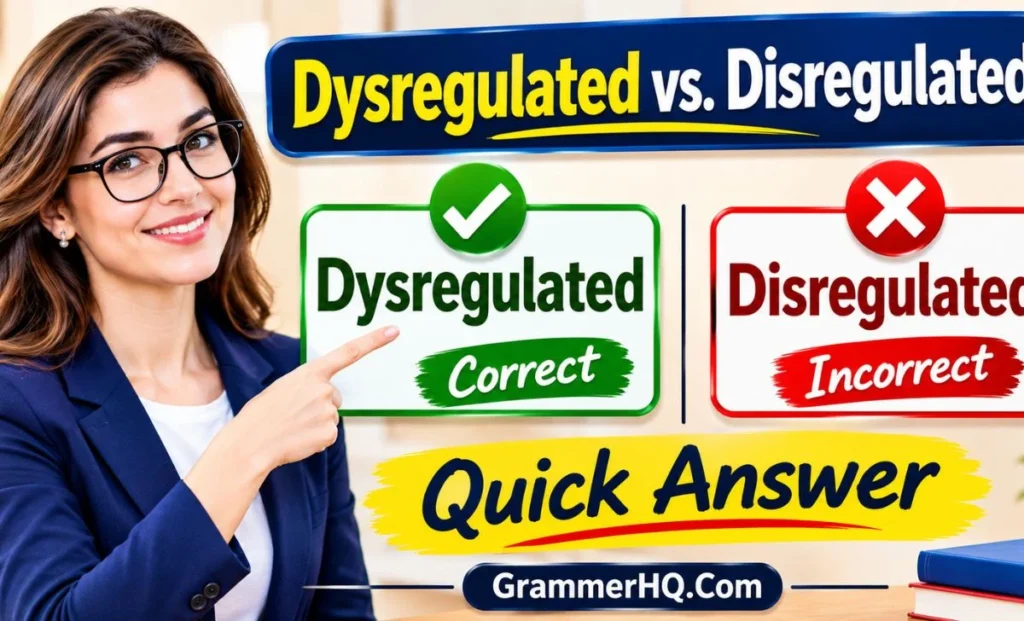
Dysregulated is the correct standard spelling. It is the adjective form of dysregulate and describes something that is not functioning or responding through its normal regulatory process.
Disregulated is generally a misspelling when someone intends to use the same meaning.
| Word | Correctness | Explanation |
|---|---|---|
| Dysregulated | Correct | Standard spelling in medical and psychological English |
| Disregulated | Nonstandard | Not the accepted spelling for this meaning |
Example:
- Correct: The child became dysregulated after the unexpected change.
- Incorrect in standard usage: The child became disregulated after the unexpected change.
Remember: Use dysregulated when writing about emotional responses, behavior, or biological processes.
Dysregulated vs. Disregulated: Spelling and Meaning:

Dysregulated:
Meaning: It describes a biological, emotional, or nervous system process that is impaired, abnormal, or functioning poorly.
Prefix: The Greek prefix dys- means “bad,” “difficult,” or “abnormal” (similar to dysfunction or dystopia).
Usage: Used widely in medicine and psychology (e.g., dysregulated nervous system, emotional dysregulation).
Disregulated:
Meaning: This spelling is generally considered a common misspelling or non-standard variant in professional dictionaries.
Prefix: The Latin prefix dis- usually means “apart,” “asunder,” or the “absence of” (similar to disconnect or disappear). While people sometimes confuse the two due to similar pronunciation, disregulated is not recognized as standard terminology.
What Does Dysregulated Mean?
Dysregulated is an adjective that describes something that is not being controlled or managed in its normal way.
The word is commonly used in psychology and medicine. Its exact meaning depends on what it describes.
For example, a person may experience emotional dysregulation when they have difficulty managing strong feelings. Similarly, a biological process may become dysregulated when its normal control mechanisms do not work as they should.
Here are some common uses:
- Emotional dysregulation: Difficulty managing emotional responses.
- Dysregulated behavior: Behavior involving difficulties with normal emotional or behavioral control.
- Dysregulated nervous system: A description of disrupted regulation in nervous system processes.
- Dysregulated immune system: An immune system process that is not properly regulated.
- Dysregulated glucose metabolism: Glucose processing that is not controlled normally.
Real-life example:
Imagine a student who receives unexpected criticism during class. Instead of calmly responding, the student becomes overwhelmed, cries, and struggles to return to the lesson.
Someone might describe this response as emotional dysregulation.
However, one emotional reaction does not automatically mean a person has an ongoing regulation problem. Context and repeated patterns matter.
Why Is Dysregulated Spelled With a Y?
The spelling becomes easier to understand when you look at how the word is formed.
Dysregulated comes from the verb dysregulate, which combines the prefix dys- with regulate. The ending -ed forms the past participle, which can also function as an adjective.
The prefix dys- comes from Greek and is used in English words to suggest something abnormal, impaired, or difficult.
Consider these related words:
| Word | Meaning |
|---|---|
| Dysfunction | Impaired or abnormal functioning |
| Dyslexia | A learning difference that affects reading and related language skills |
| Dysregulation | Impaired or abnormal regulation |
| Dysregulated | Not properly regulated |
The base word regulate means to control, manage, or adjust something.
When dys- is added, the meaning changes to suggest a problem with normal regulation.
Example: Researchers examined how stress affected dysregulated immune responses.
This word formation explains why the Y is necessary. Replacing it with an I changes the established spelling.
Is Disregulated Ever Correct?
Disregulated is not the standard spelling used for the meaning of dysregulated in ordinary modern English.
The confusion often comes from familiar English words that begin with dis-, such as:
- Disagree
- Dislike
- Disconnect
- Disapprove
- Disorganized
Because these words use the prefix dis-, writers may assume that disregulated follows the same pattern.
However, dysregulated follows a different word formation pattern. It uses the prefix dys-, not dis-.
Compare these sentences:
Incorrect in standard usage: Her emotions became disregulated after the argument.
Correct: Her emotions became dysregulated after the argument.
Incorrect in standard usage: The researchers studied disregulated immune activity.
Correct: The researchers studied dysregulated immune activity.
If you are preparing a school assignment, professional document, research paper, or website article, choose dysregulated.
How Is Dysregulated Used in Psychology and Everyday Life?
The word appears frequently in discussions about emotional regulation, behavior, and responses to stress.
The American Psychological Association describes dysregulation as an excessive or poorly managed mechanism or response. Its dictionary also discusses emotional dysregulation as an extreme or inappropriate emotional response to a situation.
Here are practical situations that make the meaning easier to understand.
1. During an Argument
A person receives an upsetting comment during a disagreement. They become extremely angry, struggle to calm down, and find it difficult to continue the conversation.
Example: He felt emotionally dysregulated after the argument and needed time to settle down.
2. At School
A student experiences an unexpected change in the classroom routine. The change makes it difficult for the student to manage their emotions and concentrate on the lesson.
Example: The teacher noticed that the sudden schedule change left the student dysregulated.
3. At Work
An employee receives several urgent messages while dealing with an important deadline. The pressure makes it difficult to manage their emotional response.
Example: Sarah felt dysregulated after a particularly stressful morning at work.
4. During a Family Situation
A child becomes upset when a favorite activity ends unexpectedly. The child cries and struggles to move on to the next activity.
Example: The parent gave the child some quiet time to recover from the dysregulated response.
5. In Medical Research
Scientists investigate how changes in normal biological processes may affect health.
Example: The research examined dysregulated glucose metabolism in patients with the condition.
These examples show that dysregulated is not limited to emotions. It can also describe biological and physiological processes.
Dysregulated vs. Unregulated vs. Deregulated
These words are related to the idea of regulation, but they have different meanings. Choosing the wrong one can change the message of your sentence.
| Word | Meaning | Example |
|---|---|---|
| Dysregulated | Not regulated normally | His emotional responses became dysregulated. |
| Unregulated | Not controlled by rules or restrictions | The industry operated in an unregulated market. |
| Deregulated | Freed from certain rules or controls | The government deregulated the industry. |
Dysregulated
Use dysregulated when describing a problem with the normal regulation of a process or response.
Example: The study investigated dysregulated immune activity.
Unregulated
Use unregulated when something operates without appropriate rules, controls, or oversight.
Example: Consumers may face risks in an unregulated market.
Deregulated
Use deregulated when restrictions or government controls have been removed.
Example: The government deregulated parts of the energy industry.
Important distinction: These words are not interchangeable. Dysregulation describes impaired regulation, while deregulation usually refers to removing formal controls or restrictions.
Common Spelling Mistakes to Avoid
Even experienced writers can confuse similar-looking words. Keep these points in mind:
- Writing disregulated instead of dysregulated: Remember that the standard spelling uses Y.
- Confusing dysregulated with unregulated: The words describe different situations.
- Using deregulated for emotional problems: Deregulated usually relates to the removal of rules or restrictions.
- Assuming every emotional reaction is dysregulation: A temporary emotional response does not establish an ongoing problem.
- Treating dysregulated as a diagnosis: The word describes a state or process; it is not a medical diagnosis by itself.
A useful way to remember the spelling is to connect dysregulated with dysregulation. Both use the same prefix, making the correct spelling easier to recall.
FAQs
1. Is it dysregulated or disregulated?
Dysregulated is the correct standard spelling when describing a poorly regulated process, system, or emotional response. Disregulated is not the standard alternative.
2. What does dysregulated mean in simple words?
Dysregulated means that something is not being controlled or managed in its normal way. It can describe emotions, behavior, or processes in the body.
3. Is disregulated a real English word?
Disregulated is not the accepted standard spelling for the meaning discussed in this article. In ordinary writing, use dysregulated instead.
4. Why do people spell dysregulated incorrectly?
The pronunciation sounds similar to familiar words beginning with dis-. This can lead writers to replace the Y with an I, even though the established spelling uses dys-.
5. What is the noun form of dysregulated?
The related noun is dysregulation.
For example:
“Emotional dysregulation can make it difficult to manage strong feelings.”
The noun describes the problem, while dysregulated describes a person, system, or process experiencing it.
6. What does emotionally dysregulated mean?
It describes difficulty managing or responding to emotions in an appropriate way. For example, someone may struggle to calm down after an upsetting conversation or manage intense frustration.
7. Is dysregulated a medical or psychological term?
It is used in both fields. In psychology, it can describe emotional or behavioral regulation difficulties. In medicine, it can describe biological processes that are not properly controlled.
8. How do you pronounce dysregulated?
Cambridge Dictionary gives these pronunciations:
- American English: /dɪsˈreɡ.jə.leɪ.t̬ɪd/
- British English: /dɪsˈreɡ.jə.leɪ.tɪd/
A simple pronunciation guide is dis-REG-yuh-lay-tid.
9. Is dysregulated the same as out of control?
Not exactly. Out of control is a general expression, while dysregulated describes impaired or abnormal regulation of a process or response. The second term is more specific.
10. Is dysregulated spelled the same in American and British English?
Yes. Dysregulated is spelled the same way in American and British English. There is no regional spelling difference between the two.
11. Can dysregulated describe the nervous system?
Yes. The term can describe disrupted regulation involving nervous system processes. However, the phrase does not identify a specific medical condition on its own.
12. What is the opposite of dysregulated?
There is no single opposite that works in every context. Depending on the sentence, you might use regulated, well-regulated, or normally functioning.
For example:
“Her emotional responses became more regulated over time.”
Conclusion
When comparing dysregulated vs. disregulated, the standard spelling is dysregulated. It uses the prefix dys- and describes a process, system, or emotional response that is not being regulated normally.
Disregulated is not the accepted standard spelling for this meaning. Whether you are writing about emotions, behavior, or biological processes, choosing dysregulated will make your writing clearer and more accurate.
Remember the Y in dysregulated, and you will avoid this common spelling confusion.
Discover More Blogs:
- Bored vs Bord: Which Spelling Is Correct?
- Assertion or Assertation: Which Spelling Is Correct?
- Crawfish vs Crayfish: Meaning, Differences, and How to Use Each Word
- Trailer or Trailor: Which Spelling Is Correct?

Hi, I’m Amelia Parker, a grammar enthusiast and writer at GrammarHQ.com. I specialize in explaining spelling differences, confusing words, and common English mistakes through simple, practical, and easy-to-understand guides.