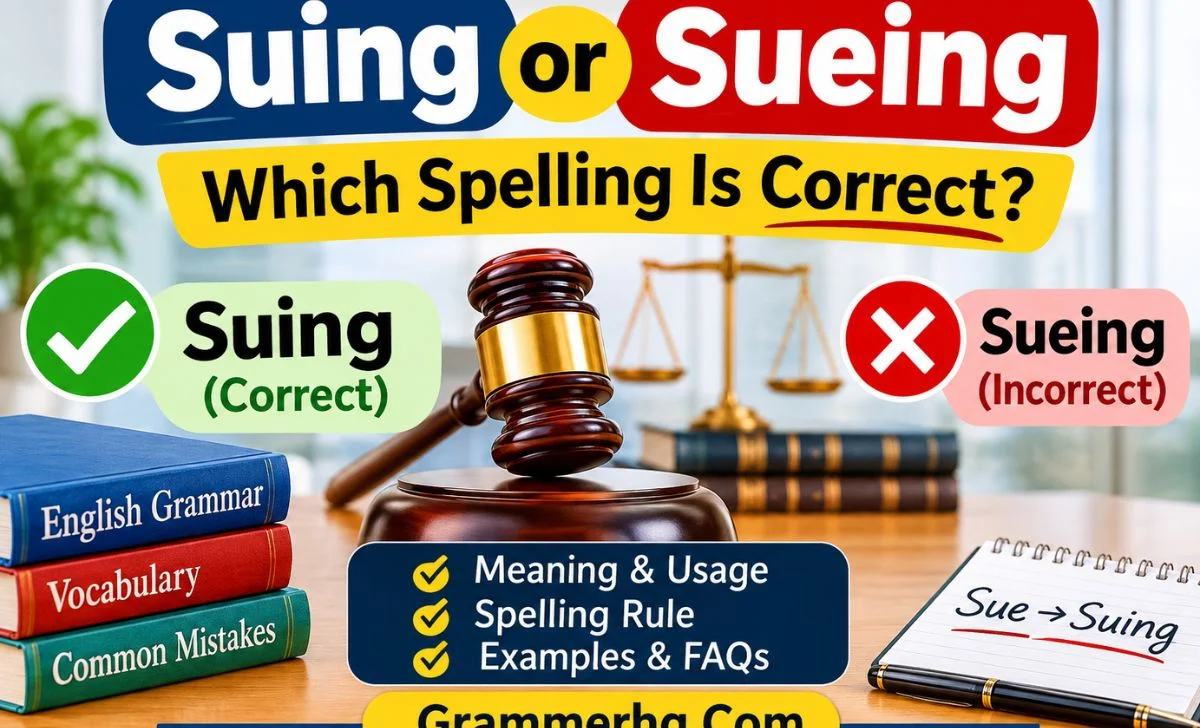
Suing is the correct spelling, while sueing is incorrect. When adding -ing to the verb sue, you must remove the final e before adding the suffix.
Suing means taking legal action against a person, company, or organization through a court. For example, “She is suing the company for damages.” Whether you use American or British English, suing is the only standard spelling.
What Is the Difference Between Suing and Sueing?
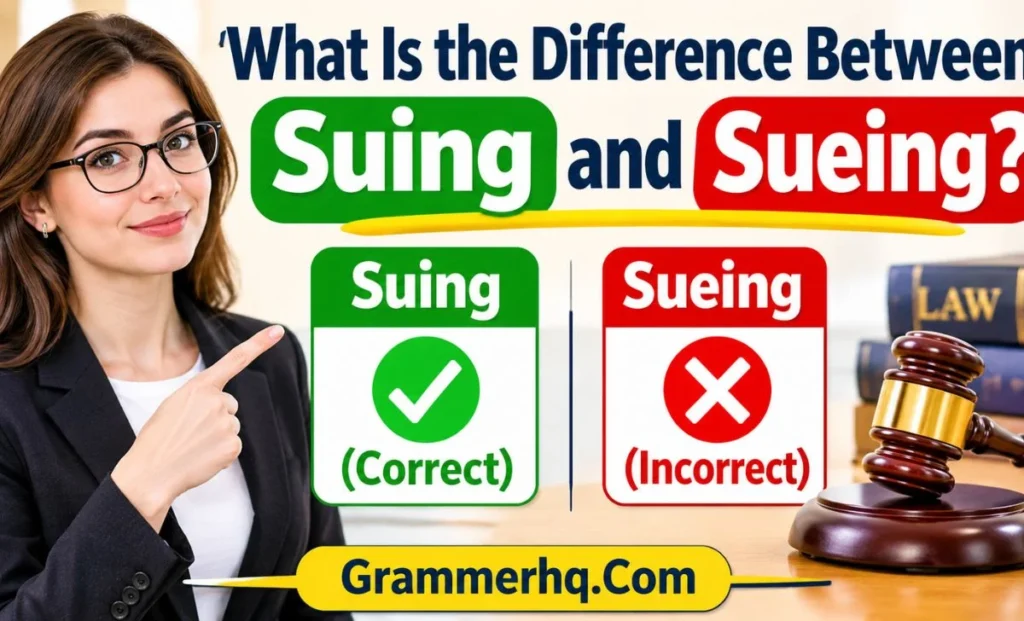
The main difference is spelling: suing is the correct English word, whereas sueing is a common spelling mistake.
Both forms may look reasonable because the original verb is sue. However, English spelling rules require dropping the final silent e before adding -ing.
| Word | Status | Meaning |
|---|---|---|
| Suing | Correct | Taking legal action against someone |
| Sueing | Incorrect | Nonstandard spelling of suing |
Examples:
- Correct: The customer is suing the company for damages.
- Incorrect: The customer is sueing the company for damages.
Remember that suing is used when someone takes legal action or is in the process of pursuing a legal claim. Always use this spelling in formal writing, schoolwork, emails, and professional communication.
What Does Suing Mean?
Suing means taking legal action against someone by bringing a claim before a court. A person may sue another individual, a business, an employer, or an organization when they believe their legal rights have been violated.
For example, someone might sue a company over a defective product, take legal action against an employer over an employment dispute, or bring a claim for financial damages.
Here are some common expressions involving suing:
- Suing a company: Taking legal action against a business.
- Suing an employer: Bringing a legal claim against an employer.
- Suing for damages: Seeking financial compensation through legal proceedings.
- Suing over a contract: Bringing a claim related to an alleged contract violation.
The word does not automatically mean that someone has won a case. It describes taking legal action, not the final outcome.
Why Is Suing Spelled Without an E?
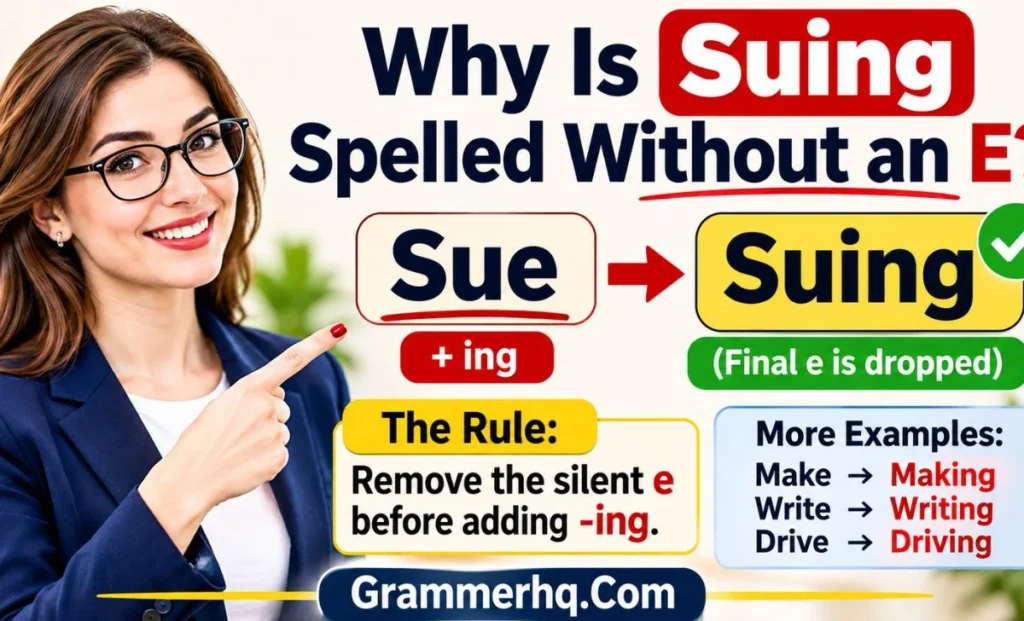
The spelling suing follows an important English spelling rule: when a verb ends in a silent e and you add the suffix -ing, you generally remove the final e.
The rule is simple:
Sue + ing = Suing
The final e disappears before the suffix is added. This is why suing is correct rather than sueing.
You can see the same pattern in other English words:
| Base verb | Correct -ing form |
|---|---|
| Make | Making |
| Write | Writing |
| Drive | Driving |
| Take | Taking |
| Use | Using |
| Sue | Suing |
These examples show why adding -ing does not always mean keeping every letter of the original verb.
One important detail: this is a common spelling pattern, not a rule that applies to every English word ending in e. Some words follow different patterns, such as seeing from see.
When Should You Use Suing?
Use suing when describing someone who is taking legal action, considering a lawsuit, or pursuing a legal claim.
Here are some common situations:
1. Suing a company
A customer may sue a company if they believe its actions caused them harm or financial loss.
Example: The customer is suing the company over a defective product.
2. Suing an employer
An employee may bring a legal claim against an employer over an employment-related dispute.
Example: The former employee is suing her employer over unpaid wages.
3. Suing for damages
Someone may sue another party to seek compensation for an alleged injury or loss.
Example: He is suing for damages after the accident.
4. Considering suing someone
People sometimes consider legal action before deciding whether to file a claim.
Example: They are considering suing their landlord.
5. Threatening to sue
A person may warn someone that they intend to take legal action.
Example: The customer threatened to sue the business.
Keep in mind that threatening to sue and actually filing a lawsuit are not the same thing.
How to Use Suing in a Sentence
The word suing can appear in different sentence structures. These examples show how to use it naturally in everyday and professional English.
- She is suing the company for damages.
- The employee is suing his former employer.
- They are considering suing their landlord.
- The family is suing the hospital over the incident.
- He threatened to sue but never filed a lawsuit.
- Suing can be expensive and time-consuming.
- The business is being sued by a former customer.
- They discussed suing the manufacturer.
- The lawyer advised her about suing the company.
- Suing someone does not guarantee a successful outcome.
Notice that suing can appear after helping verbs, prepositions, and in the subject position of a sentence.
Is Suing a Verb or a Noun?
Suing is an -ing form of the verb sue. Depending on how it is used in a sentence, it can function as a present participle or a gerund.
1. Suing as a present participle
It forms part of a continuous verb tense and describes an ongoing action.
Example: She is suing the company.
Here, is suing describes an action in progress.
2. Suing as a gerund
It functions like a noun in a sentence, even though it comes from a verb.
Example: Suing can be expensive.
Here, suing is the subject of the sentence.
Both uses are grammatically correct. The role of the word depends on the sentence structure.
What Are the Different Forms of Sue?
The verb sue has several forms that are useful in everyday and formal English.
| Verb form | Word | Example |
|---|---|---|
| Base form | Sue | I may sue. |
| Third-person singular | Sues | She sues the company. |
| Past tense | Sued | He sued his employer. |
| Past participle | Sued | They have sued before. |
| Present participle | Suing | She is suing now. |
The important spelling change happens in the present participle: sue becomes suing, not sueing.
Remember that the past tense and past participle are both spelled sued.
Is Suing the Same in American and British English?
Yes. Suing is the standard spelling in both American and British English.
Unlike words such as color and colour or organize and organise, this word does not have different standard regional spellings.
| English variety | Correct spelling | Incorrect spelling |
|---|---|---|
| American English | Suing | Sueing |
| British English | Suing | Sueing |
Whether you are writing for an American audience or a British audience, always use suing.
The same spelling rule applies in both varieties of English.
Suing vs. Being Sued: What Is the Difference?
Although these expressions are closely related, they describe opposite sides of a legal dispute.
- Suing: Bringing a legal claim against another person or organization.
- Being sued: Facing a legal claim brought by someone else.
Consider these examples:
- The customer is suing the company. (The customer is bringing the claim.)
- The company is being sued by the customer. (The company is facing the claim.)
Both sentences describe the same legal dispute from different perspectives.
Understanding this distinction helps you use the word suing correctly when discussing legal situations.
What Are Other Words for Suing?
Depending on the context, several expressions can communicate a similar idea to suing. However, they are not always exact substitutes.
| Word or expression | Meaning |
|---|---|
| Taking legal action | Pursuing a matter through legal procedures |
| Filing a lawsuit | Formally starting a lawsuit |
| Bringing a claim | Presenting a legal claim |
| Pursuing a legal claim | Continuing with a legal case |
| Litigating | Taking part in legal proceedings |
For example, you could write, “She is taking legal action against the company” instead of “She is suing the company.”
Choose the expression that best fits the situation. Some expressions describe the general process, while others refer to a specific legal step.
FAQs
1. Is it suing or sueing?
Suing is correct. Sueing is an incorrect spelling. The final silent e in sue is removed before adding -ing.
2. Why does sue become suing?
English spelling rules generally require removing a verb’s final silent e before adding -ing. Therefore, sue becomes suing.
3. Is sueing ever a correct spelling?
No. Sueing is not an accepted standard spelling in American or British English. The correct form is always suing.
4. Is suing a real word?
Yes. Suing is a standard English word and the present participle or gerund form of the verb sue.
5. How do you pronounce suing?
Suing is pronounced /ˈsuː.ɪŋ/, approximately SOO-ing. It has two syllables.
6. Is suing one word or two?
Suing is one word. It is formed by combining the verb sue with the suffix -ing, after removing the final e.
7. Is suing the same in US and UK English?
Yes. Both American and British English use suing. There is no standard regional spelling difference.
8. Can suing be used as a noun?
Yes. It can function as a gerund, which is a verb form used as a noun. For example, “Suing can be expensive.”
9. What is the past tense of sue?
The past tense of sue is sued. For example, “The customer sued the company last year.”
10. What is the difference between suing and being sued?
Suing means bringing a legal claim against someone. Being sued means facing a legal claim brought by another person or organization.
11. Is suing the same as filing a lawsuit?
They are closely related, but not always identical. Suing describes taking legal action, while filing a lawsuit refers more specifically to formally starting a court case.
12. What is another word for suing?
Depending on the context, alternatives include taking legal action, bringing a claim, and pursuing a legal claim. Filing a lawsuit may also be appropriate in certain situations.
Conclusion
The correct spelling is suing, not sueing. When adding -ing to the verb sue, remove the final silent e to form the correct word.
Suing means taking legal action against someone, and the spelling is the same in American and British English.
Remember the simple pattern: Sue → Suing. Use this spelling in your writing whenever you refer to taking legal action.
Discover More Blogs:
- Of Course or Ofcourse: Correct Spelling, Meaning & Usage?
- Tacet or Tacit: Meaning, Difference, Pronunciation & Usage?
- Weiner or Wiener: Meaning, Difference & Correct Spelling?
- Journies or Journeys: Which Is Correct?