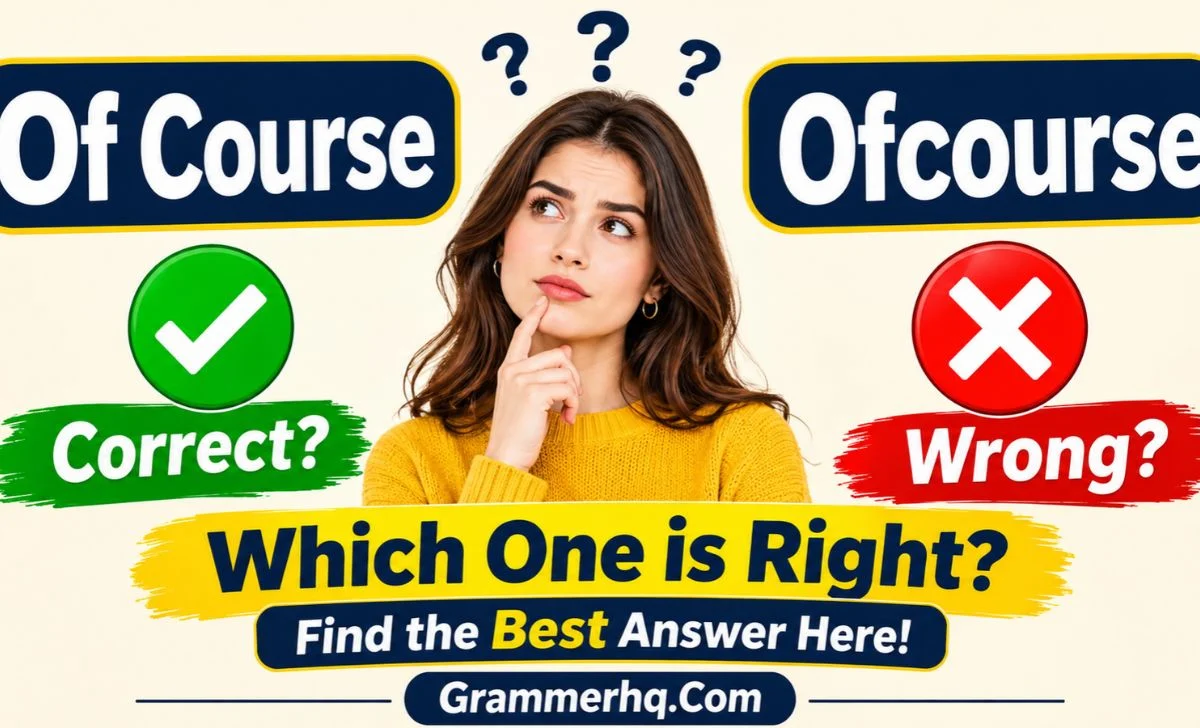
“Of course” is correct. “Ofcourse” is incorrect. The expression is always written as two separate words in standard English.
If you are writing an email, essay, article, school assignment, or professional message, use of course, not ofcourse.
Quick Answer
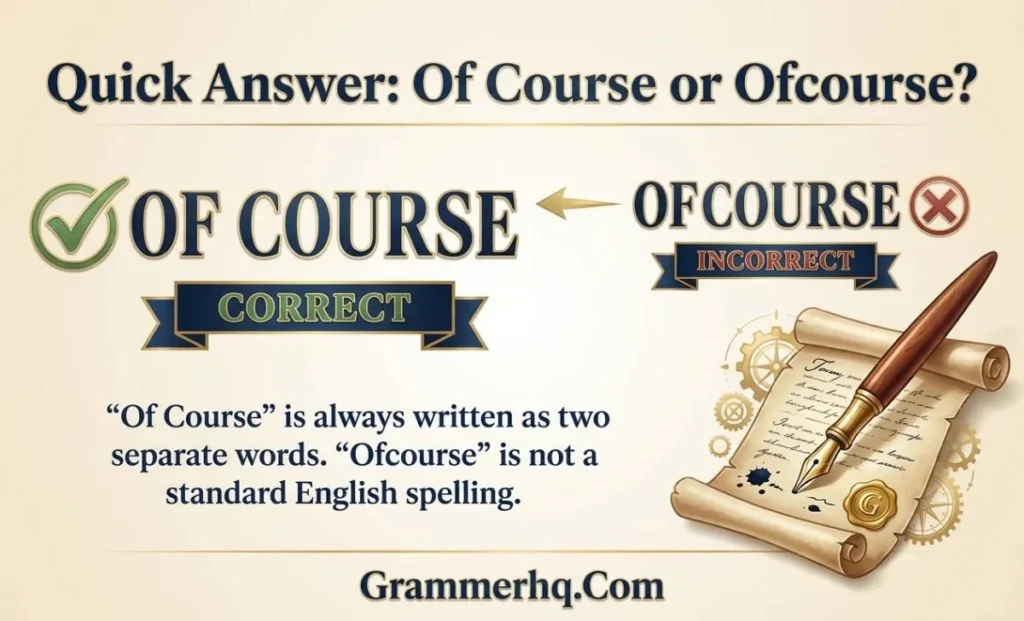
- ✅ Of course — correct
- ❌ Ofcourse — incorrect
- ❌ Ofcourse — nonstandard spelling
Example:
Of course, I can help you.
What Does “Of Course” Mean?
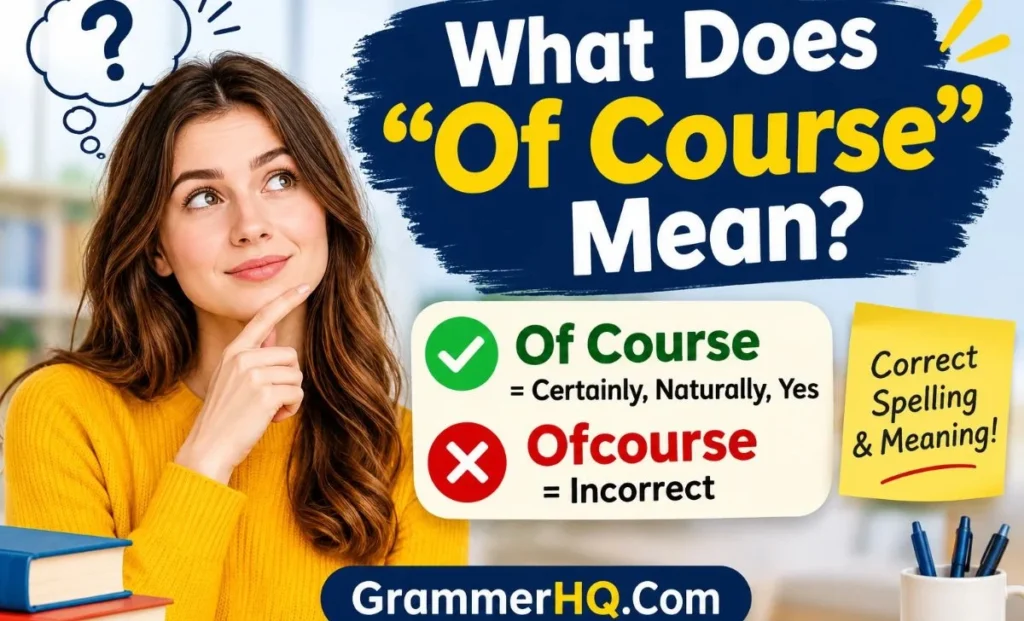
Of course usually means certainly, naturally, definitely, or yes. It can also show permission or that something is expected.
Examples:
“Can I borrow your book?”
“Of course!”
Of course, she knows the answer.
We were tired, of course, after the long journey.
The exact meaning depends on the context.
Why Is “Ofcourse” Wrong?
Ofcourse is a common spelling mistake caused by the way the phrase sounds when spoken quickly. The two words can sound closely connected, but they are still written separately.
Think of it simply:
of + course = of course
There is a space between the two words.
How Do You Use “Of Course”?
You can use of course at different points in a sentence.
At the beginning:
Of course, I’ll help you.
In the middle:
She will, of course, arrive soon.
At the end:
I can help you, of course.
It works in both everyday conversation and professional writing.
Does “Of Course” Need a Comma?
Not always.
When of course is used as an introductory or parenthetical expression, a comma is often appropriate:
Of course, I understand.
She will, of course, be there.
But a comma is not automatically required every time the phrase appears. The punctuation depends on how the expression functions in the sentence.
Of Course vs. Off Course
These expressions have completely different meanings.
Of course = certainly, naturally, or yes.
Of course, you can come with us.
Off course = away from the planned route or direction.
The boat went off course.
And remember:
Ofcourse = incorrect spelling.
Is “Of Course” Formal or Informal?
Both. You can use it in casual conversation as well as professional writing.
Of course, I would be happy to assist you.
However, tone matters. In some situations, “of course” can sound dismissive if it suggests that the answer should have been obvious. So consider the context before using it as a response.
What About “Ofc”?
Ofc is an informal abbreviation for of course, commonly used in texts, chats, and social media.
“Are you coming?”
“Ofc!”
It is fine for casual digital communication, but of course is the better choice for formal or professional writing.
Common Examples
- Of course, I remember you.
- Of course, you can use my laptop.
- “Will you join us?” “Of course!”
- She was, of course, surprised.
- Of course, there is another option.
FAQs
Is “ofcourse” a word?
No. Ofcourse is not the standard spelling. Write of course as two words.
Is “of course” one word or two?
It is two words: “of course.”
Is “of course” correct English?
Yes. Of course is standard English and is commonly used to express certainty, agreement, permission, or expectation.
Can I use “of course” in a formal email?
Yes. It is acceptable in professional and formal writing when the context and tone are appropriate.
Is “off course” the same as “of course”?
No. Of course means certainly or naturally, while off course means away from the intended direction.
How can I remember the spelling?
Remember one simple rule:
Of course = two words.
Final Answer
Of course is the correct spelling, while ofcourse is incorrect in standard English because the expression must be written as two separate words.
Of course means “certainly,” “naturally,” “definitely,” or “yes,” depending on the context, whereas ofcourse is simply a misspelling and should be corrected to of course in formal and everyday writing.
Do not confuse it with off course, which is a different phrase meaning away from the planned route or direction. The easiest rule to remember is simple: when you mean “certainly” or “yes,” always write of course with a space.
Read More Blogs:
- Pre vs. Post: What’s the Difference?
- Hustle or Hussle: Which Spelling Is Correct?
- Liter or Litre: Which Spelling Is Correct in US and UK English?
- Title vs. Tittle: What’s the Difference?