Understanding leafs vs leaves is easier when you know whether the word refers to plant parts, an action, or a proper name.
Leafs is also a correct English word in specific contexts, such as the verb “leafs through a book” or the official name Toronto Maple Leafs.
Understanding the difference will help you choose the right spelling in everyday writing, schoolwork, and professional communication.
Quick Answer: Leafs vs Leaves
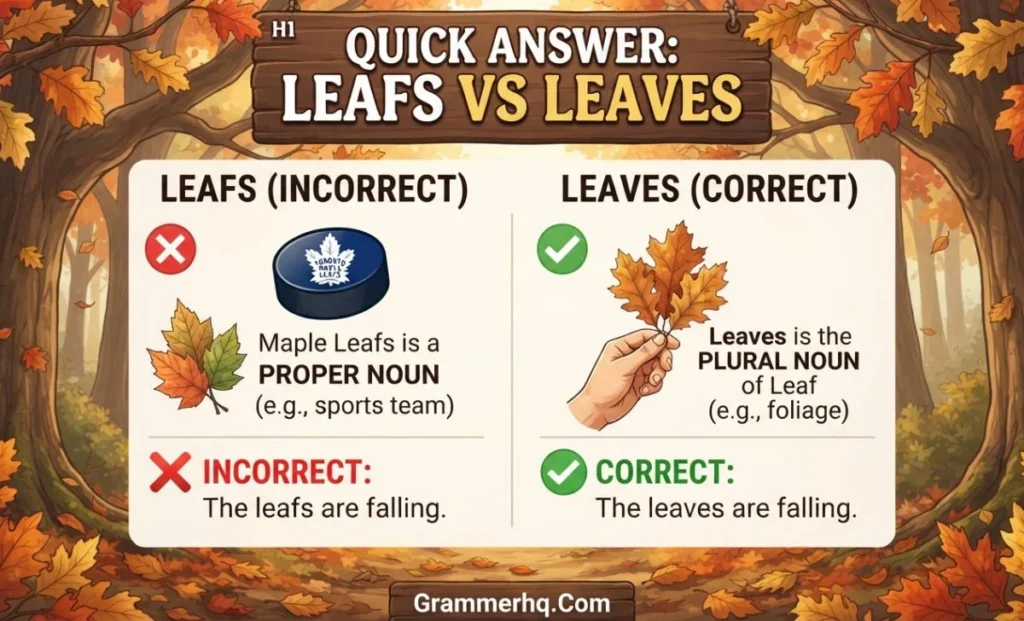
| Word | Correct use | Example |
|---|---|---|
| Leaf | Singular noun | A leaf fell from the tree. |
| Leaves | Plural noun | The tree has green leaves. |
| Leafs | Verb or part of a proper name | She leafs through a magazine. |
Easy rule: One leaf, several leaves. Use leafs when the sentence calls for the verb leaf or when writing an official name that uses that spelling.
What Is the Difference Between Leafs and Leaves?
The difference is mainly grammatical. Leaves is the standard plural of the noun leaf, while leafs is the third-person singular present-tense form of the verb leaf.
Leaves as a plural noun
A leaf is usually the flat part of a plant that grows from a stem or branch. When there is more than one, the plural is leaves.
Examples:
- The tree has bright green leaves.
- Fallen leaves covered the driveway after the storm.
- She collected red and yellow leaves for her school project.
- The gardener removed the dead leaves from the flower beds.
The word can also refer to certain flat sections of other objects, such as a leaf in a book or an extendable table. In these cases, leaves is still the standard plural.
Leafs as a verb
The verb to leaf means to turn the pages of a book, magazine, or similar publication, often casually or quickly. When the subject is he, she, or it, the verb becomes leafs.
Examples:
- She leafs through her notes before an exam.
- He leafs through an old magazine in the waiting room.
- My father leafs through the newspaper after breakfast.
In each sentence, leafs describes an action. It does not mean multiple leaves growing on a plant.
Why Does Leaf Change to Leaves?
English has several nouns that change their ending when they become plural. In many cases, a noun ending in -f or -fe changes to -ves. This is the pattern used by leaf → leaves.
Here are some common examples:
| Singular | Plural |
|---|---|
| Leaf | Leaves |
| Knife | Knives |
| Wife | Wives |
| Life | Lives |
| Wolf | Wolves |
| Shelf | Shelves |
| Loaf | Loaves |
| Thief | Thieves |
However, not every noun ending in -f follows this pattern.
| Singular | Plural |
|---|---|
| Roof | Roofs |
| Chief | Chiefs |
| Belief | Beliefs |
| Cliff | Cliffs |
These examples show why it is better to learn the established plural form of each word rather than assume that every -f ending changes to -ves.
For confirmation, the Cambridge Dictionary entry for leaf identifies leaves as its plural.
definition in the Cambridge English Dictionary
When Is Leafs Correct?
Although leafs is not the standard plural noun for a plant leaf, it is correct in particular contexts.
1. When someone leafs through a book
To leaf through something means to turn its pages quickly, usually without reading every word carefully.
Examples:
- She leafs through her textbook before class.
- He leafs through a magazine while waiting for his appointment.
- My mother leafs through an old photo album to find family pictures.
In these sentences, leafs is a verb describing an action. Cambridge Dictionary recognizes this use in both British and American English.
Cambridge English Dictionary
2. In the name Toronto Maple Leafs
The Toronto Maple Leafs are a professional Canadian ice hockey team. Leafs is part of the team’s official name, so it should remain unchanged.
Examples:
- The Toronto Maple Leafs played at home last night.
- My friend has supported the Maple Leafs for years.
This is a proper-name use, not the ordinary plural form of the plant noun leaf. The team’s official website confirms the name.
Toronto Maple Leafs
3. When a plant produces new leaves
The verb leaf can also describe a plant developing or putting out leaves. Its form changes according to the subject and tense.
Examples:
- The tree leafs out in spring.
- The shrubs leafed out after the warm weather arrived.
- The plants are leafing out in the garden.
Here, leafs is a verb. If you are counting the green parts growing on a plant, however, the plural noun is still leaves.
Leaves as a Noun vs. Leaves as a Verb
The word leaves can also be a verb. It is the third-person singular present-tense form of leave, which can mean to depart or to let something remain in a place.
| Sentence | Grammatical use |
|---|---|
| The tree has green leaves. | Plural noun: parts of a plant |
| She leaves home at seven. | Verb: departs from home |
| He leaves his keys on the desk. | Verb: lets the keys remain there |
| She leafs through a book. | Verb: turns the pages |
Notice the difference between leaves and leafs. In She leaves home, the verb is leave. In She leafs through a book, the verb is leaf.
A quick way to remember: If the sentence is about multiple plant parts, use leaves. If someone is turning pages, use leafs. If someone is departing, use leaves as a form of leave.
Leafs vs. Leaves: Real-Life Examples
The easiest way to learn the difference is to see both words in everyday situations.
Correct uses of leaves
- The oak tree drops its leaves in autumn.
- Wet leaves covered the sidewalk after the rain.
- The gardener removed the yellow leaves from the plant.
- My daughter pressed colorful leaves between sheets of paper for a school project.
- Fresh basil leaves give the pasta a wonderful flavor.
- Several leaves had fallen into the garden pond.
Correct uses of leafs
- She leafs through her notes before an important meeting.
- He leafs through the newspaper over breakfast.
- The Toronto Maple Leafs have fans across Canada.
- The tree leafs out when spring arrives.
Common mistakes and corrections
| Incorrect | Correct |
|---|---|
| The tree has many leafs. | The tree has many leaves. |
| I collected five leafs for my project. | I collected five leaves for my project. |
| She leaves through the magazine. (meaning she turns its pages) | She leafs through the magazine. |
| The garden was covered with leafs. | The garden was covered with leaves. |
The third example is especially useful. Leaves through could have a different meaning in another sentence, but it does not express the action of turning pages. For that meaning, the correct phrase is leafs through.
Is It Leafs or Leaves in American and British English?
The spelling difference in leafs vs leaves remains the same in both American and British English: leaves is the standard plural noun, while leafs can describe the action of turning pages.
For example:
- American English: The leaves are turning red.
- British English: The leaves are turning red.
Both sentences use the same spelling. The verb leafs also works in both varieties when someone turns through the pages of a book or magazine.
If you are writing for an American or British audience, use leaves when referring to multiple plant leaves. You do not need to change the spelling to match the country.
FAQs
1. What is the plural of leaf?
The key difference in leafs vs leaves is that leaves is the standard plural of leaf, while leafs is used as a verb or in certain proper names.
2. Is leafs a real word?
Yes, leafs is a real English word. It is the third-person singular form of the verb leaf, as in She leafs through a magazine. It also appears in proper names, including the Toronto Maple Leafs.
3. Why does leaf change to leaves?
Leaf follows an established English plural pattern in which the final -f changes to -ves. Similar examples include knife → knives and wolf → wolves. However, this pattern does not apply to every word ending in -f.
4. Can I use leafs when talking about trees?
Not as the standard plural noun. If you mean multiple parts growing on a tree, use leaves. For example, write The tree has green leaves, not The tree has green leafs.
5. Is it leafs or leaves in a sentence?
It depends on the meaning. Use leaves for the plural noun, as in The leaves fell from the tree. Use leafs for the page-turning verb, as in He leafs through a book.
6. Is leaves also a verb?
Yes. Leaves is the third-person singular present-tense form of leave. For example, She leaves work at five means she departs from work at five.
7. What is the difference between leafs and leaf’s?
Leafs can be a verb or part of a proper name, while leaf’s is the possessive form of the singular noun leaf. For example, The leaf’s edge is brown means the edge belonging to one leaf is brown.
8. Is leafs ever correct as a plural noun?
Leaves is the standard plural for the ordinary noun leaf. Although leafs may appear in specialized or nonstandard contexts, it is not the normal choice in everyday writing when referring to several plant leaves.
9. Is it leafs or leaves in American English?
Use leaves as the plural noun in American English. Leafs is used for the verb meaning to turn pages and in proper names such as the Toronto Maple Leafs.
10. Is it leafs or leaves in British English?
British English also uses leaves as the standard plural of leaf. The same distinction applies: leafs through a book, but leaves on a tree.
11. What is the plural of maple leaf?
The ordinary plural is maple leaves. However, the official name of the Canadian hockey team is the Toronto Maple Leafs, so its name retains Leafs.
12. How can I remember whether to use leafs or leaves?
Remember this simple distinction: one leaf, many leaves. Use leafs when someone turns through pages, as in She leafs through a magazine. Checking what the word means in the sentence is the easiest way to choose correctly.
Conclusion
When deciding between leafs vs leaves, check the meaning of the word in your sentence rather than relying on spelling alone. Leafs is correct in specific contexts, particularly as a verb or in an official name such as the Toronto Maple Leafs.
Remember the simple rule: one leaf, several leaves. When you encounter leafs, check whether it describes an action or belongs to a proper name.
This distinction will help you choose the correct spelling in everyday writing, schoolwork, and professional communication.
Editorial reference sources: Cambridge Dictionary: Leaf · Cambridge Dictionary: Leaf through · Official Toronto Maple Leafs history
Read More Blogs
- Die vs Dice: What’s the Difference? Meaning, Rules & Examples
- Artefact vs Artifact: Which Spelling Is Correct?