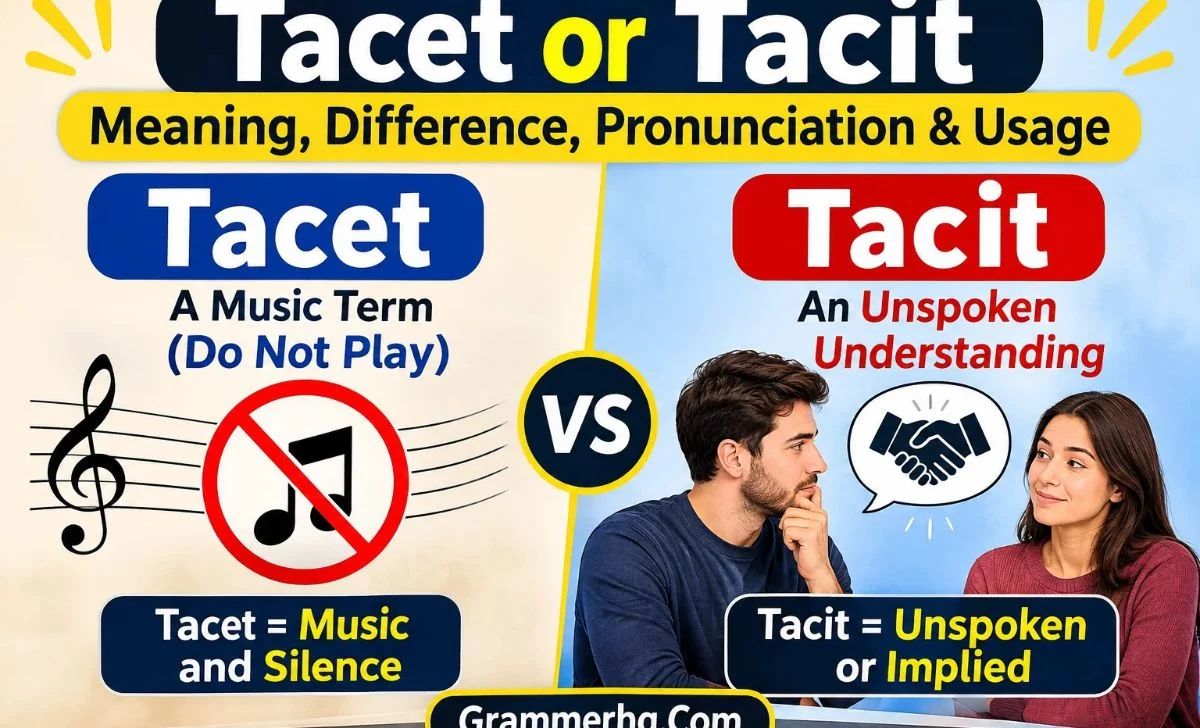
Tacet and tacit look similar, but they do not mean the same thing. Tacet is mainly a music term used when a performer should remain silent, while tacit describes something understood without being directly stated.
Their pronunciation differs too, which can make the spelling easier to remember. Whether you are writing for an American or British audience, knowing the meaning, pronunciation, and correct usage of each word will help you choose tacet or tacit with confidence.
Tacet or Tacit: Quick Answer
Tacet means “do not play or sing” in music.
Tacit means unspoken, implied, or understood without direct words.
In short:
Tacet = music and silence
Tacit = unspoken or implied
These words have different meanings, so you cannot use them interchangeably.
What Does “Tacet” Mean?
Tacet is a musical instruction. A composer or conductor can use it when an instrument or voice should remain silent during part of a musical work.
For example:
The trumpet is tacet during the second movement.
Here, the trumpet does not play during that section.
You may find tacet on a musical score or an individual performer’s part. The term mainly appears in music rather than everyday conversation.
What Does “Tacit” Mean?
Tacit describes something that people understand or accept without stating it openly.
For example:
They reached a tacit agreement.
Her silence showed tacit approval.
The two teams shared a tacit understanding.
In each example, the people involved understand something without expressing it directly.
As a result, tacit works naturally in everyday, professional, academic, and business English.
Tacet vs. Tacit: Key Difference
| Word | Meaning | Main Use |
|---|---|---|
| Tacet | Do not play or sing | Music |
| Tacit | Unspoken or implied | General English |
Therefore, choose tacet when you are talking about music.
By contrast, choose tacit when you mean an unspoken agreement, understanding, approval, or assumption.
Tacet vs. Tacit Pronunciation
Pronunciation also helps separate these two words.
- Tacet: commonly pronounced TAY-set
- Tacit: commonly pronounced TASS-it
So, although the spellings look similar, the words have different sounds and meanings.
American vs. British English
Both words work in American and British English.
The spelling stays the same in both varieties, and the meanings do not change. Tacit commonly appears in phrases such as tacit agreement and tacit approval.
Meanwhile, tacet remains mainly a music term in both varieties.
Therefore, you do not need to remember a US-versus-UK spelling difference for these words. Instead, focus on their meanings and contexts.
Common Mistake
Writers sometimes choose tacet when they actually mean tacit.
Incorrect:
They had a tacet agreement.
Correct:
They had a tacit agreement.
The correct choice is tacit because the sentence describes an unspoken agreement, not a musical instruction.
How to Remember the Difference
Use this simple memory trick:
Tacet → Music → Do not play
Tacit → Unspoken → Implied
Once you connect tacet with music, the difference becomes much easier to remember.
Final Answer
Use tacet for musical silence:
The violin is tacet in this section.
Use tacit for something people understand without directly saying it:
They reached a tacit agreement.
So, tacet belongs mainly to music, while tacit describes something unspoken or implied.
FAQs
Is tacet the same as tacit?
No. Tacet is mainly a musical instruction, whereas tacit means unspoken or implied.
How do you pronounce tacet?
In American English, tacet is commonly pronounced TAY-set.
How do you pronounce tacit?
In American English, tacit is commonly pronounced TASS-it.
Is “tacit agreement” correct?
Yes. Tacit agreement refers to an agreement that people understand without stating it directly.
Do American and British English spell these words differently?
No. Tacet and tacit have the same spelling in American and British English.
Which word should I use for music?
Use tacet when a musical score tells a performer not to play or sing.
Which word should I use for an unspoken agreement?
Use tacit, as in tacit agreement or tacit understanding.
Read More Blogs:
- Hoody or Hoodie: Which Spelling Is Correct?
- Bored vs Bord: Which Spelling Is Correct?
- Spicket or Spigot: Which Spelling Is Correct?
- Choosing vs Chosing: Which Spelling Is Correct?

Hi, I’m Amelia Parker, a grammar enthusiast and writer at GrammarHQ.com. I specialize in explaining spelling differences, confusing words, and common English mistakes through simple, practical, and easy-to-understand guides.