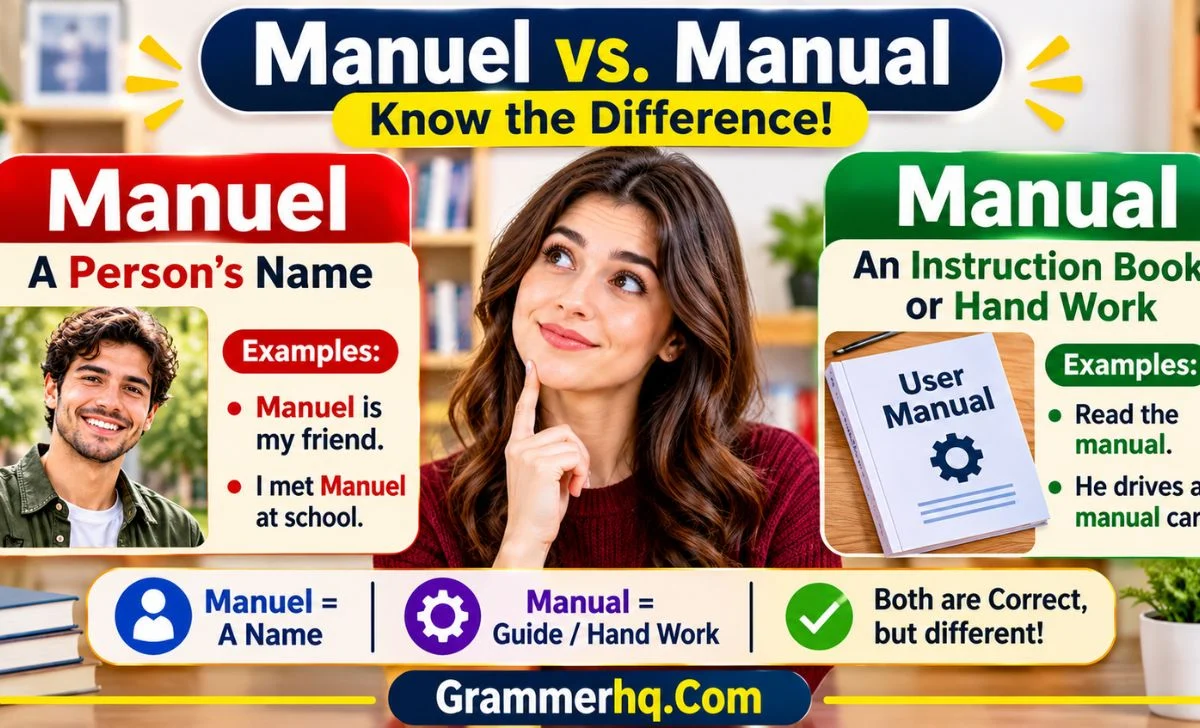
Have you ever wondered about the difference between Manuel vs. Manual? Although these two words look and sound similar, they have completely different meanings.
Manuel is a male personal name, while manual is an English word that refers to an instruction book, something operated by hand, or work that requires physical effort.
Both spellings are correct, but they are used in different situations. Understanding when to use each word will help you avoid spelling mistakes and communicate more clearly in everyday writing.
Manuel vs. Manual: Quick Answer
Manuel is a person’s name, while manual is a word used for instructions or something done by hand. The main difference is simple: use Manuel when referring to someone named Manuel, and use manual when talking about a guide, a process performed by hand, or equipment that requires human control.
For example:
- Manuel: Manuel joined our team last week.
- Manual: The technician checked the machine’s manual before repairing it.
Easy way to remember: If you are talking about a person, write Manuel. If you mean an instruction guide or something done by hand instead of automatically, write manual. Both spellings are correct, but they have different meanings and cannot be used in place of each other.
What Does Manuel Mean?
Manuel is a masculine personal name commonly used in Spanish and Portuguese-speaking communities. It is a form of the name Emmanuel, which has Hebrew roots and is commonly understood to mean “God is with us.”
Unlike an ordinary English vocabulary word, Manuel is a proper noun. This means it identifies a particular person and should begin with a capital letter.
For example, if a student, teacher, or colleague is named Manuel, you should always write their name with a capital M.
Real-life examples:
- Manuel works at a local hospital.
- My friend Manuel lives in Spain.
- Manuel helped his brother with his homework.
- I received an email from Manuel yesterday.
In each sentence, Manuel identifies a person. It does not describe an activity or refer to a book.
Remember: Manuel is a correct spelling when you are writing someone’s name. It is not a misspelling of manual.
What Does Manual Mean?
Manual is a common English word with several meanings. It can function as a noun or an adjective, depending on the sentence.
As a noun, a manual is a book or document containing instructions about how to use, repair, or operate something. You may find manuals with computers, phones, vehicles, household appliances, and other equipment.
For example, if you purchase a new washing machine, the manufacturer may provide a manual explaining how to install it, select washing programs, and maintain it.
As an adjective, manual describes something done by hand or controlled by a person instead of operating automatically. It is also used for physical work that requires human effort.
Real-life examples:
- Read the manual before installing the software.
- My father prefers driving a manual car.
- The workers completed the manual sorting process.
- She entered the information manually instead of using a computer program.
In these sentences, manual describes an instruction guide, a type of car, a human-controlled process, and an activity done by hand.
When Should You Use Manuel?
Use Manuel when referring to a person whose given name is Manuel. It is especially common in Spanish and Portuguese-speaking communities, although people with this name live in many parts of the world.
Because Manuel is a proper noun, its first letter should always be capitalized when you write the person’s name.
Here are situations where Manuel is the correct choice:
1. Talking About a Friend
If your friend’s name is Manuel, use this spelling when talking about him.
Example: Manuel invited me to his birthday party.
2. Writing About a Student or Teacher
Use Manuel when identifying someone in a school or educational setting.
Example: Manuel submitted his assignment before the deadline.
3. Writing a Professional Message
If you are sending an email to someone named Manuel, use their correct name.
Example: Dear Manuel, thank you for your response.
4. Mentioning Someone in a Story
When a character or real person is named Manuel, keep the same spelling throughout the story.
Example: Manuel walked into the office and greeted his colleagues.
The important rule is simple: if you are referring to a person named Manuel, do not replace the name with manual.
When Should You Use Manual?
Use manual when referring to an instruction guide, something operated by hand, or work that requires physical effort.
It is useful in everyday conversations, education, technology, workplaces, and discussions about vehicles.
1. For Instruction Books
Use manual when talking about a guide that explains how to use a product or complete a task.
Example: I read the camera manual before taking pictures.
2. For Cars and Vehicles
Use manual to describe a vehicle with gears that the driver changes using a gear lever. This is often called a manual transmission.
Example: My brother learned to drive a manual car last year.
3. For Physical Work
Use manual when describing work that involves physical effort or the use of hands.
Example: My uncle has a manual labor job at a construction company.
4. For Activities Done by Hand
Use manual when an activity is performed by a person rather than automatically by a machine or computer.
Example: The office still uses manual data entry for some records.
In all these situations, manual is the correct word. Writing Manuel would change the meaning and could confuse your reader.
Manuel vs. Manual: Key Differences
Understanding Manuel vs. Manual becomes easier when you remember that Manuel is a person’s name, whereas manual describes instructions, hand-operated equipment, or work performed by hand.
| Feature | Manuel | Manual |
|---|---|---|
| Meaning | A person’s name | Instructions or something done by hand |
| Word type | Proper noun | Noun and adjective |
| Capitalization | Usually starts with a capital M | Usually lowercase |
| Common use | Names and personal references | Books, machines, work, and processes |
| Example | Manuel is my friend. | Read the manual. |
The biggest difference is that Manuel identifies a person, while manual describes an object, activity, or process. Remembering this distinction makes it much easier to choose the correct spelling.
Manuel vs. Manual: Spelling and Pronunciation
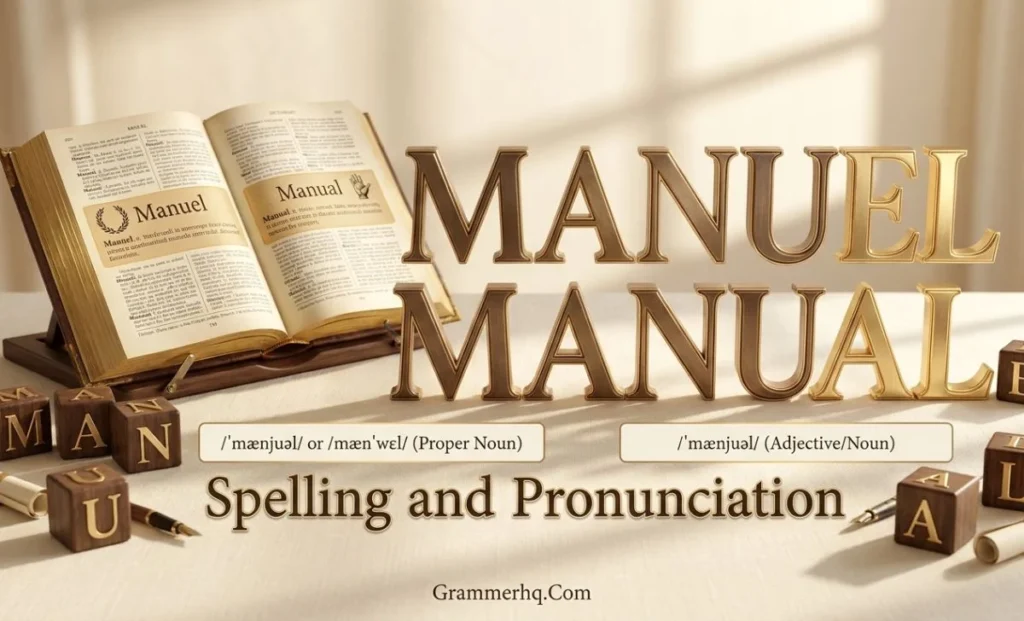
Both words contain six letters and begin with the same five letters: M, A, N, U, and E. However, their final letters are different.
- Manuel: M-A-N-U-E-L
- Manual: M-A-N-U-A-L
The easiest way to remember the spelling is to focus on the final three letters. Manuel ends in -uel, while manual ends in -ual.
Their pronunciation can also differ. Manual is commonly pronounced MAN-yoo-uhl in both American and British English.
Manuel has different pronunciations depending on the language and the person’s preferred pronunciation. In Spanish, it is commonly pronounced mah-NWEL.
Although the words look similar, they should not be treated as interchangeable.
Common Mistakes to Avoid
People sometimes confuse Manuel and manual because they have similar spellings. However, using the wrong word can change the meaning of an entire sentence.
Here are some common mistakes and their corrections:
| Incorrect | Correct | Why? |
|---|---|---|
| Please read the Manuel. | Please read the manual. | An instruction book is a manual. |
| My friend is named Manual. | My friend is named Manuel. | Manuel is the person’s name. |
| I drive a Manuel car. | I drive a manual car. | Manual describes the type of transmission. |
| Manuel work requires physical effort. | Manual work requires physical effort. | Manual describes work done by hand. |
Helpful tip: Before choosing a spelling, ask yourself whether you are talking about a person or something related to instructions and hand-operated work. This simple question can prevent most mistakes.
FAQs
1. Is Manuel a correct English word?
Manuel is a valid personal name used in many languages, including Spanish and Portuguese. However, it is not the standard English word for an instruction book or something done by hand. For those meanings, use manual.
2. Is Manuel the same as Manual?
No. Manuel is a person’s given name, while manual is an English noun or adjective. For example, “Manuel bought a manual” uses both words correctly because one identifies a person and the other identifies an instruction book.
3. How do you spell Manual correctly?
The correct spelling is M-A-N-U-A-L. It ends with the letters U-A-L. Use this spelling when referring to an instruction book, a manual car, or work performed by hand.
4. What is the meaning of Manuel?
Manuel is a masculine given name and a form of Emmanuel. Its name meaning is commonly given as “God is with us.” It is especially popular in Spanish and Portuguese-speaking cultures.
5. Is Manual a noun or an adjective?
Manual can be both a noun and an adjective. As a noun, it means an instruction book or guide. As an adjective, it describes something done by hand, controlled by a person, or involving physical work.
6. Is Manual spelled differently in American and British English?
No. Manual has the same spelling in American and British English. However, some related words differ, such as American English “labor” and British English “labour.” The word manual itself does not change.
7. What is the difference between a manual and an automatic car?
A manual car requires the driver to change gears using a gear lever, while an automatic car changes gears without the driver manually selecting each gear. Both are common types of vehicle transmissions.
8. Can Manuel be used instead of Manual?
No. These words have different meanings. You can use Manuel for a person’s name, but you should use manual when referring to an instruction guide or something operated by hand.
Conclusion
Understanding Manuel vs. Manual is simple once you know what each word means. Manuel is a personal name, while manual refers to an instruction book, hand-operated equipment, or work done by hand. Both spellings are correct, but the right choice depends on the meaning of your sentence.
Remember this simple rule: Manuel is a name, and manual is an English word for instructions or something done by hand. Use the correct spelling, and your writing will be clear and accurate.
Discover More Blogs:
- Meating vs Meeting: What’s the Difference?
- Email vs Gmail: What’s the Difference and Which Should You Use?
- Molding vs Moulding: American vs British English Explained
- Couch or Coach: Easy Explanation with Real Examples?