Long Term or Longterm: The correct forms are long term (two words) and long-term (with a hyphen). The one-word spelling longterm is not standard English.
Use long term when referring to an extended period, as in “in the long term.” Use long-term when it describes a noun, as in “a long-term investment.”
Both forms communicate the idea of something lasting or continuing for an extended period, but their grammatical roles determine which spelling to choose.
What Is the Difference Between Long Term, Long-Term, and Longterm?

These three spellings look similar, but only two are accepted in standard English. The difference is mainly grammatical rather than semantic.
| Form | Correctness | Usage |
|---|---|---|
| Long term | Correct | Noun phrase referring to an extended period |
| Long-term | Correct | Compound adjective describing a noun |
| Longterm | Incorrect | Not a standard English spelling |
Examples:
- Long term: We are considering the long term before making a decision.
- Long-term: The company needs a long-term growth strategy.
- Longterm: The company needs a longterm growth strategy. (Incorrect)
The hyphen connects long and term when they work together as a descriptive unit. Without it, the expression can function as a noun phrase.
What Does Long Term Mean?
Long term means an extended period of time or the distant future. It describes something that continues, develops, or produces results over a considerable period rather than happening immediately.
The expression is common in several areas of everyday life:
- Finance: Long-term savings and investments.
- Education: Goals that require years of learning.
- Healthcare: Effects that continue after treatment.
- Business: Strategies designed for future growth.
- Relationships: Commitments intended to last.
For example, someone who starts saving money for retirement is thinking about the long term. Similarly, a business that invests in employee development may expect long-term benefits.
When Should You Use Long Term (Two Words)?
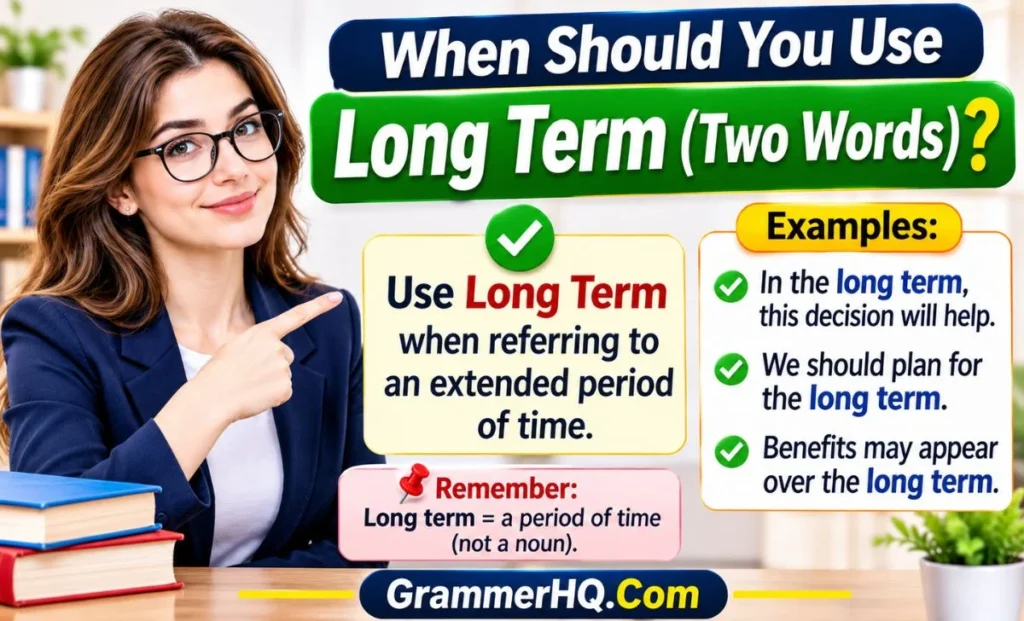
Use long term when the expression functions as a noun phrase and refers to a period of time. It frequently appears after prepositions such as in, over, and for.
Common expressions include:
- In the long term
- Over the long term
- For the long term
- The long term
Sentence examples:
- In the long term, regular exercise can improve overall fitness.
- We should evaluate the financial consequences over the long term.
- She is building a career that will support her in the long term.
- The organization needs to consider the long term before changing its policies.
In each sentence, the expression refers to a period rather than describing a particular noun.
When Should You Use Long-Term (With a Hyphen)?
Use long-term when the two words combine to describe a noun. This grammatical structure is called a compound adjective.
The hyphen shows that long and term work together rather than independently.
Sentence examples:
- The patient requires long-term care.
- They are looking for a long-term business partner.
- The university introduced a long-term research program.
- Good financial habits can support long-term stability.
Here, long-term describes care, partner, program, and stability.
A useful grammar rule: When the compound expression appears directly before a noun as a descriptive modifier, use the hyphen. This is the usual convention in standard edited English.
When the expression follows a linking verb, the open form is commonly used:
- Their plans are long term.
- The benefits may be long term.
- These effects could become long term.
Some publishers and style guides retain the hyphen in certain after-the-verb constructions. Follow the relevant publication’s style consistently.
Why Is Longterm Incorrect?
Longterm is an incorrect spelling in standard English because the expression has not become an accepted single-word form.
The mistake usually happens when writers assume that two frequently used words should be combined. However, frequency does not determine correct spelling.
Compare these incorrect and correct sentences:
| Incorrect | Correct |
|---|---|
| We need a longterm solution. | We need a long-term solution. |
| Think about the longterm. | Think about the long term. |
| She has longterm career goals. | She has long-term career goals. |
| The effects may last in the longterm. | The effects may last in the long term. |
For essays, business documents, website articles, and professional emails, avoid the one-word version.
Long Term vs. Long-Time vs. Longtime: Are They Different?
Yes. These expressions are related to duration, but they do not have the same meaning or grammatical function.
- Long term: Refers to an extended period. Example: We are planning for the long term.
- Long-time: A hyphenated adjective sometimes used before a noun. Example: He is a long-time customer.
- Longtime: A single-word adjective meaning having existed or continued for a long period. Example: They are longtime friends.
- Long time: A noun phrase referring to a considerable duration. Example: I have known her for a long time.
These distinctions matter because replacing one expression with another can change the meaning of a sentence.
What Are the Word Forms and Related Expressions?
Understanding the individual word long can help readers recognize related forms without confusing them with long term.
| Word | Part of speech | Meaning |
|---|---|---|
| Long | Adjective | Having great length or duration |
| Longer | Comparative adjective | More extended in length or time |
| Longest | Superlative adjective | Greatest in length or duration |
| Long-term | Compound adjective | Continuing over an extended period |
| Term | Noun | A fixed period or a particular word or expression |
For example:
- Long: We had a long meeting.
- Longer: This meeting was longer than yesterday’s.
- Longest: It was the longest meeting of the week.
- Long-term: They need a long-term solution.
Notice that longer and longest are grammatical forms of long. They are not alternative spellings of long term.
What Are the Synonyms of Long Term?
The best alternative depends on the sentence and the meaning you want to communicate.
Synonyms for the noun phrase:
- Extended period
- Long run
- Distant future
- Longer period
Related adjectives:
- Lasting
- Extended
- Sustained
- Enduring
- Long-lasting
For example:
- Original: We need to consider the long term.
- Alternative: We need to consider the long run.
Another example:
- Original: The company needs a long-term strategy.
- Alternative: The company needs a lasting strategy.
These expressions are not interchangeable in every context, so choose an alternative that preserves the intended meaning.
How Do You Pronounce Long Term?
The expression long term has two syllables in connected speech, with the main stress on term.
- American English (US): /ˌlɔːŋ ˈtɝːm/
- British English (UK): /ˌlɒŋ ˈtɜːm/
The pronunciation is essentially the same whether you write long term or long-term. The hyphen changes the written grammatical structure, not the pronunciation.
Is Long Term Used Differently in American and British English?
No. American and British English generally follow the same spelling and hyphenation conventions for this expression.
Both varieties use:
- Long term for the noun phrase.
- Long-term for the compound adjective.
- Longterm as a nonstandard spelling.
For example:
- American English: The company is developing a long-term investment plan.
- British English: The company is developing a long-term investment plan.
There is no separate American or British spelling to memorize.
FAQs
1. Is long term one word or two?
Long term is written as two words when it functions as a noun phrase. When it describes a noun as a compound adjective, write long-term with a hyphen.
2. Is longterm a real English word?
It is not a standard spelling. Use long term or long-term according to the grammatical context.
3. Should long term always have a hyphen?
No. The hyphen is normally used when the expression acts as a compound adjective before a noun. It is omitted in noun phrases such as in the long term.
4. Is long-term grammatically correct after a linking verb?
The open form long term is commonly used after linking verbs, as in “The effects are long term.” However, some style guides permit the hyphenated form in this position. Follow your chosen style guide.
5. What is the opposite of long term?
The usual opposite is short term or short-term. For example, short-term goals describes objectives expected to be achieved relatively soon.
6. Is long-term the same as long-lasting?
They have similar meanings, but their grammatical usage differs. Long-term describes something associated with an extended period, while long-lasting emphasizes that something continues for a considerable time.
7. Is long-time the same as long-term?
No. Long-time and longtime describe something or someone associated with a long duration, such as a longtime friend. Long-term refers to an extended period or something planned to continue over time.
Conclusion
The correct choice is long term or long-term, depending on its grammatical function. Use the two-word form when referring to an extended period and the hyphenated form when describing a noun.
Avoid longterm because it is not standard English. Understanding this distinction will help you write more clearly and confidently in academic, professional, and everyday communication.
Discover More Blogs:
- Imbed vs Embed, Which Spelling Should You Use?
- Tweak vs Tweek: Which Is Correct?
- Receive or Recieve: Correct Spelling & Meaning Explained
- Dammit or Damnit 2026: Which Spelling Is Correct?