Take Effect or Take Affect: Take effect is the correct phrase when something begins to work, becomes active, or starts producing results.
Take affect is incorrect in standard English when used with this meaning. For example, a new policy will take effect on Monday, meaning it officially becomes active that day.
The confusion comes from effect, a noun meaning a result, and affect, usually a verb meaning to influence something.
What Does Take Effect Mean?

Take effect means to begin working, become active, or start producing a result. It is commonly used when a new law, policy, agreement, medical treatment, or decision starts to apply or produce an outcome.
The phrase can describe two situations: something officially becoming active or something beginning to produce its intended results.
For example:
- The new parking regulations will take effect next month.
- The medicine started to take effect after 30 minutes.
- The company’s updated schedule takes effect on Monday.
- The new safety measures are beginning to take effect.
In each sentence, something either becomes active or starts producing results.
According to the Cambridge Dictionary, take effect can describe something beginning to produce the results you want. This is why the expression works for both official changes and practical outcomes.
Why Is Take Effect Correct Instead of Take Affect?
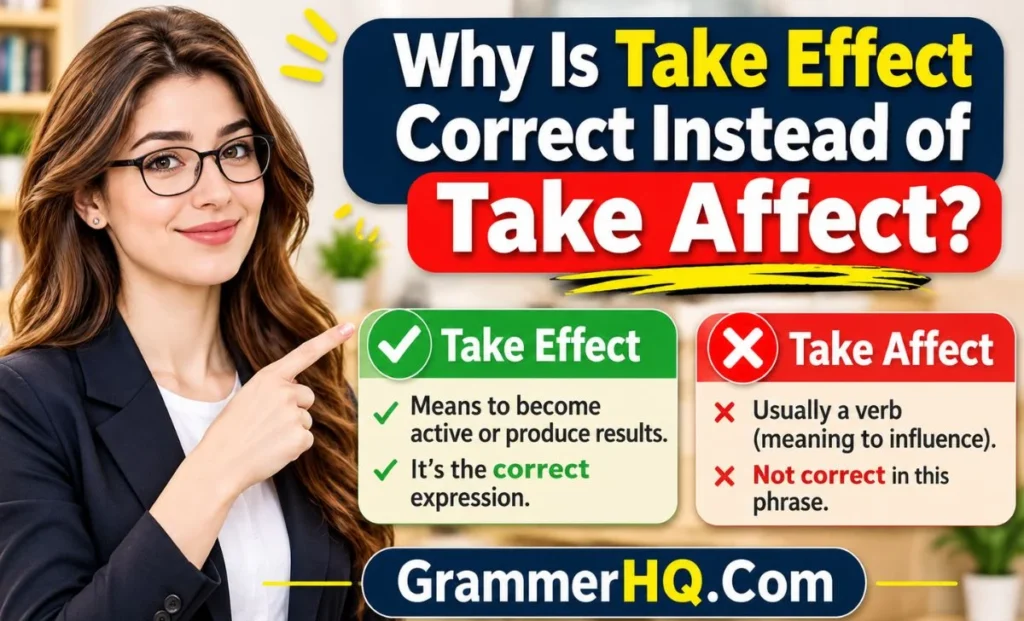
The correct expression is take effect because effect functions as a noun in this established phrase. It refers to a result, outcome, or influence that something begins to produce.
On the other hand, affect is usually a verb meaning to influence or change something. It does not fit the standard expression take effect.
Consider these examples:
- Correct: The new tax rules will take effect in January.
- Incorrect: The new tax rules will take affect in January.
- Correct: The new tax rules may affect small businesses.
- Incorrect: The new tax rules may effect small businesses (when you mean influence).
Notice how the words perform different grammatical jobs. Use effect in the fixed phrase take effect, but use affect when describing something that influences another person or thing.
Effect vs. Affect: What’s the Difference?
Although effect and affect look and sound similar, they usually have different meanings and grammatical functions.
| Word | Part of Speech | Meaning | Example |
|---|---|---|---|
| Effect | Noun | A result or outcome | The change had a positive effect. |
| Affect | Verb | To influence or change | The change may affect employees. |
The easiest way to understand the difference is to look at what the sentence describes.
Effect (noun): Use it when talking about the result of an action or event.
Example: The new schedule had a noticeable effect on productivity.
Affect (verb): Use it when describing an action that influences something.
Example: The new schedule may affect employee productivity.
There is also a less common use of effect as a verb, meaning to bring something about or accomplish it. For example, “The committee hopes to effect positive change.” However, this does not change the standard expression take effect.
Take Effect in Real-Life Sentences
Understanding how people use take effect in everyday situations makes the expression easier to remember. Here are some practical contexts.
1. Laws and Government Rules
When a law or regulation takes effect, it officially becomes active and begins to apply.
- The new traffic law will take effect on January 1.
- The revised regulations took effect earlier this year.
- The state announced when the new restrictions would take effect.
2. Medicine and Medical Treatments
When medicine takes effect, it starts producing its intended results.
- The pain reliever should take effect within an hour.
- The treatment began to take effect after several days.
- The doctor explained how long the medication might take to effect?
Note: In ordinary patient-facing English, write “take effect,” not “take affect.”
3. Business Policies and Workplace Changes
Businesses use this expression when new rules, schedules, or decisions officially begin.
- The updated vacation policy will take effect next week.
- The new working hours take effect on Monday.
- The company’s pricing changes took effect in October.
4. Contracts and Agreements
A contract or agreement takes effect when its terms begin to apply.
- The agreement will take effect after both parties sign it.
- The revised contract takes effect on the date stated in the document.
- The new employment terms took effect at the beginning of the month.
What Does Take Affect Mean?
Take affect is not the standard English expression when you mean that something begins working, becomes active, or starts producing results.
It is usually a spelling or word-choice mistake caused by confusing affect with effect.
For example:
- Incorrect: The new company policy will take affect tomorrow.
- Correct: The new company policy will take effect tomorrow.
- Incorrect: The medication should take affect soon.
- Correct: The medication should take effect soon.
- Incorrect: The new regulations took affect last week.
- Correct: The new regulations took effect last week.
The important point is that affect is a perfectly valid English word. It simply does not belong in this particular expression.
Take Effect vs. Affect: When Should You Use Each?
Sometimes both words can appear in the same sentence, but they communicate different things.
Use take effect when something starts applying or producing results. Use affect when something influences a person, situation, or outcome.
Compare these examples:
| Sentence | Correct Usage | Why |
|---|---|---|
| The new law will take effect tomorrow. | Take effect | The law becomes active. |
| The new law may affect drivers. | Affect | The law influences drivers. |
| The medicine should take effect soon. | Take effect | The medicine starts working. |
| The medicine may affect your sleep. | Affect | The medicine influences sleep. |
| The policy takes effect in June. | Take effect | The policy officially begins. |
| The policy could affect employees. | Affect | The policy influences employees. |
This distinction is especially useful in professional writing, school assignments, workplace emails, and everyday communication.
Common Mistakes to Avoid
Writers often confuse these words because they have similar spellings and pronunciations. However, checking the meaning and grammar of the sentence can prevent most errors.
Here are three mistakes worth remembering:
Mistake 1: Using affect after take
Incorrect: The new rules will take affect next month.
Correct: The new rules will take effect next month.
Mistake 2: Using effect when you mean influence
Incorrect: The weather may effect our travel plans.
Correct: The weather may affect our travel plans.
Mistake 3: Confusing a starting date with an influence
Incorrect: The updated policy will take affect and change employee schedules.
Better: The updated policy will take effect on Monday and affect employee schedules.
A simple check can help: if you mean “become active” or “start working,” choose take effect. If you mean “influence,” choose affect.
How to Remember Take Effect or Take Affect
The easiest way to remember the correct phrase is to connect effect with a result and affect with an action.
- Effect = Result: The new rule had a positive effect.
- Affect = Influence: The new rule may affect workers.
- Take effect = Start working: The new rule will take effect tomorrow.
You can also replace take effect with “become active” or “start working” to check whether the expression makes sense.
For example:
The new policy will take effect on Friday.
The new policy will become active on Friday.
Both sentences communicate the same idea. This quick substitution makes it easier to choose the correct expression.
FAQs
Is it take effect or take affect?
Take effect is the correct expression in standard English when something begins to work, becomes active, or starts producing results. Take affect is incorrect for this meaning.
What does take effect mean in simple words?
It means something starts working or officially becomes active. For example, when a new rule takes effect on Monday, people must follow it starting that day.
Can you ever say take affect?
Not in standard English when you mean “start working” or “become active.” Although affect can be a noun in specialized psychological contexts, take affect is not the correct expression for this meaning.
Why do people confuse effect and affect?
People confuse them because they have similar spellings and almost identical pronunciations. Their meanings are also related to changes and results, which makes it easy to choose the wrong word.
Does a new law take effect or take affect?
A new law takes effect. This means the law officially becomes active and begins to apply on a specified date.
Does medicine take effect or take affect?
Medicine takes effect when it begins producing its intended results. For example, the pain medication started to take effect after 30 minutes.
What is another way to say take effect?
Depending on the context, you can use become active, go into effect, come into effect, become effective, or start working.
Is take effect the same in American and British English?
Yes. Take effect is the standard expression in both American and British English. There is no regional spelling difference between the two varieties.
Conclusion
The correct expression is take effect, not take affect. Use it when a law, policy, agreement, medical treatment, or other change begins to apply or starts producing results.
Remember the simple distinction: effect is usually a noun meaning a result, while affect is usually a verb meaning to influence.
A new rule can take effect on Monday and affect thousands of people. Once you understand this difference, choosing the right expression becomes much easier.
Discover More Blogs:
- Manuel vs. Manual: What’s the Difference?
- Suing or Sueing: Which Spelling Is Correct?
- Transferred vs. Transfered: Correct Spelling and Meaning?
- Submission vs. Submittion: Which Spelling Is Correct?

Hi, I’m Amelia Parker, a grammar enthusiast and writer at GrammarHQ.com. I specialize in explaining spelling differences, confusing words, and common English mistakes through simple, practical, and easy-to-understand guides.