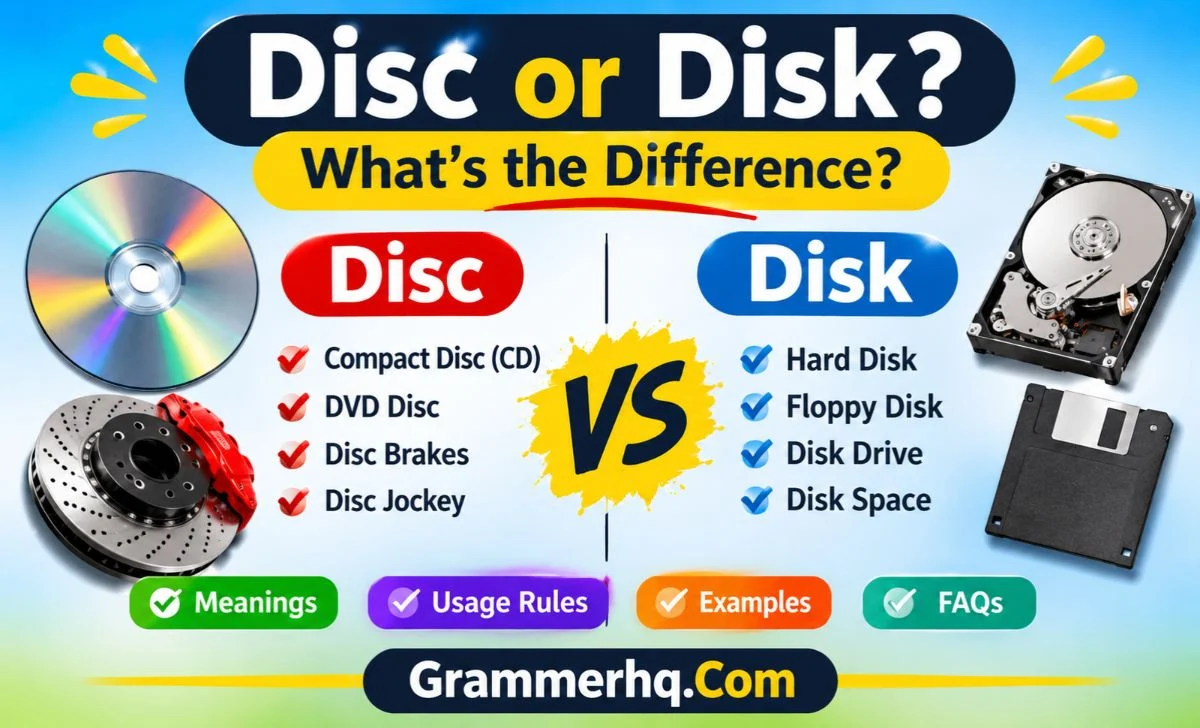
Both disc and disk are correct English spellings. They have the same pronunciation and generally refer to a thin, flat, circular object.
However, their usage depends on context, regional spelling preferences, and established technical terms. British English generally prefers disc, while American English often uses disk.
Computer-related terms usually take disk in both varieties, as in hard disk and floppy disk. For optical media, compact disc (CD) and Blu-ray Disc use disc.
What Is the Difference Between Disc and Disk?
The main difference between disc and disk is their conventional usage rather than their meaning. Both words describe flat, round objects, but certain industries and expressions prefer one spelling over the other.
For example, disc commonly appears in terms related to music, optical media, and mechanical components. In contrast, disk is standard in computer storage terminology.
Here is a quick comparison:
| Disc | Disk |
|---|---|
| Common in British English | Common in American English |
| Compact disc (CD) | Hard disk |
| Blu-ray Disc | Floppy disk |
| Disc jockey | Disk drive |
| Disc brakes | Disk space |
| Slipped disc | Disk storage |
Although regional preferences matter, established expressions are more important than applying a simple British-versus-American rule.
What Does Disc Mean?
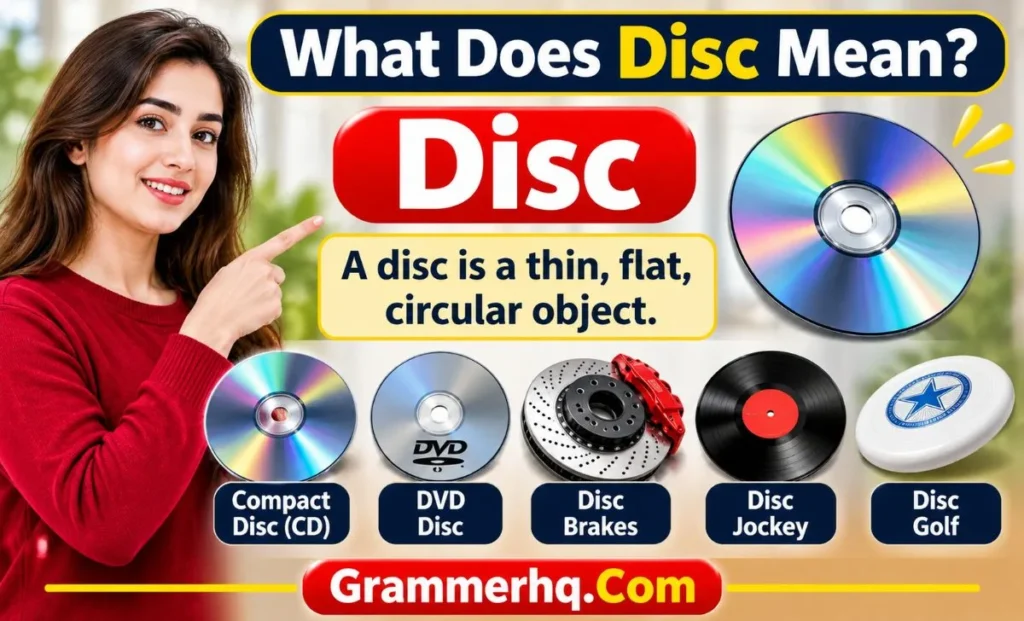
Disc is a noun that refers to a thin, flat, circular object. It can describe physical objects used in music, entertainment, machinery, sports, and medicine.
The spelling disc is particularly common in British English. However, Americans also use it in established expressions such as compact disc and disc jockey.
Common uses of disc include:
- Compact disc: A circular optical storage medium used for digital audio and other data.
- DVD: An optical disc used to store video and other digital information.
- Blu-ray Disc: An optical storage format used for high-definition video and digital data.
- Disc brakes: A braking system that uses a rotating metal disc and brake pads.
- Disc jockey: A person who selects and plays recorded music for an audience.
- Spinal disc: A structure of cartilage and connective tissue between the bones of the spine.
Examples of disc in sentences:
- I bought a new compact disc for my music collection.
- The mechanic inspected the car’s disc brakes.
- She inserted the DVD disc into the player.
- The DJ played several popular songs at the party.
- The doctor examined the patient’s spinal disc.
These examples demonstrate how disc appears in different contexts, including entertainment, machinery, and anatomy.
What Does Disk Mean?
Disk is also a noun that describes a thin, flat, circular object. However, it is especially common in American English and computer-related terminology.
In technology, a disk generally refers to a storage device or medium that holds digital information. Computers use different types of disks to store operating systems, documents, photographs, applications, and other files.
Common uses of disk include:
- Hard disk: A magnetic storage device used to store computer data.
- Floppy disk: An older removable storage medium used to save and transfer files.
- Disk drive: Hardware that reads or writes information on a disk.
- Disk space: The available storage capacity on a computer or storage device.
- Disk storage: A method of storing digital information on disk-based media.
Examples of disk in sentences:
- My computer has a large hard disk.
- The old floppy disk contains important documents.
- I need more disk space to install this software.
- The technician replaced the damaged disk drive.
- She saved all her photographs on an external disk.
These examples show why disk is the established spelling in many computer-related expressions.
Disc vs. Disk in American and British English

One of the most common questions about these spellings is whether disc belongs to British English and disk belongs to American English.
The general distinction is correct, but it has important exceptions.
In British English:
- Disc is generally preferred for ordinary circular objects.
- Disc appears in expressions such as disc brakes and disc jockey.
- Disk is standard in computer terminology, including hard disk and disk drive.
- Compact disc is the conventional spelling.
In American English:
- Disk is generally preferred for many ordinary circular objects.
- Disk is standard in computer-related expressions.
- Disc remains conventional in terms such as compact disc, Blu-ray Disc, and disc jockey.
- Disc brakes is also a well-established spelling.
The following table makes the distinction easier to understand:
| Context | British English | American English |
|---|---|---|
| General circular object | Disc | Disk |
| Computer storage | Disk | Disk |
| Hard drive | Hard disk | Hard disk |
| Music storage | Compact disc | Compact disc |
| DJ | Disc jockey | Disc jockey |
| Car braking system | Disc brakes | Disc brakes |
| Optical media | Optical disc | Optical disc |
Remember: Regional spelling preferences do not override established technical names. Always consider the context before choosing a spelling.
When to Use Disc
Use disc when referring to optical media, music-related objects, certain mechanical components, or established expressions that conventionally use this spelling.
Here are the most common situations:
1. For CDs and optical media
Use disc when referring to compact discs and other established optical media terms.
Example: I found an old compact disc in my bedroom.
2. For music-related expressions
The conventional expression disc jockey refers to someone who plays recorded music.
Example: The disc jockey played our favorite songs.
3. For vehicle braking systems
Disc brakes is a standard expression for a braking system that uses a rotating disc.
Example: The new car comes with reliable disc brakes.
4. For certain medical expressions
Slipped disc and herniated disc are familiar expressions, particularly in British English.
Example: My uncle visited a specialist because of a slipped disc.
When to Use Disk
Use disk when referring to computer storage and related technology. This spelling is standard in both American and British English for many technical expressions.
Here are some common situations:
1. For computer storage devices
Use hard disk when referring to a magnetic storage device.
Example: The computer stores its files on a hard disk.
2. For older storage media
Use floppy disk when describing the removable magnetic storage medium used by older computers.
Example: My father still has a floppy disk from his first computer.
3. For available storage capacity
Use disk space when discussing the amount of storage available on a computer.
Example: The software requires at least 10 GB of disk space.
4. For computer hardware
Use disk drive when referring to hardware that reads or writes information on a disk.
Example: The technician repaired the computer’s disk drive.
Disc or Disk in Computer Terminology
Computer terminology is one of the most important areas where these two spellings differ.
Although British English generally favors disc for many ordinary circular objects, computer-related expressions usually use disk in both British and American English.
For example:
- Hard disk
- Floppy disk
- Disk drive
- Disk space
- Disk storage
- Disk partition
- Disk management
However, optical storage follows a different naming convention.
A compact disc (CD) stores information using optical technology rather than the magnetic storage system used by traditional hard disks. DVDs and Blu-ray Discs also belong to the optical media family.
This distinction explains why hard disk and compact disc are both correct.
Disc or Disk in Medical Terminology
The spellings disc and disk also appear in medical terminology, particularly when describing structures in the spine and other parts of the body.
A spinal disc is a cushion-like structure located between adjacent vertebrae. These structures help absorb pressure and support movement.
Common medical expressions include:
- Intervertebral disc
- Spinal disc
- Herniated disc
- Slipped disc
- Prolapsed disc
The spelling can vary depending on the medical reference, country, and established terminology. For example, slipped disc is particularly familiar in British English, while herniated disk is commonly encountered in American medical writing.
Therefore, do not assume that every medical reference must use disc. Follow the terminology used by the relevant medical authority or publication.
Disc vs. Disk: Examples in Real Sentences
Understanding the difference becomes easier when you see both spellings in everyday situations.
Disc examples:
- My brother bought a new compact disc yesterday.
- The DVD disc contains several exciting movies.
- The mechanic checked the vehicle’s disc brakes.
- The disc jockey entertained everyone at the wedding.
- The doctor explained the problems associated with a herniated disc.
Disk examples:
- I purchased a new hard disk for my computer.
- The floppy disk contains some old photographs.
- My laptop is running out of disk space.
- The computer cannot recognize the external disk.
- The technician replaced the faulty disk drive.
Mixed examples:
- I saved the files on a hard disk and copied the music onto a compact disc.
- The computer uses a disk drive, but the movie comes on a DVD disc.
- British writers often prefer disc for general objects, but they still write hard disk.
- American writers commonly use disk, although compact disc remains the established expression.
These examples show that the correct spelling depends on the expression and its context.
Common Mistakes to Avoid
Writers sometimes assume that disc is always British and disk is always American. This is an oversimplification.
Avoid these common mistakes:
Mistake 1: Using disk for every computer-related medium
Although disk is standard for hard disks and floppy disks, optical media generally use disc in established names.
Mistake 2: Assuming disc is incorrect in American English
American English uses disc in expressions such as compact disc, disc jockey, and disc brakes.
Mistake 3: Assuming disk is incorrect in British English
British English also uses disk in computer terminology, including hard disk and disk space.
Mistake 4: Treating the words as completely different in meaning
Both words can describe flat, circular objects. Their differences mainly involve conventional spelling and context.
Mistake 5: Changing established technical expressions
Do not replace hard disk with hard disc or automatically change compact disc to compact disk. Follow standard terminology.
FAQs
1. Is disc or disk correct?
Both disc and disk are correct English spellings. Their usage depends on context, regional preferences, and established expressions. For example, compact disc and hard disk are both standard terms.
2. Is disc British or American English?
Disc is generally preferred in British English for ordinary circular objects. However, American English also uses it in established expressions such as compact disc, disc jockey, and disc brakes.
3. Is disk American or British English?
Disk is generally preferred in American English for many ordinary circular objects. However, British English also uses disk in computer terminology, including hard disk, floppy disk, and disk drive.
4. Is it hard disk or hard disc?
Hard disk is the standard spelling in both American and British English. It refers to a computer storage device that uses magnetic technology to store digital information.
5. Is it compact disc or compact disk?
Compact disc is the established conventional spelling for the optical storage format commonly abbreviated as CD. Although compact disk appears in some references, compact disc is the standard form to use.
6. Are disc and disk pronounced the same?
Yes. Both words have the same pronunciation: /dɪsk/. They sound identical when spoken, even though their spellings differ.
7. What is the plural of disc and disk?
The plural of disc is discs, while the plural of disk is disks.
Examples:
- I bought two compact discs.
- The computer contains two hard disks.
8. Why are there two spellings of disc and disk?
Both spellings developed from the same historical word origin. Over time, different English-speaking regions and industries adopted different spelling preferences. As a result, both forms remain correct today.
Conclusion
The difference between disc and disk is mainly a matter of spelling conventions and usage. Both words are correct, sound the same, and generally describe thin, flat, circular objects.
Use disc for established expressions such as compact disc, disc jockey, and disc brakes. Choose disk for computer-related terms such as hard disk, floppy disk, and disk space.
Although British English generally favors disc and American English often favors disk, technical terminology can follow its own conventions.
The easiest way to remember the distinction is to learn the established expression rather than relying entirely on regional spelling rules. That way, you can choose the correct form confidently in both American and British English.
Discover More Blogs:
- Fiesty or Feisty: Correct Spelling, Meaning & Usage?
- Paid vs. Payed: Meaning, Difference, and Correct Usage
- Suing or Sueing: Which Spelling Is Correct?
- Commit vs. Comit: Which Spelling Is Correct?
- Manuel vs. Manual: What’s the Difference?