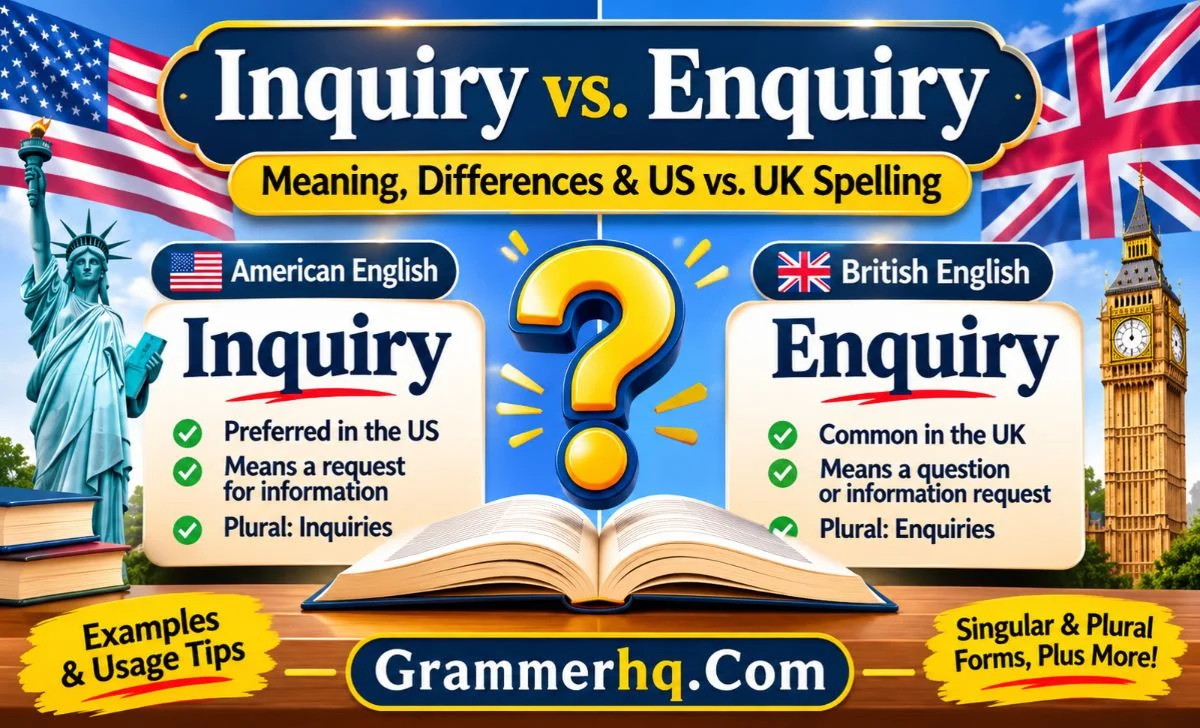
Inquiry vs. Enquiry:Both inquiry and enquiry are correct English spellings. However, they differ in regional preference.
Inquiry is the standard and preferred spelling in American English, while enquiry is especially common in British English when asking for general information.
Traditionally, British English often uses inquiry for formal investigations and enquiry for ordinary questions. However, both spellings can be used for either meaning.
For example:
- American English: I sent an inquiry about the university admission process.
- British English: I sent an enquiry about the university admission process.
Both sentences are correct. The best choice depends on your audience and the English spelling style you follow.
What Is the Difference Between Inquiry and Enquiry?
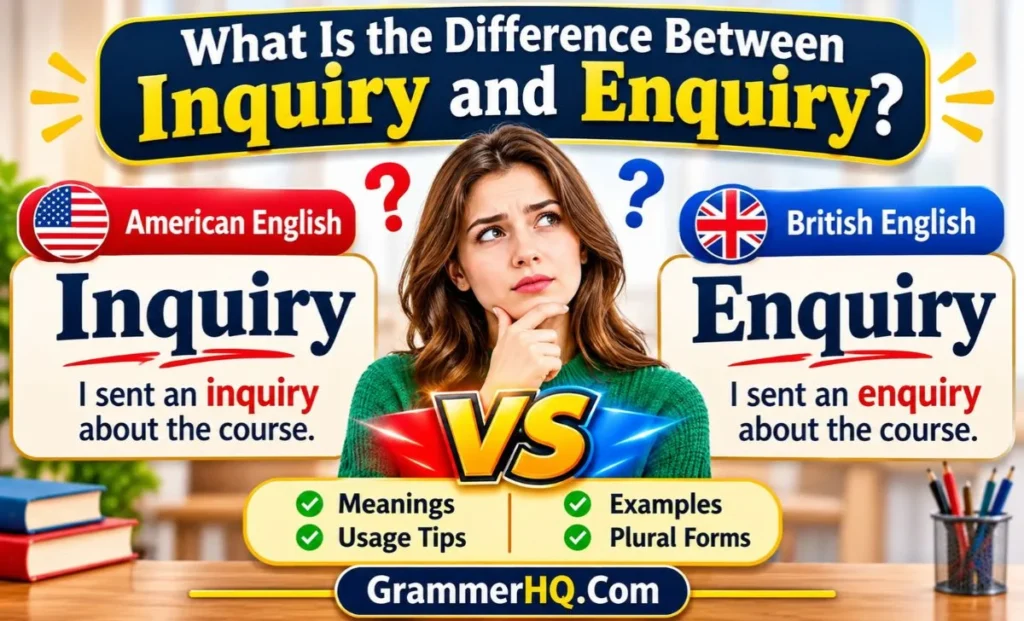
The main difference between inquiry and enquiry is their regional spelling preference, not their basic meaning. Both words are nouns that describe asking questions, requesting information, or investigating a particular subject.
In American English, writers generally prefer inquiry for both ordinary questions and official investigations. In British English, enquiry is frequently used for general requests, while inquiry is traditionally associated with formal investigations.
Consider these examples:
- The customer made an inquiry about the product’s price.
- The customer made an enquiry about the product’s price.
Both examples communicate the same idea. The first follows the spelling preferred in American English, while the second follows a common British English convention.
Therefore, neither word is universally wrong. Understanding the regional difference helps you choose the most suitable spelling.
What Does Inquiry Mean?
Inquiry is a noun that means a request for information, a question about something, or a formal investigation into a particular matter.
People use this word when they want to learn more about a subject, understand a situation, or discover the facts behind an event.
For example:
- She made an inquiry about the available courses.
- The police started an inquiry into the robbery.
- Our company received several inquiries from new customers.
- The teacher encouraged scientific inquiry among students.
In American English, inquiry is the usual spelling for both general information requests and official investigations.
In British English, it is also commonly used, particularly when referring to formal investigations.
What Does Enquiry Mean?
Enquiry is a noun that means a question or request for information about someone or something. It can also describe the process of collecting information or investigating a subject.
This spelling is especially common in British English, particularly in everyday communication and customer service.
For example:
- I made an enquiry about the job vacancy.
- She sent an enquiry to the hotel about room availability.
- Please contact our office for further enquiries.
- The school received several enquiries from parents.
In these examples, people want information about a job, hotel, office service, or school.
Although enquiry is especially associated with British English, it is not an incorrect spelling. American readers can understand it, but American writers generally prefer inquiry.
Inquiry vs. Enquiry in American and British English
English spelling conventions vary between countries. Some words have different spellings in American and British English, and inquiry and enquiry are another example.
Here is how these words are generally used in the United States and the United Kingdom.
| Usage | American English | British English |
|---|---|---|
| General questions | Inquiry | Enquiry |
| Information requests | Inquiry | Enquiry |
| Customer questions | Inquiry | Enquiry |
| University admission questions | Inquiry | Enquiry |
| Official investigations | Inquiry | Inquiry |
| Scientific investigations | Inquiry | Inquiry |
Important British English note: This table shows traditional and common preferences, not compulsory rules. British dictionaries recognize both spellings for both meanings. You may encounter enquiry in an official investigation or inquiry in an ordinary information request.
For American writers, inquiry is the safest and most natural choice in almost every context.
For British writers, enquiry is a natural choice for general questions, while inquiry is particularly familiar in formal investigation contexts.
When to Use Inquiry
Use inquiry when writing in American English or when referring to a question, request for information, or formal investigation.
Here are some common situations where this spelling is appropriate.
1. When Requesting Information
Use inquiry when someone wants details about a service, product, educational program, or opportunity.
Examples:
- I submitted an inquiry about the training program.
- The company received an inquiry from a potential customer.
- Please send your inquiry to our support department.
2. When Referring to an Official Investigation
Use inquiry when an organization or authority examines an incident to discover what happened.
Examples:
- The government launched an inquiry into the financial scandal.
- The police conducted an inquiry into the accident.
- An independent committee will lead the inquiry.
3. In Education and Research
Inquiry can also describe the process of asking questions, examining evidence, and developing knowledge.
Examples:
- Scientific inquiry helps researchers discover new information.
- Students should develop their skills through inquiry-based learning.
- The teacher encouraged inquiry and critical thinking in the classroom.
When to Use Enquiry
Use enquiry when following British English spelling conventions, particularly when someone requests information or asks a general question.
Here are some everyday situations where this spelling is common.
1. When Asking About a Service
Use enquiry when someone wants to know more about a service or facility.
Examples:
- I made an enquiry about the available services.
- She contacted the office with an enquiry.
- Please direct your enquiry to the customer service team.
2. When Asking About Education
Students and parents often make enquiries about admission requirements, course fees, and school facilities.
Examples:
- I sent an enquiry about university admission.
- Parents made several enquiries about the school.
- The college answered my enquiry about tuition fees.
3. When Asking About Prices or Availability
Use enquiry when requesting information about costs, bookings, or available products.
Examples:
- He made an enquiry about the hotel prices.
- We received an enquiry about product availability.
- She sent an enquiry before booking her holiday.
Remember that British English also accepts inquiry in these situations. The choice of enquiry simply reflects a common British spelling preference.
Inquiry vs. Enquiry Examples in Real Sentences
The following examples show how both spellings work in everyday English.
| Inquiry (American English) | Enquiry (British English) |
|---|---|
| I made an inquiry about the course. | I made an enquiry about the course. |
| She sent an inquiry to the company. | She sent an enquiry to the company. |
| We received an inquiry about our services. | We received an enquiry about our services. |
| He submitted an inquiry about admission. | He submitted an enquiry about admission. |
| Please contact us for further inquiries. | Please contact us for further enquiries. |
Both columns express the same ideas. The difference is the spelling preference associated with each variety of English.
More Examples of Inquiry in Sentences
- The customer submitted an inquiry about the new product.
- I called the university to make an inquiry about admission.
- The manager responded to every customer inquiry.
- The investigation began with a formal inquiry.
- Our website provides a form for online inquiries.
More Examples of Enquiry in Sentences
- She made an enquiry about the available job positions.
- The receptionist answered my enquiry politely.
- Please email us if you have any further enquiries.
- He sent an enquiry about the holiday packages.
- The school received enquiries from several parents.
Inquiry vs. Enquiry: Singular and Plural Forms
Both words have regular plural forms, but their spellings change slightly when adding the plural ending.
| Singular | Plural |
|---|---|
| Inquiry | Inquiries |
| Enquiry | Enquiries |
The spelling changes from y to ies when forming the plural.
For example:
- Singular: The company received one inquiry.
- Plural: The company received several inquiries.
- Singular: The customer made an enquiry.
- Plural: The office received several enquiries.
Common Plural Spelling Mistakes
Some writers mistakenly use inquirys or enquirys. These are incorrect plural forms.
The correct spellings are:
- Inquiry → Inquiries
- Enquiry → Enquiries
Remember this simple rule: When a noun ends in a consonant followed by y, the usual plural form changes y to ies.
Inquire vs. Enquire: What Is the Difference?
Besides the nouns inquiry and enquiry, English also has two related verbs: inquire and enquire.
Both verbs mean to ask for information or investigate something. Their regional preferences are similar to those of their noun forms.
- Inquire: Preferred in American English.
- Enquire: Especially common in British English.
Examples:
- I want to inquire about the admission requirements.
- I want to enquire about the admission requirements.
- She called the office to inquire about the application.
- She called the office to enquire about the application.
Both versions are grammatically correct.
Verb Forms of Inquire and Enquire
| Verb form | Inquire | Enquire |
|---|---|---|
| Base form | Inquire | Enquire |
| Third-person singular | Inquires | Enquires |
| Past tense | Inquired | Enquired |
| Past participle | Inquired | Enquired |
| -ing form | Inquiring | Enquiring |
Examples:
- She inquired about the meeting.
- He enquired about the train schedule.
- They are inquiring about the new policy.
- We are enquiring about the available rooms.
These spellings are both recognized. Choose the version that matches your preferred English variety.
Common Mistakes to Avoid
Writers sometimes confuse inquiry and enquiry because the two words look and sound almost identical. However, a few simple rules can help you avoid mistakes.
1. Thinking that enquiry is always wrong
This is incorrect. Enquiry is a recognized English spelling, particularly in British English.
2. Thinking that inquiry is only American
Inquiry is widely used in American English, but it is also correct and common in British English.
3. Using the wrong plural form
Do not write inquirys or enquirys. The correct forms are inquiries and enquiries.
4. Assuming that both words have completely different meanings
Both words can refer to information requests and investigations. Their distinction is mainly related to regional preference and traditional usage.
5. Mixing spelling styles unnecessarily
If you are writing for an American audience, use inquiry consistently. If you are following British English conventions, choose enquiry for general information requests when appropriate.
FAQs
Is inquiry or enquiry correct?
Both inquiry and enquiry are correct English spellings. Inquiry is preferred in American English, while enquiry is especially common in British English.
Is inquiry American or British English?
Inquiry is the standard spelling in American English. However, British English also uses inquiry, particularly for formal investigations.
Is enquiry British English?
Yes. Enquiry is especially common in British English and is frequently used when asking for general information.
Is enquiry wrong in American English?
No. Enquiry is a recognized English spelling, but American writers generally prefer inquiry.
Do inquiry and enquiry mean the same thing?
Yes. Both words can mean a request for information, a question, or an investigation. Their main difference is regional spelling preference.
What is the plural of inquiry?
The plural of inquiry is inquiries. For example: The company received several inquiries from customers.
What is the plural of enquiry?
The plural of enquiry is enquiries. For example: The school received several enquiries from parents.
Should I write further inquiries or further enquiries?
Both expressions are correct. Use further inquiries when following American English and further enquiries when following a common British English convention.
What is the difference between inquiry and investigation?
An inquiry can be a simple request for information or a formal process of examining a matter. An investigation generally refers to a systematic examination to discover facts, causes, or evidence.
Can I use inquiry in British English?
Yes. Inquiry is correct in British English. It is traditionally preferred for formal investigations, but it can also describe ordinary requests for information.
Conclusion: Inquiry vs. Enquiry
The difference between inquiry vs. enquiry is mainly a matter of American and British English spelling preferences. Both words are correct, and both can describe a request for information or an investigation.
Use inquiry when writing for an American audience because it is the standard American spelling. Choose enquiry for general information requests when following traditional British English conventions. However, remember that British English accepts both spellings in both contexts.
The most important thing is to understand your audience and maintain consistent spelling throughout your writing. Once you know this simple difference, choosing between inquiry and enquiry becomes much easier.
Discover More Blogs:
- Paid vs. Payed: Meaning, Difference, and Correct Usage
- Suing or Sueing: Which Spelling Is Correct?
- Commit vs. Comit: Which Spelling Is Correct?
- Manuel vs. Manual: What’s the Difference?
- Submission vs. Submittion: Which Spelling Is Correct?

Hi, I’m Amelia Parker, a grammar enthusiast and writer at GrammarHQ.com. I specialize in explaining spelling differences, confusing words, and common English mistakes through simple, practical, and easy-to-understand guides.