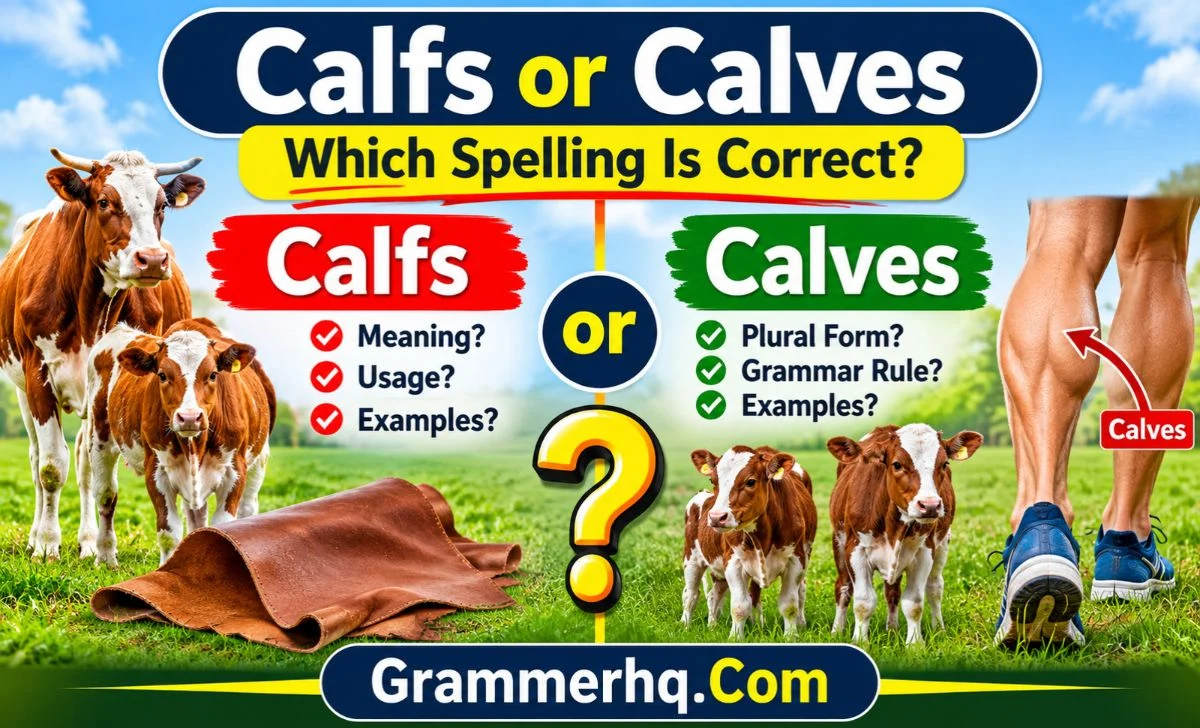
Calfs or Calves:Calves is the standard and preferred plural of calf when referring to young animals, the back of the lower leg, or pieces of ice broken away from a glacier. However, calfs is not simply a meaningless or invented spelling.
Some American dictionary references recognize it as a specialized alternative plural when referring to calfskin or leather made from a calf’s hide.
For ordinary writing about animals and human anatomy, always use calves. For example, a farmer may raise several calves, and a runner may stretch both calves after exercise.
The confusion comes from an English spelling pattern in which certain nouns ending in -f change to -ves in the plural.
Understanding this difference helps you choose the correct word in everyday conversations, academic writing, farming, fitness, and professional communication.
What Is the Difference Between Calfs and Calves?
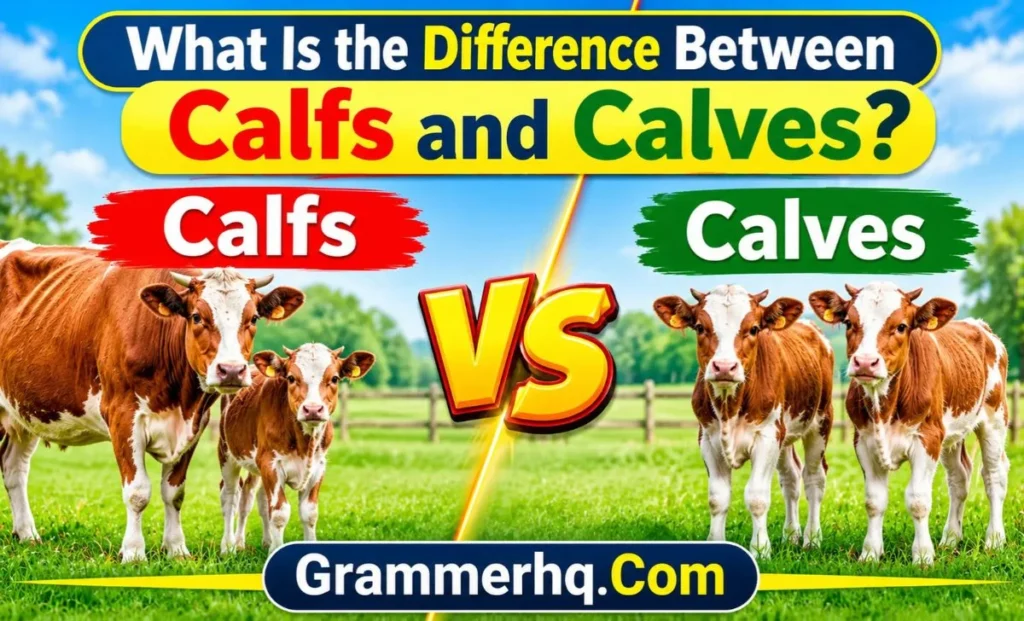
The main difference between calfs and calves is their standard grammatical use. Calves is the normal plural form of calf, whereas calfs has a much more limited use in specialized leather-related contexts.
Here is a quick comparison:
| Word | Meaning | Usage |
|---|---|---|
| Calf | One young animal or the back of one lower leg | Singular noun |
| Calves | More than one young animal or lower-leg area | Standard plural |
| Calfs | A less common alternative plural associated with calfskin | Specialized usage |
For most English writing, calves is the correct choice.
Examples:
- Correct: The farmer has four healthy calves.
- Incorrect in ordinary animal-related writing: The farmer has four calfs.
- Correct: My calves hurt after running.
- Incorrect: My calfs hurt after running.
- Specialized usage: The dictionary records calfs as an alternative plural in the leather or calfskin sense.
Therefore, do not treat these two spellings as interchangeable in ordinary sentences. The intended meaning and context determine the appropriate form.
What Does Calf Mean?
Calf is a singular countable noun with several meanings. It most commonly refers to a young animal, the muscular area at the back of the lower leg, or leather made from a young animal’s hide.
1. Calf as a Young Animal
A calf is a young animal, particularly a young cow or other member of the cattle family. The word also describes the young of several other large mammals, including elephants, whales, buffalo, and some other species.
Examples:
- The newborn calf is standing beside its mother.
- A farmer feeds the calf every morning.
- The elephant calf follows its mother through the forest.
- The veterinarian examined a young calf.
In farming and livestock management, calf is an important word used when discussing animal births, feeding, breeding, health, and development.
2. Calf as Part of the Human Leg
In human anatomy, the calf is the thick, fleshy area at the back of the lower leg, between the knee and ankle.
The calf region contains important muscles that help with walking, running, jumping, and standing on your toes. The gastrocnemius and soleus are its principal muscles.
Examples:
- My right calf hurts after exercising.
- She injured her calf while playing football.
- The runner stretched his calf before the race.
- He has a strong calf muscle.
In fitness and sports, the word frequently appears in discussions about calf exercises, muscle development, injuries, and physical training.
3. Calf as Leather
The word calf also has a leather-related meaning. It can refer to soft leather made from the hide of a young calf. This material is commonly called calfskin or calf leather.
Calfskin is used in products such as shoes, handbags, wallets, and bookbinding materials.
Examples:
- The shoes are made from calf leather.
- The book has a calfskin cover.
- The manufacturer selected high-quality calfskin for the product.
This meaning is particularly important when explaining why some dictionaries recognize calfs as a specialized alternative plural.
4. Calf as a Piece of Ice
In geographical and environmental contexts, calf can also refer to a large piece of ice that breaks away from an iceberg or glacier.
Examples:
- A large calf of ice separated from the glacier.
- The researchers observed several ice calves near the coast.
This is a less familiar meaning, but it demonstrates that the word has uses beyond animals and human anatomy.
What Does Calves Mean?
Calves is the standard plural form of calf. It generally refers to more than one young animal, multiple lower-leg areas, or separate pieces of ice broken away from a larger glacier or iceberg.
The meaning depends on the context of the sentence.
1. Calves as Young Animals
When discussing farming, wildlife, or animal development, calves refers to two or more young animals.
Examples:
- The farmer bought six calves from the livestock market.
- The calves are drinking milk.
- Several elephant calves were seen near the river.
- The newborn calves stayed close to their mothers.
- The veterinarian checked the health of the calves.
2. Calves as Human Muscles
When discussing human anatomy, fitness, or exercise, calves refers to the muscular areas at the backs of the lower legs.
Examples:
- My calves feel tired after a long walk.
- Running regularly can strengthen your calves.
- She exercises her calves at the gym.
- Both of his calves are sore after the marathon.
- Stretching your calves can help prepare your legs for exercise.
3. Calves as Pieces of Ice
In glaciology and environmental writing, calves can describe multiple pieces of ice that have broken away from larger ice formations.
For example:
- The researchers photographed several ice calves near the glacier.
- Small ice calves floated away from the larger formation.
This usage is specialized and less common than the animal and anatomy meanings.
Why Does Calf Become Calves Instead of Calfs?
The word calf follows an established English plural spelling pattern. Certain nouns ending in -f or -fe change their final letters to -ves when forming their plural.
The transformation looks like this:
Calf → Calves
Here is how the spelling changes:
- Start with the singular word calf.
- Remove the final letter f.
- Replace it with ves.
- The resulting plural form is calves.
This pattern also appears in several other English words.
| Singular | Plural |
|---|---|
| Calf | Calves |
| Half | Halves |
| Leaf | Leaves |
| Wolf | Wolves |
| Knife | Knives |
| Wife | Wives |
| Life | Lives |
| Shelf | Shelves |
| Loaf | Loaves |
| Thief | Thieves |
However, this is not a universal rule for every noun ending in -f.
For example:
| Singular | Plural |
|---|---|
| Roof | Roofs |
| Chief | Chiefs |
| Cliff | Cliffs |
| Belief | Beliefs |
| Proof | Proofs |
Some words also allow more than one plural form, such as dwarfs/dwarves, hoofs/hooves, and scarfs/scarves, depending on the word and context.
Therefore, learning individual plural forms is more reliable than assuming that every word ending in f must change to ves.
Is Calfs Ever Correct?
Yes, but its use requires an important qualification.
Although calves is the standard plural for young animals and the muscles at the backs of the legs, some American dictionary references record calfs as an alternative plural in the specialized sense of calfskin or leather made from calf hide.
For example, Merriam-Webster usage is discussed in Grammarly’s explanation of the difference between the two spellings. Collins also records calfs in its American English entry, particularly in connection with leather.
This does not mean that calfs is the preferred spelling in ordinary writing.
Consider these distinctions:
| Context | Preferred Form |
|---|---|
| Young cows | Calves |
| Young elephants | Calves |
| Human leg muscles | Calves |
| Pieces of glacier ice | Calves |
| Specialized calfskin or leather usage | Calfs may occur |
Practical advice: If you are writing about animals, sports, anatomy, or everyday activities, choose calves. Only consider calfs when a specialized leather-related context and the relevant dictionary support it.
Calfs vs. Calves: Examples in Real Sentences
The easiest way to understand the difference is to see how these words work in natural English sentences.
Related to Animals
- The farmer bought three healthy calves from a nearby farm.
- The newborn calf needs proper nutrition.
- Several calves are resting in the barn.
- The mother cow protects her calf from danger.
- The elephant calves stayed close to their mothers.
- The veterinarian examined all the calves.
- Two calves were born on the farm yesterday.
- The young calf followed its mother across the field.
Related to Human Anatomy
- My left calf hurts after a long run.
- Both of her calves are strong.
- The athlete injured his calf during the football match.
- Regular exercise can help strengthen your calves.
- She stretched her calf muscles before running.
- His calves became tired after climbing the mountain.
- The trainer recommended exercises for stronger calves.
- I felt a sudden pain in my right calf.
Examples Related to Leather
- The designer selected calf leather for the shoes.
- This wallet is made from soft calfskin.
- The leather manufacturer works with different types of calf hide.
These examples show that context is essential when deciding how to use the word correctly.
Calf or Calves: Singular and Plural Grammar
Understanding the difference between singular and plural nouns also helps you avoid subject-verb agreement mistakes.
Use calf when discussing one animal or one lower-leg area. Use calves when referring to more than one.
| Singular | Plural |
|---|---|
| One calf | Two calves |
| A healthy calf | Several healthy calves |
| My left calf | Both my calves |
| This calf is young. | These calves are young. |
| The calf needs food. | The calves need food. |
Notice how the verb changes with the subject:
- The calf is healthy.
- The calves are healthy.
- My calf hurts after exercise.
- My calves hurt after exercise.
A singular countable noun generally takes a singular verb, while a plural noun generally takes a plural verb.
Is Calves Also a Verb?
Yes. Besides being the plural noun form of calf, calves can also function as the third-person singular present-tense form of the verb calve.
The verb calve means to give birth to a calf or, in some contexts, to break away as a piece of ice from a glacier.
Examples:
- The cow calves every spring.
- This glacier calves into the ocean.
- The farmer expects that the cow calves next month.
Compare these forms:
| Word | Grammatical Function |
|---|---|
| Calf | Singular noun |
| Calves | Plural noun |
| Calve | Base form of a verb |
| Calves | Third-person singular verb |
| Calved | Past tense and past participle |
| Calving | Present participle and gerund |
The correct meaning becomes clear from the sentence structure.
Is Calves Different in American and British English?
No. Calves is the standard plural form in both American and British English. Neither variety uses a different ordinary spelling for this word.
However, pronunciation differs between the two varieties.
| Detail | American English | British English |
|---|---|---|
| Singular | Calf | Calf |
| Plural | Calves | Calves |
| Singular pronunciation | /kæf/ | /kɑːf/ |
| Plural pronunciation | /kævz/ | /kɑːvz/ |
| Standard plural | Calves | Calves |
In American English, calf generally has the short vowel sound /æ/, similar to the vowel in cat. In standard British pronunciation represented by /ɑː/, the vowel is longer, like the sound in father.
Despite the pronunciation difference, the spelling and grammatical rules remain the same.
Examples:
- American English: The calves are grazing in the field.
- British English: The calves are grazing in the field.
Both sentences are correct.
Common Mistakes When Using Calf, Calves, and Calfs
Writers sometimes confuse these words because English has several different plural spelling patterns.
Here are common mistakes and their corrections:
| Incorrect Usage | Correct Usage |
|---|---|
| Three calfs are sleeping. | Three calves are sleeping. |
| My calfs hurt after running. | My calves hurt after running. |
| The cow has two calfs. | The cow has two calves. |
| These calfs need food. | These calves need food. |
| The athlete injured his calves. (when only one leg is injured) | The athlete injured his calf. |
| My calves muscle hurts. | My calf muscle hurts. |
| The calves is healthy. | The calves are healthy. |
Remember these three useful points:
- Use calf for one animal or one lower-leg area.
- Use calves for two or more animals or lower-leg areas.
- Use calfs only when a specialized dictionary-supported leather context calls for that alternative form.
Related Words and Vocabulary
Learning related words helps you understand how calf is used in different situations.
| Word | Meaning |
|---|---|
| Calf | A young animal or the back of the lower leg |
| Calves | Standard plural of calf |
| Calve | To give birth to a calf |
| Calved | Gave birth to a calf |
| Calving | The process of giving birth to a calf |
| Calfskin | Leather made from a calf’s hide |
| Calf muscle | Muscle in the back of the lower leg |
| Newborn calf | A recently born young animal |
Examples:
- The cow will calve in early spring.
- The farmer prepared for the calving season.
- The cow calved during the night.
- The shop sells shoes made from calfskin.
- The athlete developed a calf muscle injury.
These words are useful in farming, veterinary science, fashion, sports, and everyday English.
FAQs
1. Is It Calfs or Calves?
Calves is the standard plural of calf. Use it when referring to young animals, lower-leg muscles, or pieces of ice broken away from a glacier. Calfs has a limited specialized use in some leather-related contexts.
2. What Is the Plural of Calf?
The standard plural of calf is calves. For example, one calf becomes two calves.
3. Is Calfs Ever a Correct Word?
Yes. Some American dictionaries recognize calfs as an alternative plural in the specialized sense of calfskin or leather made from calf hide. However, calves is the standard form for animals and human anatomy.
4. Why Does Calf Change to Calves?
The word follows an established English plural pattern in which the final f changes to v, followed by -es. Similar examples include leaf → leaves, wolf → wolves, and half → halves.
5. Is Calves Singular or Plural?
Calves is a plural noun when it refers to more than one young animal or lower-leg area. However, it can also be a singular verb form of calve, as in “The cow calves every spring.”
6. Are Calves Baby Cows?
Yes. A calf is a young cow or another young bovine animal. The word calves refers to more than one. It is also used for the young of certain other mammals, including elephants and whales.
7. What Are Calves on the Human Body?
Calves are the muscular areas at the backs of the lower legs, between the knees and ankles. These muscles help with walking, running, jumping, and other movements.
8. Is It Calf Muscle or Calves Muscle?
Use calf muscle or calf muscles, depending on the sentence. The word calf works as a noun modifier in both expressions. When referring directly to the plural body parts, use calves.
9. Is Calves Used in American and British English?
Yes. Both American and British English use calves as the standard plural. The main difference is pronunciation, not spelling.
10. What Are Other Examples of Words That Change F to V?
Examples include half → halves, leaf → leaves, wolf → wolves, knife → knives, wife → wives, and shelf → shelves. However, not all nouns ending in -f follow this pattern.
Conclusion: Calfs or Calves?
The correct choice for ordinary English writing is calves, the standard plural form of calf. Use calf when referring to one young animal or one lower-leg area, and use calves when referring to more than one.
Although some American dictionary references recognize calfs as a specialized alternative in the leather-related sense, it is not the usual spelling for animals or human anatomy.
Remember the main spelling pattern:
Calf → Calves
Whether you are writing about farming, wildlife, human anatomy, fitness, or everyday activities, choosing the correct form makes your writing clearer and more accurate. When in doubt, use calves for the ordinary plural and check a reliable dictionary for specialized meanings.
Discover More Blogs:
- Offerring vs. Offering: Which Spelling Is Correct?
- Recurring vs. Reoccurring: What Is the Difference?
- Inclusivity vs. Inclusiveness: What’s the Difference?
- Ma’am or Maam: Correct Spelling and Meaning?

Hi, I’m Amelia Parker, a grammar enthusiast and writer at GrammarHQ.com. I specialize in explaining spelling differences, confusing words, and common English mistakes through simple, practical, and easy-to-understand guides.