
Affect vs effect is a common source of confusion in English because both words relate to influence, change, and results.
The easiest way to tell them apart is to remember that affect is usually a verb meaning “to influence,” while effect is usually a noun meaning “a result.”
For example, lack of sleep can affect your concentration, while its negative effect may be difficulty focusing at work or school.
Although this simple rule works in most everyday situations, both words have less common uses that are worth learning.
Affect vs Effect: The Quick Answer
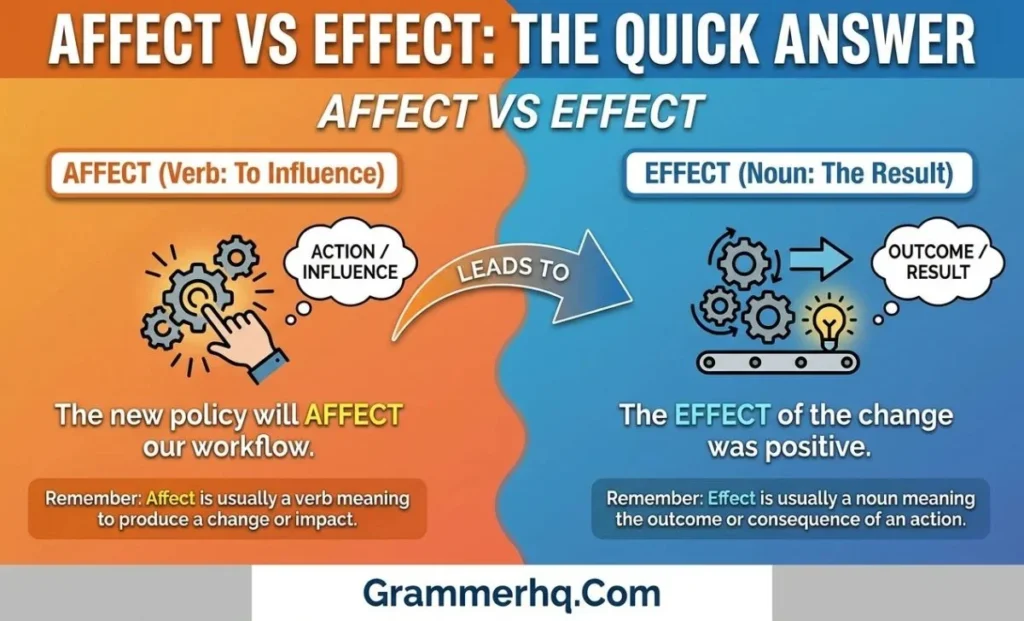
- Affect: Usually a verb that means to influence, change, or have an impact on something.
- Effect: Usually a noun that means a result, consequence, or outcome.
| Word | Usual role | Meaning | Example |
|---|---|---|---|
| Affect | Verb | To influence | Noise can affect concentration. |
| Effect | Noun | A result | Noise can have an effect on concentration. |
There are two important exceptions. In psychology, affect can be a noun describing observable emotional expression. In formal writing, effect can be a verb meaning to bring something about.
What Does Affect Mean?
Affect is most commonly a verb. It describes how an action, situation, or event influences someone or something.
How to Use It in a Sentence
Use this word when you want to explain that something influences a person, decision, situation, or outcome.
- Poor sleep can affect your ability to concentrate.
- Heavy rain may affect traffic conditions.
- Rising prices affect household budgets.
- A change in school policy could affect students.
- Workplace stress can affect employee performance.
In each sentence, the word describes an influence rather than the result itself.
The Less Common Noun Meaning
In psychology and psychiatry, affect refers to the observable expression of emotion, including facial expressions, tone of voice, and emotional presentation.
For example:
The clinician noted a flat affect during the assessment.
This is a specialized meaning, so most everyday writers will encounter the word as a verb.
What Does Effect Mean?
Effect is most often a noun that describes what happens because of an action, event, decision, or condition.
How to Use It in a Sentence
Choose this word when discussing a result or consequence.
- Regular exercise can have a positive effect on health.
- The new law had a significant effect on small businesses.
- The medicine produced an unexpected effect.
- The power outage had a serious effect on local services.
- Better lighting can improve the effect of a presentation.
A common grammatical pattern is have an effect on something.
For example:
Too much screen time can have an effect on sleep quality.
The Verb Meaning
As a verb, effect means to bring about, accomplish, or make something happen. This usage is more common in formal, academic, and professional writing.
- The government hopes to effect meaningful reforms.
- The agreement helped effect a peaceful transition.
- The organization plans to effect changes in its procedures.
This meaning is different from simply influencing something.
The Difference Between Affect and Effect
The key distinction is whether you mean the act of influencing something or the result that follows.
Consider these two sentences:
The new schedule may affect employee productivity.
The new schedule may have an effect on employee productivity.
The first describes a possible influence. The second refers to the impact or result.
Here is another comparison:
The storm affected several coastal communities.
The storm had a devastating effect on several coastal communities.
Both sentences describe the same event, but the first emphasizes what the storm influenced, while the second emphasizes its consequences.
Affect vs Effect: Common Sentence Mistakes
Understanding common errors makes it easier to choose the right word when writing emails, assignments, reports, and articles.
Mistake 1: Using the Wrong Word After “Have”
Incorrect: The new policy had a positive affect on attendance.
Correct: The new policy had a positive effect on attendance.
Why? The phrase had a positive effect on describes a result. In this sentence, the noun is required.
Mistake 2: Confusing Influence With a Result
Incorrect: The loud music effected my concentration.
Correct: The loud music affected my concentration.
Why? The intended meaning is that the music influenced the speaker’s concentration. The verb affect is appropriate.
Mistake 3: Using “Effect” When You Mean Influence
Incorrect: The weather may effect our travel plans.
Correct: The weather may affect our travel plans.
Why? The sentence describes how weather might influence a decision or situation, not bring about a specific change.
Mistake 4: Misunderstanding “Effect Change”
Correct: The new leadership hopes to effect change.
Here, effect is a verb meaning to bring about change. It is not an error, even though affect is more common as a verb in everyday English.
Affected vs Effected
Affected and effected are both correct forms, but they communicate different meanings.
When to Use Affected
Affected is the past tense and past participle of affect. It means influenced or changed.
The heat affected the workers’ ability to perform their duties.
The heat influenced their working conditions or performance.
When to Use Effected
Effected is the past tense and past participle of effect. It means brought about or accomplished.
The new director effected several major changes.
The director brought the changes into existence.
Remember: Affected means influenced; effected means brought about.
Affecting vs Effecting
The same distinction applies to these two forms.
- Affecting: Influencing or changing something. Example: Rising costs are affecting local businesses.
- Effecting: Bringing something about. Example: The committee is effecting changes to its procedures.
The first form is much more common in ordinary conversation and everyday writing.
Affect vs Effect in Everyday English
These examples show how the two words work in different contexts without changing their basic meanings.
- Health: Poor sleep can affect memory, while tiredness is one possible effect of insufficient rest.
- Education: A student’s home environment may affect learning, and one possible effect is a change in academic performance.
- Weather: Heavy snow can affect road conditions, while travel delays may be an effect of the storm.
- Business: Higher costs can affect company profits, and reduced earnings may be one effect.
- Technology: A software update may affect how an application works, while improved performance could be a positive effect.
Related Expressions You Should Know
Cause and Effect
Cause and effect describes the relationship between an event and the result it produces.
Example: The report examines the cause and effect of rising energy prices.
Side Effect
A side effect is an additional, sometimes unwanted, result of a treatment, medicine, or action.
Example: Drowsiness can be a side effect of certain medicines.
Take Effect
To take effect means to begin producing a result or become operative.
Example: The new rules will take effect next month.
Affect vs Impact
Both words can describe influence.
Example: The decision may affect the company.
Example: The decision may have a significant impact on the company.
In these examples, affect is a verb and impact is a noun.
Effect vs Result
Both words can describe an outcome.
Example: The training had a positive effect.
Example: The training produced a positive result.
The best choice depends on the sentence and the expression being used.
How to Remember the Difference
A simple memory trick is:
- Affect = Action or influence
- Effect = End result
This is a helpful shortcut for everyday English, although it does not cover every specialized use.
Try this quick test:
- The weather may ___ our plans. (affect)
- The weather had a noticeable ___ on our plans. (effect)
- The manager ___ several changes to improve efficiency. (effected)
- The changes ___ employee morale. (affected)
Answers: 1. affect, 2. effect, 3. effected, 4. affected.
FAQs
Is it affect or effect?
It depends on the intended meaning. Use affect when you mean influence or change. Use effect when you mean a result or consequence.
What is the main difference between these words?
Affect is usually a verb, whereas effect is usually a noun. The former describes influence; the latter describes a result.
Can effect be used as a verb?
Yes. As a verb, effect means to bring about or accomplish something, as in “effect reform.”
Can affect be used as a noun?
Yes. In psychology, affect refers to observable emotional expression or presentation.
Should I write affected or effected?
Use affected when something was influenced or changed. Use effected when someone or something brought about a result or change.
What does “have an effect on” mean?
It means to produce an influence, impact, or result in relation to someone or something.
Is “cause and effect” correct?
Yes. It is a standard expression describing the relationship between a cause and its result.
How can I remember the correct spelling?
For most everyday sentences, remember affect = influence and effect = result. Then check whether the word is being used as a verb or a noun.
Conclusion
The difference between affect vs effect becomes much easier when you focus on meaning. Affect usually describes an influence or change, while effect usually names the result of an action or event.
For example, stress can affect your sleep, and poor sleep can have an effect on your concentration. Remember the less common forms, too: effect can mean to bring about something, while affect has a specialized noun meaning in psychology.
With this distinction in mind, you can use both words more confidently in everyday conversations, school assignments, and professional writing.
Read More Blogs
- Dual vs Duel: What’s the Difference? Meaning, Usage & Examples
- Paid or Payed: Which Is Correct? Meaning, Rules & Examples