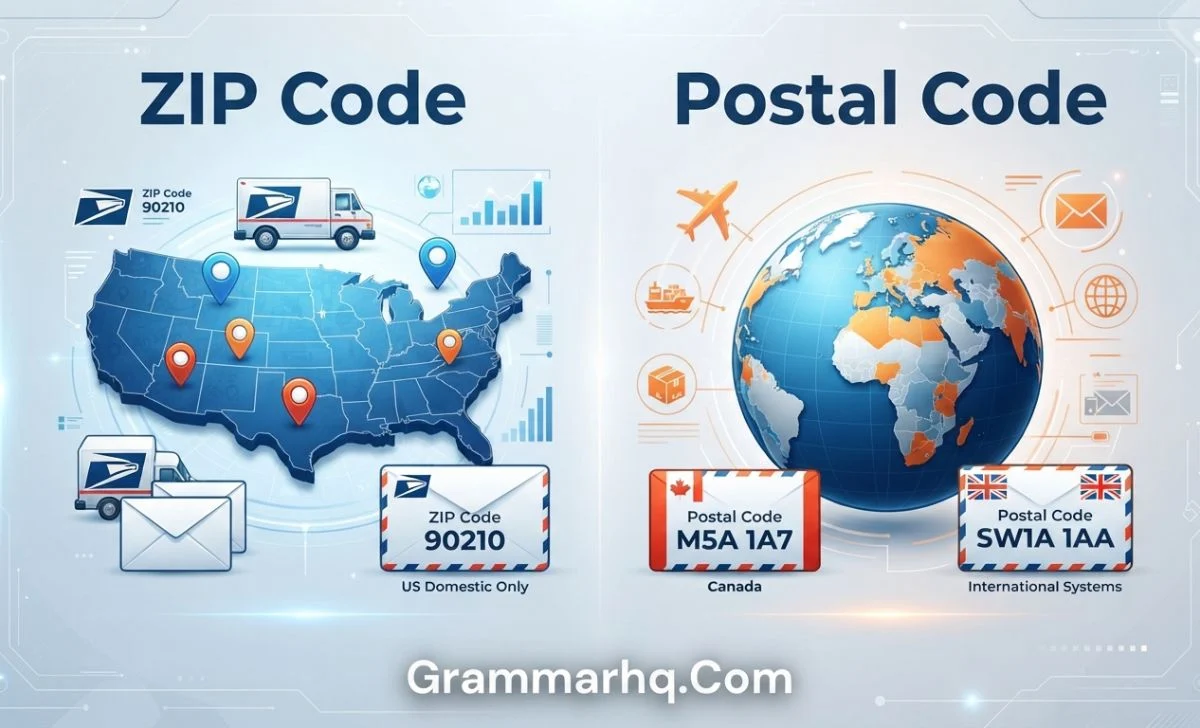
ZIP Code vs. Postal Code can be confusing because both terms refer to codes used to help sort and deliver mail.
The main difference is that ZIP Code is the specific term used in the United States, while postal code is a broader term used for similar addressing systems in many countries.
For example, a U.S. address may use 10001 as its ZIP Code, while a Canadian address may use M5V 3A8 as its postal code. The United Kingdom commonly uses the term postcode, such as SW1A 1AA.
So, if you are filling out an address form, the rule is simple: use the postal code system used by your country. For a U.S. address, that means entering the ZIP Code.
Quick Answer: ZIP Code vs. Postal Code
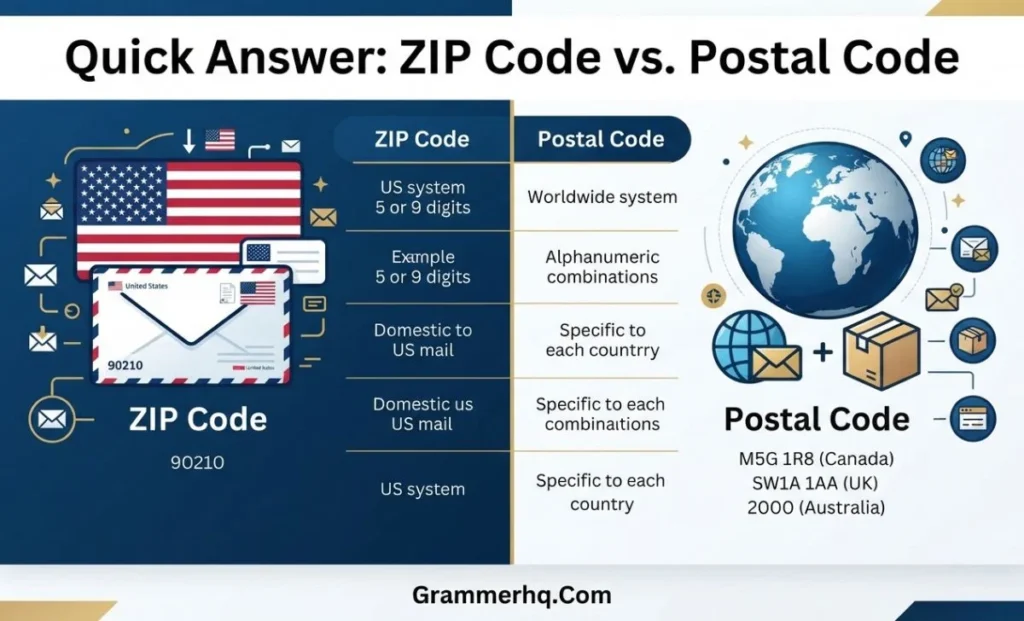
A ZIP Code is the U.S. name for a postal code used to identify geographic areas for mail delivery.
A postal code is the general term for a code that helps postal services identify and route mail to a particular area or delivery location.
The easiest way to remember the difference is:
- ZIP Code → United States
- Postal code → General term used internationally
- Postcode → Common term in the UK and Australia
- Postal code → Common term in Canada
So, a U.S. ZIP Code can be considered a postal code, but a postal code from another country is not necessarily called a ZIP Code.
What Is a ZIP Code?
A ZIP Code is a system used by the United States Postal Service to help organize and deliver mail.
A standard ZIP Code contains five digits, for example:
10001
Some addresses use ZIP+4, which adds four digits to the standard five-digit code:
10001-1234
The extra four digits can provide more specific delivery information.
The word ZIP comes from Zone Improvement Plan, the name associated with the U.S. system introduced in 1963.
Example of a U.S. address
A simplified U.S. address might look like this:
John Smith
123 Main Street
New York, NY 10001
Here, 10001 is the ZIP Code.
If a U.S. website asks for your ZIP Code, it wants the ZIP Code associated with your address.
What Is a Postal Code?
A postal code is a broader term for a code used to identify a geographic area for mail delivery.
Unlike the U.S. ZIP Code system, postal-code systems around the world do not all use the same format.
For example:
| Country | Common term | Example |
|---|---|---|
| United States | ZIP Code | 10001 |
| Canada | Postal code | M5V 3A8 |
| United Kingdom | Postcode | SW1A 1AA |
| Australia | Postcode | 2000 |
The important point is that each country can have its own postal system, terminology, and format.
That is why a postal code does not always look like a five-digit U.S. ZIP Code.
What Is the Difference Between a ZIP Code and a Postal Code?
The difference is primarily the name and the country-specific system.
A ZIP Code specifically refers to the U.S. postal coding system. Postal code is a more general expression that can refer to similar systems used in different countries.
For example:
United States:
10001 → ZIP Code
Canada:
M5V 3A8 → Postal code
United Kingdom:
SW1A 1AA → Postcode
All three codes serve a similar basic purpose, but they belong to different national systems.
So you should not assume that a postal code from another country is a ZIP Code.
Is a ZIP Code the Same as a Postal Code?
A ZIP Code is a type of postal code, but the terms are not completely interchangeable.
Think of postal code as the broader category.
A ZIP Code belongs to that category because it is a code used for postal routing in the United States.
However, Canada has its own postal-code system, and the UK has its own postcode system. Those codes are not U.S. ZIP Codes.
This distinction matters most when you are filling out forms or entering an address online.
What Should You Enter When a Form Says “ZIP/Postal Code”?
This is one of the most useful things to know.
If an online form says:
ZIP/Postal Code
it usually means:
Enter the postal code used for the address you are providing.
For example:
If your address is in the United States
Enter your ZIP Code.
Example:
10001
If your address is in Canada
Enter your Canadian postal code.
Example:
M5V 3A8
If your address is in the United Kingdom
Enter your postcode.
Example:
SW1A 1AA
You generally should not change your country’s postal code into a U.S.-style five-digit number just because the form uses the word “ZIP.”
If the form only accepts five numbers and your country’s postal code contains letters, the problem may be that the website does not properly support your country’s address format.
Why Do Websites Use “ZIP/Postal Code”?
Many websites sell products or provide services to customers in different countries.
Instead of creating a separate field for every country, they may use a general label such as:
ZIP/Postal Code
This allows the same form to work for addresses from multiple regions.
U.S. customer, the field means ZIP Code.
Canadian customer, it means postal code.
UK customer, it generally means postcode.
The label may be different, but the website is asking for the location code associated with your address.
Do All Postal Codes Have Five Numbers?
No.
This is one of the most common misunderstandings.
U.S. ZIP Codes commonly use five digits:
10001
Canada uses letters and numbers:
M5V 3A8
The UK also uses letters and numbers:
SW1A 1AA
Australia commonly uses four digits:
2000
Therefore, you should never assume that a postal code must contain five numbers.
The correct format depends on the country.
ZIP Code vs. Postal Code vs. Postcode
These terms can look like different concepts, but they are often different names for country-specific postal coding systems.
ZIP Code
ZIP Code is the U.S. term.
Example:
90210
Postal code
Postal code is a broad term and is commonly used in countries such as Canada.
Example:
M5V 3A8
Postcode
Postcode is commonly used in the UK and Australia.
Example:
SW1A 1AA
The terminology changes, but the basic purpose is similar: the code helps identify where mail should be routed.
Why Is the Correct Postal Code Important?
A postal code is more than just another part of an address.
It helps postal services and other delivery systems identify the correct geographic area and route mail or packages efficiently.
A wrong or incomplete code can cause problems such as:
- Delivery delays
- Address-validation errors
- Difficulty calculating shipping
- Problems with online checkout forms
- Mail being routed incorrectly
That is why you should use the exact code associated with your address rather than guessing from the city or state.
Common Mistakes About ZIP Codes and Postal Codes
1: Calling every postal code a ZIP Code
A ZIP Code specifically belongs to the U.S. system.
A Canadian postal code or UK postcode should not automatically be called a ZIP Code.
2: Assuming every postal code has five digits
Postal codes have different formats around the world. Some contain numbers only, while others contain both letters and numbers.
3: Entering the city’s code without checking the address
A postal code should correspond to the actual address. Do not simply choose a nearby code because it belongs to the same city.
4: Removing letters from an international postal code
If your country’s postal code contains letters, keep them unless the form specifically provides different instructions.
5: Thinking ZIP Codes are simply city codes
ZIP Codes are part of the U.S. postal delivery system. They do not necessarily match the legal boundaries of cities or towns.
How Can You Tell Which One a Website Wants?
Look at the address form.
If it specifically says:
ZIP Code
and you are entering a U.S. address, enter the U.S. ZIP Code.
If it says:
Postal Code
it is usually using a broader term and may accept the postal code used in your country.
If it says:
ZIP/Postal Code
the website is likely trying to support both U.S. and international addresses.
If the form rejects your valid postal code, do not immediately change the code. Check whether the website has a country selector first. The available postal-code format may depend on the country you selected.
A Simple Comparison
Here is the easiest way to understand it:
| Question | ZIP Code | Postal Code |
|---|---|---|
| What is it? | U.S. postal code system | General term for postal coding systems |
| Mainly associated with | United States | Many countries |
| Can it contain letters? | Standard ZIP Codes are numeric | Depends on the country |
| Example | 10001 | M5V 3A8 |
| Another common term | — | Postcode in some countries |
The key difference is not the basic purpose. Both are used to identify locations for postal delivery. The important difference is the terminology and the country’s specific system.
FAQs
Is a ZIP Code a postal code?
Yes. A U.S. ZIP Code is a type of postal code. However, postal code is the broader term used for similar systems in many countries.
What is a ZIP Code in the UK?
The UK generally does not call its system a ZIP Code. The usual term is postcode.
What is a postal code in the USA?
In the United States, the corresponding term is ZIP Code.
Can a postal code have letters?
Yes. Some countries use alphanumeric postal codes. Canada’s M5V 3A8 and the UK’s SW1A 1AA are examples.
What should I enter for ZIP/Postal Code?
Enter the postal code associated with your address. Use your U.S. ZIP Code for a U.S. address, your Canadian postal code for a Canadian address, and your local postcode or postal code for other countries.
Is ZIP+4 the same as a ZIP Code?
ZIP+4 is an extended version of a standard five-digit ZIP Code. It adds four digits after a hyphen, such as 10001-1234.
Why does my postal code not work on a website?
The website may not support your country’s postal-code format, or the selected country may be incorrect. Check the country field and the website’s address requirements before changing your postal code.
Final Answer: ZIP Code vs. Postal Code
ZIP Code and postal code are closely related, but they are not simply two names for exactly the same system.
ZIP Code is the specific term used for the U.S. postal coding system. Postal code is the broader term used for similar systems in countries around the world.
Other countries may use terms such as postcode and may have completely different formats.
So remember:
U.S. address → ZIP Code
Canadian address → Postal code
UK address → Postcode
And when an international website asks for ZIP/Postal Code, enter the code that belongs to the address and country you selected.
That is the key difference: the purpose is similar, but the name, format, and postal system depend on the country.
Read More Blogs