Hoody or hoodie is a common spelling question because both forms refer to the same type of casual clothing. Both spellings are accepted, but hoodie is the more familiar choice for general writing.
A hoodie is a sweatshirt or similar garment with an attached hood, often worn for warmth and comfort. You may see hoody in dictionaries, clothing descriptions, or informal writing as an alternative spelling.
The best choice for most readers is hoodie, especially when writing articles, school assignments, or product descriptions.
Hoody vs. Hoodie: Quick Comparison
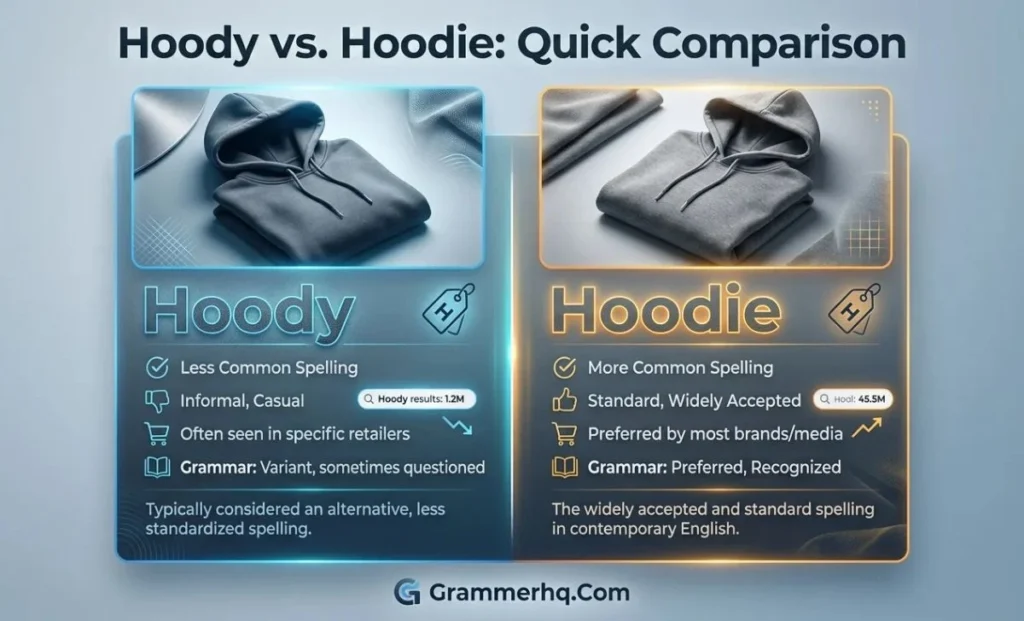
| Feature | Hoodie | Hoody |
|---|---|---|
| Spelling status | Accepted and widely used | Accepted alternative |
| Meaning | A hooded sweatshirt or similar garment | Generally the same |
| Pronunciation | HOO-dee | HOO-dee |
| Part of speech | Noun | Noun |
| Plural form | Hoodies | Hoodies is the standard general form |
| Best use | General and professional writing | When preferred by a brand or context |
The main difference is spelling, not meaning. You can use hoodie confidently in everyday English without worrying that it is limited to one country.
What Does Hoodie Mean?
A hoodie is a casual garment with an attached hood. It is commonly made from cotton, fleece, or a cotton-blend fabric. Some styles have a front pocket, drawstrings, or a zipper, while others are designed to be pulled over the head.
People wear hoodies at home, at school, while travelling, and during outdoor activities. Their comfort and practical design make them a popular choice for everyday clothing.
Examples:
- I wore a warm hoodie on my morning walk.
- She bought a black hoodie to wear to college.
- He packed his favourite hoodie for the weekend trip.
A hoodie may be lightweight or thick, depending on its material and design. Although it is often associated with casual wear and streetwear, it can also be part of sportswear or a work uniform.
Is Hoody a Correct Spelling?
Yes. Hoody is a recognized spelling variant of hoodie, so it should not automatically be treated as a spelling mistake.
The two forms generally have the same meaning and pronunciation. However, hoodie is the more familiar spelling for many readers and is the safer choice when you want your writing to be easily understood by a broad audience.
For example, a clothing store might use hoody in a product listing or brand-specific description. That does not necessarily make the spelling incorrect. If you are writing an article, an educational resource, or a general product description, hoodie is usually the more straightforward option.
For dictionary confirmation, consult the entries for hoodie in Cambridge Dictionary and hoody in Oxford Learner’s Dictionaries. Dictionary entries can differ in how they present a main spelling and an alternative, so check the entry itself rather than assuming that every reference treats both forms identically.
Hoody or Hoodie in American and British English
The spelling choice is not a simple division between American and British English. Hoodie is widely used in both varieties, and hoody is also recognized as an alternative.
In American English, hoodie is a familiar term for a hooded sweatshirt. It appears in everyday conversation, clothing stores, and online shopping descriptions.
In British English, hoodie is also widely understood and used. British writers may encounter hoody as an alternative spelling, but it is inaccurate to say that the alternative belongs exclusively to British English.
Consider these examples:
- American English: I ordered a gray hoodie online.
- British English: She wore a hoodie on the way to university.
Both sentences use natural English. The spelling grey rather than gray may vary by region, but the word hoodie itself does not require a different spelling for British readers.
If your website targets both American and British audiences, choose hoodie and use it consistently throughout your content.
How Do You Pronounce Hoodie and Hoody?
Both spellings are generally pronounced the same way: HOO-dee, represented in IPA as /ˈhʊd.i/.
The first syllable sounds like the word hood, followed by a short ee sound. The spelling difference does not normally change the pronunciation.
For example, someone asking for a hoodie in a clothing shop would generally be understood in the same way whether they had encountered the alternative spelling hoody in writing.
What Is the Plural of Hoodie or Hoody?
The standard plural of hoodie is hoodies. It follows the usual English spelling pattern for a noun ending in a consonant followed by y: change the y to i and add -es.
- One hoodie, two hoodies.
- One black hoodie, three black hoodies.
- The shop sells hoodies in different colours.
The spelling hoodys is not the standard plural form. When referring to more than one garment, use hoodies in ordinary writing.
Hoodie and Hoody Examples in Real-Life Sentences
These examples show how the words can appear in everyday situations.
Shopping: “I’m looking for a comfortable hoodie that I can wear on cold mornings.”
School or college: “Daniel wore his navy hoodie to class because the lecture hall was cold.”
Online product description: “This cotton hoodie features a front pocket and an adjustable drawstring hood.”
Informal writing: “I left my hoody at my friend’s house.”
The last example illustrates the accepted alternative spelling. In a piece of writing where spelling consistency matters, it is sensible to select one form and stick with it.
Which Spelling Should You Use?
Choose hoodie in most situations. It is widely recognized and works well across general, educational, and professional writing.
- School assignments: Use hoodie unless your teacher or style guide specifies otherwise.
- Blog posts and articles: Prefer hoodie for clarity and consistency.
- Online shopping: Use hoodie in general product descriptions, unless an official product or brand name uses another form.
- Editing existing content: Do not automatically flag hoody as an error. Check whether the context supports the alternative spelling.
- Branding and product names: Preserve the spelling used in the official name when referring to a specific product.
The practical rule is simple: use hoodie as your default, recognize hoody as an accepted alternative, and avoid switching between spellings without a reason.
FAQs
Is hoody or hoodie correct?
Both spellings are accepted. Hoodie is the more familiar general choice, while hoody is a recognized alternative.
Is hoody a real word?
Yes. Hoody is used as an alternative spelling for a hooded sweatshirt. It is not automatically an error simply because another spelling is more familiar.
Are hoodie and hoody pronounced the same?
Yes. Both are generally pronounced HOO-dee, with the IPA pronunciation /ˈhʊd.i/.
What is the plural of hoodie?
The standard plural is hoodies. For example, “The shop sells hoodies in several sizes.”
Conclusion
Both hoody and hoodie are accepted spellings for the same type of casual, hooded garment. The difference is mainly a matter of spelling preference rather than meaning or pronunciation.
For most articles, schoolwork, online stores, and everyday communication, hoodie is the clearest default.
If you encounter hoody, you do not need to assume it is wrong; simply consider the context and keep your spelling consistent.
Read More Blogs
- Inter vs Intra: Meaning, Differences, and Examples?
- Repore or Rapport: Which Is Correct?
- Further vs Farther: What’s the Difference?