Repore or rapport is a common spelling confusion because both forms sound similar, but only one is the standard English word for a positive connection between people.
Rapport means mutual understanding, trust, or a comfortable relationship that helps people communicate effectively.
It is often used in education, business, healthcare, and everyday conversations to describe a good connection between individuals.
For example, a teacher may build rapport with students by listening to their concerns and treating them with respect. Repore is a misspelling of rapport when this meaning is intended.
Understanding the difference helps you avoid spelling errors in emails, essays, professional documents, and online writing. This guide explains the correct spelling, meaning, pronunciation, and practical examples.
Quick Answer
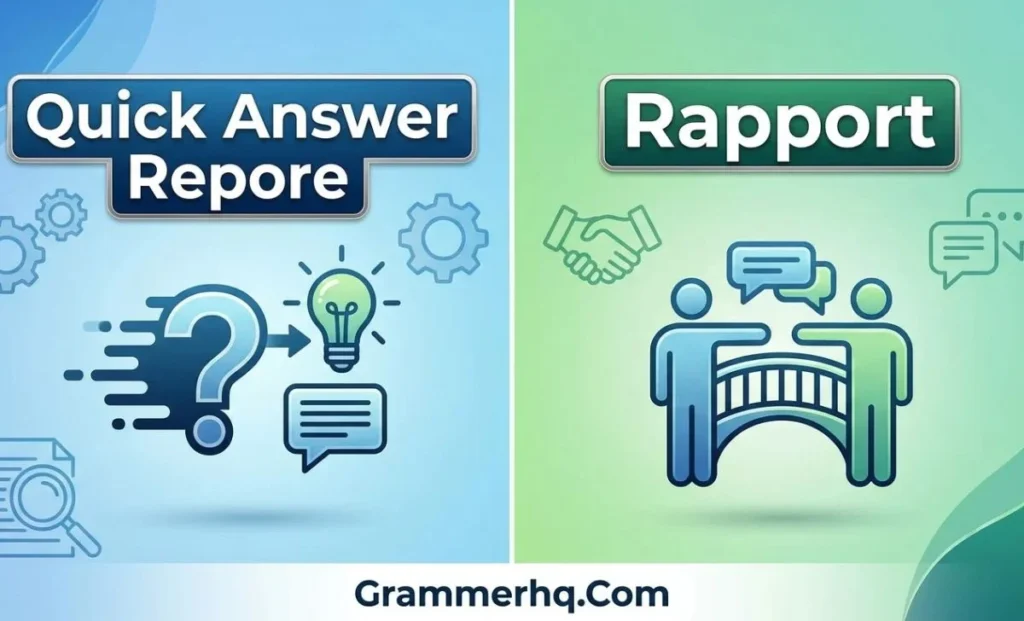
Rapport is the correct spelling. Repore is an incorrect spelling when you mean a good relationship, understanding, or connection between people. Rapport is a noun used in both American and British English. Cambridge Dictionary
| Word | Status | Meaning/Use |
|---|---|---|
| rapport | Correct | A good understanding and ability to communicate well with someone |
| repore | Incorrect | Common misspelling of rapport |
Examples:
- Correct: She has a good rapport with her students.
- Incorrect: She has a good repore with her students.
So, if you mean a positive connection between people, choose rapport.
What Does Rapport Mean?
Rapport is a noun that describes a good understanding between people and an ability to communicate comfortably with each other.
It can involve trust, sympathy, mutual understanding, or an easy flow of communication. Cambridge Dictionary gives the core meaning as a good understanding of someone and the ability to communicate well with them. Cambridge Dictionary
For example:
- The teacher has a strong rapport with her students.
- The doctor developed a good rapport with the patient.
- The manager quickly built rapport with the new employees.
Rapport does not necessarily mean friendship. Two people can have good rapport even when their relationship is professional, such as a doctor and patient, teacher and student, manager and employee, or salesperson and customer.
The central idea is understanding and comfortable communication.
Repore or Rapport Meaning Explained
When people search for repore or rapport, they are usually trying to determine whether the two spellings represent different words.
They do not.
For the meaning of a positive relationship or good understanding, rapport is the standard English word. Repore is generally a phonetic misspelling created from the way rapport sounds when spoken.
You can therefore remember the distinction this way:
Rapport = a good connection or understanding
Repore = incorrect spelling of rapport
For example:
The counselor established a good rapport with the client.
Here, rapport refers to the comfortable and understanding relationship that helps the two people communicate effectively.
Why Do People Confuse Repore and Rapport?
The main reason is pronunciation.
English pronunciation does not always make spelling obvious, and rapport is a particularly easy word to spell incorrectly when you have learned it mainly by hearing it.
Cambridge lists the pronunciation as /ræpˈɔːr/ in US English and /ræpˈɔːr/ with the corresponding UK pronunciation notation. Cambridge Dictionary
The sound can make someone think of a spelling such as repore. The written word, however, contains two p’s and ends in -ort:
R-A-P-P-O-R-T
That difference between sound and spelling is the main source of the confusion.
Other incorrect forms can also appear, including raport, repor, and repoire. These are attempts to represent the word by sound or memory rather than its standard spelling.
The Spelling Rule Behind Rapport
There is no special English spelling rule that lets you derive rapport from its pronunciation. Instead, the best approach is to learn its standard spelling as a whole word.
There are two details worth remembering:
- Rapport has two p’s.
- Rapport ends with t, even though the final letter is not clearly heard in the usual English pronunciation.
The correct spelling is:
R-A-P-P-O-R-T
Because the word does not follow a simple sound-to-letter pattern, trying to spell it entirely from pronunciation can lead to repore. Learning the written form is more reliable.
Why Repore Is Incorrect
Repore is incorrect when you are using it to mean a good relationship or understanding between people.
Frequent online use does not turn repore into an accepted alternative spelling. Current search results show that the confusion is widespread, but the standard word remains rapport. wordclarified.com
Compare these examples:
| Incorrect | Correct |
|---|---|
| We built a good repore with the clients. | We built a good rapport with the clients. |
| She has a strong repore with her students. | She has a strong rapport with her students. |
| The doctor developed repore with the patient. | The doctor developed rapport with the patient. |
The incorrect form usually appears because the writer remembers how the word sounds rather than how it is spelled.
British English vs American English
There is no spelling difference between American and British English here.
| English variety | Correct spelling |
|---|---|
| American English | rapport |
| British English | rapport |
Both varieties use rapport for a good understanding or relationship between people. Cambridge provides both UK and US definitions and pronunciation information for the same word. Cambridge Dictionary
So you should not treat repore as a British spelling and rapport as an American spelling. That distinction does not exist.
How Do You Pronounce Rapport?
Rapport is commonly pronounced roughly like “rah-PORE.”
Cambridge gives these pronunciations:
- UK: /ræpˈɔːr/
- US: /ræpˈɔːr/
The exact sound can vary slightly by accent, but the spelling remains rapport. Cambridge Dictionary
The pronunciation is one reason people write repore. The final t is not pronounced in the usual English pronunciation, so the spelling is not obvious from the sound.
A useful way to remember it is:
Sounds like: “rah-PORE”
Spelled: RAPPORT
Examples in Everyday Sentences
Here are natural examples showing how rapport works in different situations.
Everyday communication
- I developed a good rapport with my new neighbor.
- The two friends have an easy rapport.
Professional communication
- The manager has a strong rapport with her team.
- Good communication helped him build rapport with his clients.
Education
- Experienced teachers often develop rapport with their students.
- Her friendly approach helped her establish rapport with the class.
Healthcare
- The doctor quickly established rapport with the nervous patient.
- A good rapport can make conversations between healthcare professionals and patients more comfortable.
Interviews
- The interviewer spent a few minutes building rapport with the candidate.
- His relaxed manner helped create rapport during the interview.
These examples show that rapport is useful in both personal and professional relationships.
Common Mistakes
The most common problem is replacing rapport with a spelling that matches its pronunciation.
| Incorrect | Correct |
|---|---|
| repore | rapport |
| raport | rapport |
| repor | rapport |
| repoire | rapport |
| good repore | good rapport |
| build repore | build rapport |
| strong repore | strong rapport |
The safest rule is simple: if you mean a positive relationship or comfortable understanding, write rapport.
Related Words and Similar Words
Several words are related to rapport, but they do not always mean exactly the same thing.
- Relationship — a connection between people or groups.
- Connection — a link or sense of closeness between people.
- Understanding — awareness of another person’s thoughts, feelings, or situation.
- Trust — confidence in someone’s reliability or character.
- Harmony — a state in which people or things work well together.
- Empathy — the ability to understand or share another person’s feelings.
Rapport combines some of these ideas, especially understanding and effective communication. That is why someone can have rapport with a coworker, teacher, doctor, client, or student without being close friends.
Easy Memory Trick
Remember the spelling as:
RA + PP + ORT = RAPPORT
Focus on two things:
- Two P’s
- A T at the end
You may hear something close to “rah-PORE,” but write:
R-A-P-P-O-R-T
A simple sentence can also help:
Good rapport makes communication easier.
Why Correct Usage Matters
Using rapport correctly matters most in situations where spelling and word choice need to be clear and professional.
The word commonly appears in:
- Emails
- Business communication
- Resumes
- Academic writing
- School assignments
- Customer service
- Healthcare writing
- Workplace communication
- Content writing
Writing repore in a professional document can make the writer appear unsure of the word. Using rapport avoids that problem and follows standard English spelling.
Rapport vs Report
Although rapport and report look similar, they have different meanings.
Rapport refers to a good understanding, trust, or connection between people.
In contrast, a report is a written or spoken account that provides information about an event, situation, or subject.
Report can mean information about something, a written description, or the act of giving information. Cambridge lists report as both a noun and a verb with several uses. Cambridge Dictionary
Compare:
- The teacher has a good rapport with her students.
- The teacher wrote a report about the students’ progress.
So:
rapport = understanding or relationship
report = information or description
They should not be used interchangeably.
Word Origin / Language History
Rapport is a word borrowed into English from French. Its history helps explain why its spelling may look less predictable from an English pronunciation perspective.
Etymonline traces the English noun to French rapport, with earlier connections to the French verb rapporter. The English word has been used since the 17th century and developed senses involving relationship, harmony, and agreement. Etymonline
This French origin is useful to know because rapport is not spelled according to a straightforward English sound pattern. That helps explain why people may try to write repore after hearing it.
Practice Session: Repore or Rapport
Choose the correct word or spelling for each sentence.
- The new teacher quickly developed a good ______ with her students.
- We need to build ______ with our customers.
- The doctor established a strong ______ with the patient.
- She has excellent ______ with her coworkers.
- The interviewer tried to establish ______ before beginning the questions.
- Which spelling is correct: repore or ______?
- The manager has a positive ______ with his team.
- Good communication helped them develop ______.
- The counselor worked hard to establish ______ with the client.
- Which sentence is correct: “She has good repore with her staff” or “She has good rapport with her staff”?
Answers
- rapport
- rapport
- rapport
- rapport
- rapport
- rapport
- rapport
- rapport
- rapport
- She has good rapport with her staff.
Trusted Source
Cambridge Dictionary is a reliable reference for the meaning and pronunciation of rapport. It identifies rapport as a noun referring to a good understanding and ability to communicate well with someone, and it provides UK and US pronunciation information. Cambridge Dictionary
FAQs
Is it repore or rapport?
Rapport is correct. Repore is an incorrect spelling when you mean a good relationship or understanding between people.
Is repore a real English word?
Repore is not the standard spelling of the word used for a good relationship or understanding. Use rapport in this context.
What does rapport mean?
Rapport means a good understanding between people and an ability to communicate well with each other. Cambridge Dictionary
How do you pronounce rapport?
Rapport is commonly pronounced roughly “rah-PORE.” Cambridge lists /ræpˈɔːr/ for both its UK and US English pronunciation entries, with accent differences possible in actual speech. Cambridge Dictionary
Is rapport spelled differently in British and American English?
No. The standard spelling is rapport in both British and American English. Cambridge Dictionary
What does it mean to build rapport?
To build rapport means to develop a positive relationship in which people understand each other and communicate comfortably.
Is “good rapport” correct?
Yes. “Good rapport” is a standard and natural expression. For example: “She has good rapport with her students.”
Is “strong rapport” correct?
Yes. “Strong rapport” is also natural when describing a well-established positive connection between people.
What is the difference between rapport and report?
Rapport refers to a good relationship or understanding between people, while report can refer to information, a written description, or the act of giving information. Cambridge Dictionary
Why is rapport often misspelled as repore?
The main reason is pronunciation. The word sounds roughly like “rah-PORE,” so people may try to spell it according to the sound instead of remembering its standard spelling, rapport.
Conclusion
When choosing between repore or rapport, the correct spelling is rapport. It is a noun describing a good understanding, positive relationship, or comfortable communication between people. Repore is a common misspelling, not an alternative spelling of the word.
The easiest way to remember rapport is to focus on its written form: two P’s and a final T. Although the final t is not clearly pronounced, it belongs in the spelling.
So when you mean a good connection with someone, remember:
Build rapport — not repore.
Read More Blogs
- Humorous vs. Humerous: Which Spelling Is Correct?
- Paid or Payed: Which Is Correct? Meaning, Rules & Examples