Bass vs base can be confusing because the two words sound identical in some situations but have different meanings.
Bass usually refers to low musical sounds, musical instruments, or a type of fish, while base means a foundation, starting point, or place used for a particular purpose.
The difference becomes especially interesting because bass has two pronunciations: one for music and another for fish. Both spellings are correct, so choosing the right one depends on the context.
Whether you are writing about music, fishing, baseball, buildings, or business, understanding these differences will help you use each word accurately.
Quick Answer: Bass vs Base
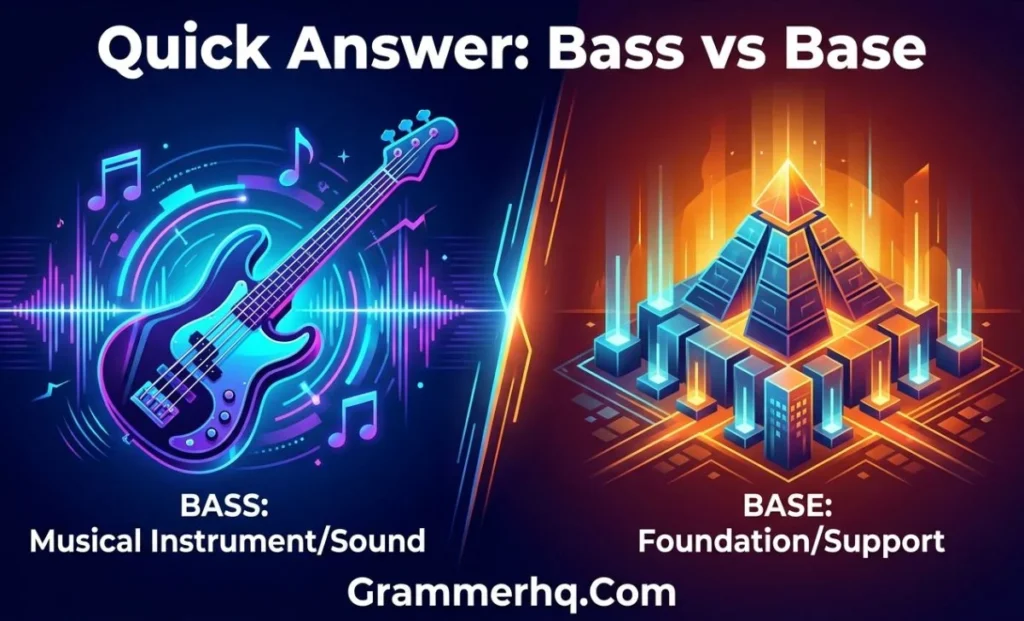
Bass refers to low musical sounds, instruments such as the bass guitar, or certain types of fish. Base refers to a foundation, starting point, central location, or other underlying support.
- The bass in this song is too loud. — Music
- The lamp has a solid wooden base. — Foundation
- We caught a bass in the lake. — Fish
- The team returned to base camp. — Starting point
Remember: both words are correct, but their meanings determine which spelling you need.
What Does Bass Mean?
Bass is a noun commonly used in music and fishing. Its meaning depends on the context, and its pronunciation changes accordingly.
Bass in Music
In music, bass refers to the lower range of musical pitches or to instruments that produce those notes. Bass sounds give music depth and help support its rhythm and harmony.
Common musical terms include:
- Bass guitar: An instrument that usually plays low notes in a band.
- Double bass: A large string instrument used in orchestras, jazz, and other musical styles.
- Bass drum: A drum that produces a deep, low sound.
- Bass line: A sequence of low notes that supports a musical arrangement.
- Bass voice: A voice with a low vocal range.
- Bass clef: A musical symbol used to notate lower-pitched notes.
For example, a bass guitarist may work closely with the drummer to create a steady rhythm, while a subwoofer reproduces the low-frequency sounds in a music system.
Examples:
- The bass guitar gave the song a fuller sound.
- The singer has a deep bass voice.
- Turn down the bass if the low frequencies sound too powerful.
- The drummer used a bass drum to strengthen the beat.
In these examples, bass relates to sound, music, or musical equipment.
Bass as a Type of Fish
Bass also names several types of fish found in freshwater and marine environments. Different species include largemouth bass, smallmouth bass, striped bass, and sea bass.
Bass fishing is popular among anglers, particularly in areas where freshwater species are common. Some types of bass are also sold as food.
Examples:
- My uncle caught a largemouth bass in the lake.
- The restaurant served grilled sea bass with lemon.
- She bought a new fishing rod for bass fishing.
Here, bass refers to a fish rather than a musical sound. The surrounding words usually make the intended meaning clear.
What Does Base Mean?
Base refers to a foundation, supporting part, starting point, or central location. It can also describe the underlying basis of a decision, calculation, or argument.
Unlike bass, the word base has a broad range of uses in everyday English, business, sports, and science.
Base as a Foundation or Supporting Part
The base of an object is often the bottom part that supports it or helps keep it stable. It may be made of wood, stone, metal, concrete, or another material.
Examples:
- The statue stands on a wide stone base.
- The table has a heavy metal base.
- Engineers reinforced the base of the building to improve its stability.
In each sentence, base identifies the part that supports the object or structure.
Base as a Starting Point or Location
A base can also be a place from which people organize activities, conduct operations, or begin a journey.
Common expressions include military base, air base, home base, base camp, and base of operations.
Examples:
- The soldiers returned to their military base.
- The climbers established a base camp before attempting the summit.
- The company used Chicago as its base of operations.
The same idea appears in business expressions such as customer base and user base. These terms describe the people who buy from or use a company.
For example, an online store may expand its customer base by offering products in more locations.
Base in Baseball
In baseball, a base is one of the four stations that runners must reach in order to score. The bases are first base, second base, third base, and home plate, which serves as the final scoring destination.
Examples:
- The runner slid safely into third base.
- The batter reached first base after hitting the ball.
This meaning also appears in the expression touch base, which means to make contact or check in with someone.
For example: “I’ll touch base with the manager tomorrow to discuss the schedule.”
Base in Mathematics and Chemistry
In mathematics, a base is the number on which a positional number system is built. The decimal system uses base 10, while the binary system used in computing uses base 2.
In chemistry, a base is a substance defined by how it behaves chemically, including its reactions with acids. In introductory chemistry, basic aqueous solutions generally have a pH above 7 at 25°C.
Examples:
- The computer represents data using a binary system with base 2.
- The students studied how acids and bases react in the laboratory.
The word also appears in the phrase based on, which means founded on or developed using particular information.
For example: “The report was based on data collected during the survey.”
Bass vs Base: Key Differences
| Feature | Bass | Base |
|---|---|---|
| Main meanings | Low musical sounds, instruments, or fish | Foundation, starting point, location, or underlying basis |
| Pronunciation | /beɪs/ for music; /bæs/ for fish | /beɪs/ |
| Common contexts | Music, audio, fishing | Buildings, baseball, business, science |
| Example | The bass guitar sounds powerful. | The table has a sturdy base. |
The main distinction is meaning, not correctness. Neither word is a misspelling of the other.
Bass vs Base: Pronunciation Difference
The pronunciation of bass depends on which meaning you intend.
- Bass in music: Pronounced /beɪs/, rhyming with face.
- Bass as a fish: Pronounced /bæs/, rhyming with mass in standard American English.
- Base: Pronounced /beɪs/, also rhyming with face.
When bass refers to music, it and base are homophones: they sound the same but have different spellings and meanings.
The word bass is also a homograph with different pronunciations, depending on whether it refers to music or a fish. Such words are often called heteronyms.
This explains why hearing a word alone may not be enough to determine its spelling. If someone says, “Turn up the bass,” the musical context points to bass. If someone says, “We caught a bass,” the fishing context identifies the fish.
Bass vs Base in Real-Life Sentences
These examples show how the surrounding context helps you choose the right spelling.
Music and Audio
- Correct: The bass in the recording is too loud.
- Incorrect for this meaning: The base in the recording is too loud.
The sentence refers to low-frequency sound, so bass is the appropriate word.
Buildings and Furniture
- Correct: The lamp has a wide base.
- Incorrect for this meaning: The lamp has a wide bass.
The supporting part of the lamp is its base.
Fishing
- Correct: We caught a bass during our fishing trip.
- Incorrect for this meaning: We caught a base during our fishing trip.
The intended meaning is a fish, so use bass.
Business Communication
- Correct: I’ll touch base with you after the meeting.
- Incorrect: I’ll touch bass with you after the meeting.
Touch base is an established expression meaning to contact someone or briefly check in.
Describing a Story
- Correct: The film is based on a true story.
- Incorrect: The film is bassed on a true story.
The expression based on indicates that something was developed from a source, idea, or set of facts.
Common Mistakes When Using Bass and Base
Because musical bass and base sound alike, writers sometimes choose the wrong spelling. The following distinctions can prevent common errors:
- Bass guitar, not base guitar: The musical instrument is called a bass guitar.
- Base camp, not bass camp: A base camp is a central camp used to prepare for activities such as climbing.
- Bass fishing, not base fishing: The correct expression refers to fishing for bass.
- Base of a building, not bass of a building: Use base for the supporting part of a structure.
- Based on, not bassed on: The correct expression means founded on or derived from something.
One useful habit is to identify the thing being described before choosing the spelling. If the sentence concerns sound or fish, bass may be correct. If it concerns support, location, or a starting point, base is usually the right choice.
How to Remember Bass vs Base
Use these two simple associations:
- Bass = music or fish. Think of a bass guitar or a fish in a lake.
- Base = foundation or starting point. Think of the base of a lamp or a base camp.
For example, a musician plays a bass guitar while standing on a stage with a solid base beneath a speaker. The two words appear in the same situation but refer to different things.
Remember that pronunciation can help, but context is the more reliable guide when the words sound identical.
FAQs
Is it bass or base?
Both are correct words. Use bass for low musical sounds, bass instruments, and certain fish. Use base for a foundation, starting point, central location, or underlying basis.
Are bass and base pronounced the same?
Musical bass and base are pronounced /beɪs/ in standard American English. Fish-related bass is pronounced /bæs/, so its vowel sound is different.
Is it bass guitar or base guitar?
The correct expression is bass guitar. It refers to a musical instrument that plays low notes and helps support a song’s rhythm and harmony.
Is it base camp or bass camp?
The correct expression is base camp. It describes a central camp used as a starting point or operational location, particularly during mountain climbing and outdoor expeditions.
Why is musical bass spelled differently from base?
The musical word bass has its own historical spelling and refers to low musical pitches. Although it sounds like base, the two words developed with different meanings and are not interchangeable.
Are bass and base homophones?
Yes, when bass refers to music. In that sense, both words have the same pronunciation but different spellings and meanings. Fish-related bass is pronounced differently.
What does touch base mean?
Touch base means to contact someone, exchange updates, or briefly check in. For example, “Let’s touch base on Friday to review the project.”
Conclusion
Bass and base are both correct English words, but their meanings are different. Use bass when discussing music, low-frequency sounds, or fish.
Choose base when referring to a foundation, starting point, location, or underlying basis. Because musical bass and base sound alike, context is the best way to identify the correct spelling.
Once you recognize what each word describes, choosing between them becomes straightforward.
Read More Blogs