Habit vs habbit is a common spelling confusion, especially when you are unsure whether the word needs one “b” or two.
The good news is that the answer is simple: habit is the correct spelling, while habbit is a common misspelling.
If you are writing about a repeated behavior, daily practice, or something you regularly do, always use habit.
But why does habbit look so convincing, and how can you remember the correct spelling without second-guessing yourself?
In this guide, we’ll explain the difference between habit and habbit, their meanings, pronunciation, word forms, British and American usage, common mistakes, and practical examples so you can use the correct spelling confidently every time.
Quick Answer
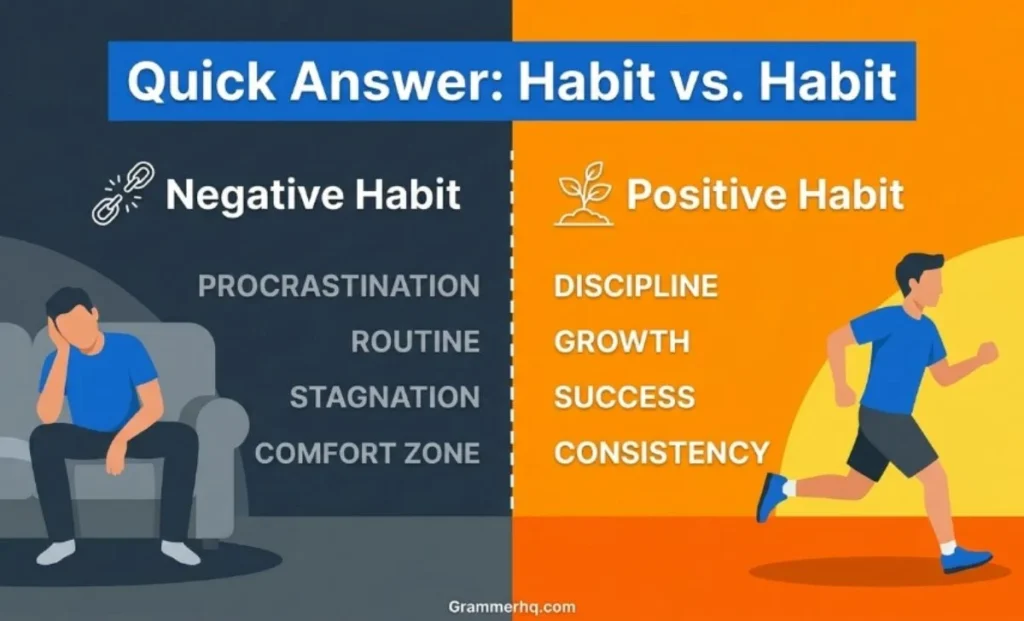
Habit is correct. Habbit is incorrect.
| Word | Status | Meaning |
|---|---|---|
| Habit | ✅ Correct | A regular or repeated behavior |
| Habbit | ❌ Incorrect | A common misspelling of habit |
The easiest rule to remember
Habit has one B.
For example:
- ✅ Reading every day is a good habit.
- ❌ Reading every day is a good habbit.
If you are writing in standard English, choose habit every time.
What Does “Habit” Mean?
Habit is a noun used for something a person does regularly or repeatedly. With repetition, a behavior can become something you do almost automatically.
For example:
She has a habit of checking her phone before going to sleep.
Here, habit describes a repeated behavior.
Habits can be:
- Good: exercising regularly
- Bad: staying up too late
- Healthy: drinking enough water
- Unhealthy: eating too much junk food
- Neutral: checking the time frequently
The word is commonly used when talking about health, studying, work, relationships, lifestyle, and daily routines.
Everyday Examples
Reading before bed has become a habit.
He is trying to develop better study habits.
Leaving everything until the last minute is a bad habit.
Walking after dinner is part of her daily habits.
Why Is “Habbit” a Common Mistake?
The incorrect spelling habbit looks convincing because English contains many words with double consonants. Learners may therefore assume that habit follows the same pattern.
Another reason is simple visual memory. When people hear or say HAB-it, they may remember the sound correctly but still be uncertain about how many b’s belong in the written word.
Typing quickly can also produce the extra letter.
But none of these reasons changes the spelling:
habit = standard English
habbit = misspelling
It is also important to understand that habbit is not a British variant or an American variant. The correct spelling is the same across both major varieties of English.
How Do You Spell Habit?
The correct spelling is:
H-A-B-I-T
There is only one B.
A simple way to remember it is to break the word into two parts:
HAB + IT = HABIT
Don’t add another b.
The same rule applies when you make it plural:
habit → habits
Not:
habbit → habbits
A Simple Memory Trick
Think:
One habit, one B.
This is only a spelling trick not the historical origin of the word but it makes the correct form easy to remember.
Habit Pronunciation
The standard pronunciation of habit is approximately:
/ˈhæbɪt/
It sounds roughly like:
HAB-it
The first syllable receives the main stress.
Notice that the pronunciation does not require a double b. English spelling and pronunciation do not always correspond perfectly, so hearing the word alone may not tell you exactly how to spell it.
Habit in British English vs. American English
Unlike words such as colour/color or organise/organize, habit does not have different British and American spellings.
| Variety | Correct spelling |
|---|---|
| British English | habit |
| American English | habit |
So whether your audience is in London, New York, Toronto, Sydney, or elsewhere, habit is the standard spelling.
Habbit is incorrect in both varieties.
Habit: Grammar and Related Word Forms
Understanding the word family can help you use habit more accurately.
| Word | Part of Speech | Example |
|---|---|---|
| habit | Noun | Reading is a useful habit. |
| habits | Plural noun | Good habits take time to build. |
| habitual | Adjective | His habitual lateness became a problem. |
| habitually | Adverb | She habitually checks her calendar. |
| habit-forming | Adjective | Some behaviors can become habit-forming. |
The key distinction is simple: habit is the noun, while habitual describes something that happens regularly or repeatedly.
Common Expressions With “Habit”
You will often see habit in everyday expressions. Learning these phrases is more useful than memorizing the definition alone.
Get Into the Habit
To start doing something regularly.
I’m trying to get into the habit of exercising in the morning.
Break a Habit
To stop doing something that has become regular.
She wants to break the habit of checking social media during work.
Be in the Habit of
To regularly do something.
He is in the habit of making a list before starting work.
Out of Habit
To do something automatically because you are accustomed to doing it.
I reached for my phone out of habit.
Make a Habit of Something
To make an action a regular practice.
Don’t make a habit of arriving late.
Force of Habit
To do something because it has become automatic.
I locked the door twice out of force of habit.
These expressions show why habit is such a common word in everyday English.
Habit vs. Routine: What’s the Difference?
Habit and routine are closely related, but they are not interchangeable in every situation.
A habit is a repeated behavior that can become automatic.
A routine is a regular pattern or sequence of activities.
For example:
My morning routine includes breakfast, a shower, and checking my calendar.
One part of that routine might be:
Drinking coffee after breakfast is one of my habits.
A useful shortcut is:
Habit = repeated behavior
Routine = regular sequence of activities
Habit vs. Hobby vs. Addiction
These words can overlap in everyday conversations, but they have different meanings.
Habit
A repeated behavior:
Checking your email every morning can become a habit.
Hobby
An activity you enjoy doing in your free time:
Photography is his favorite hobby.
Addiction
A compulsive dependence that can be difficult to control:
Addiction can seriously affect a person’s health and daily life.
A hobby is usually something you choose for enjoyment. A habit is something repeated. An addiction involves a much stronger form of dependence or compulsion.
Common Spelling Mistakes With Habit
The extra b is the main spelling problem.
| ❌ Incorrect | ✅ Correct |
|---|---|
| habbit | habit |
| habbits | habits |
| good habbit | good habit |
| bad habbit | bad habit |
| daily habbit | daily habit |
| healthy habbits | healthy habits |
Example
❌ Exercise is a good habbit.
✅ Exercise is a good habit.
Another Example
❌ He is trying to develop healthy habbits.
✅ He is trying to develop healthy habits.
The plural does not introduce a second b. It simply adds s:
habit → habits
Habit in Real-Life English
Here are some natural examples showing how habit is used in different situations:
- Reading for 20 minutes before bed is a relaxing habit.
- She developed the habit of planning her day every morning.
- Checking your phone constantly can become a difficult habit to break.
- Good study habits can make learning more effective.
- He has a bad habit of interrupting people.
- Walking after dinner has become part of my daily routine.
- I opened the app out of habit, even though I had nothing to check.
- It takes consistency to turn a new behavior into a habit.
- Her habit of arriving early makes her a reliable coworker.
- Small healthy habits can make a difference over time.
Where Does the Word “Habit” Come From?
The history of habit is older than its modern meaning of a repeated behavior.
The English word ultimately comes from the Latin habitus, which was associated with condition, character, appearance, or manner. It passed through French before becoming part of English.
Historically, habit could also refer to dress or clothing, which is why the word can still appear in specialized contexts involving a person’s attire or outward appearance.
Over time, one important sense developed around a person’s usual behavior or tendency, giving us the everyday meaning we use today.
The history is interesting, but one thing has remained consistent for modern English writers: the standard spelling is habit, with one b.
Is “Habbit” Ever Correct?
No, not when you mean the English word “habit.”
Habbit is not an alternative spelling. It is simply a common misspelling.
So if you mean a repeated behavior, use:
habit ✅
For example:
Reading every day is a good habit.
Not:
Reading every day is a good habbit. ❌
The same applies whether you are writing formal English, everyday English, British English, or American English.
FAQs
1: Is it habit or habbit?
Habit is the correct spelling. Habbit is a misspelling.
2: Is “habbit” a correct English word?
No. Habbit is not the standard spelling of habit. Use habit when referring to a regular or repeated behavior.
3: Does habit have one B or two?
Habit has one B. The correct spelling is H-A-B-I-T.
4: What is the plural of habit?
The plural form is habits.
Good habits can improve your daily life.
5: How do you spell habit?
Spell it H-A-B-I-T. Remember: there is only one B.
6: Why do people spell habit as habbit?
The mistake may come from confusion with English words that contain double consonants, uncertainty about spelling, or a simple typing error. However, the standard spelling is always habit.
7: Is habit spelled differently in British and American English?
No. Both British and American English use habit.
8: Is habit a noun?
Yes. Habit is primarily a noun.
Example:
Exercise is an important habit.
9: What is the difference between a habit and a routine?
A habit is a repeated behavior that can become automatic, while a routine is a regular sequence or pattern of activities.
10: How do you pronounce habit?
Habit is commonly pronounced /ˈhæbɪt/, approximately HAB-it.
Final Verdict
There is no spelling dilemma once you know the rule: habit is correct, and habbit is incorrect. The word habit refers to a regular or repeated behavior and is spelled with one “b” in both British and American English.
Its plural is habits, and related forms include habitual and habitually. So whenever you are writing about a daily behavior, routine, or repeated action, choose habit, never habbit.
Read More Blogs:
- Succesful vs Successful: Which Spelling Is Correct?
- Stich vs Stitch: Correct Spelling, Meaning, and Usage