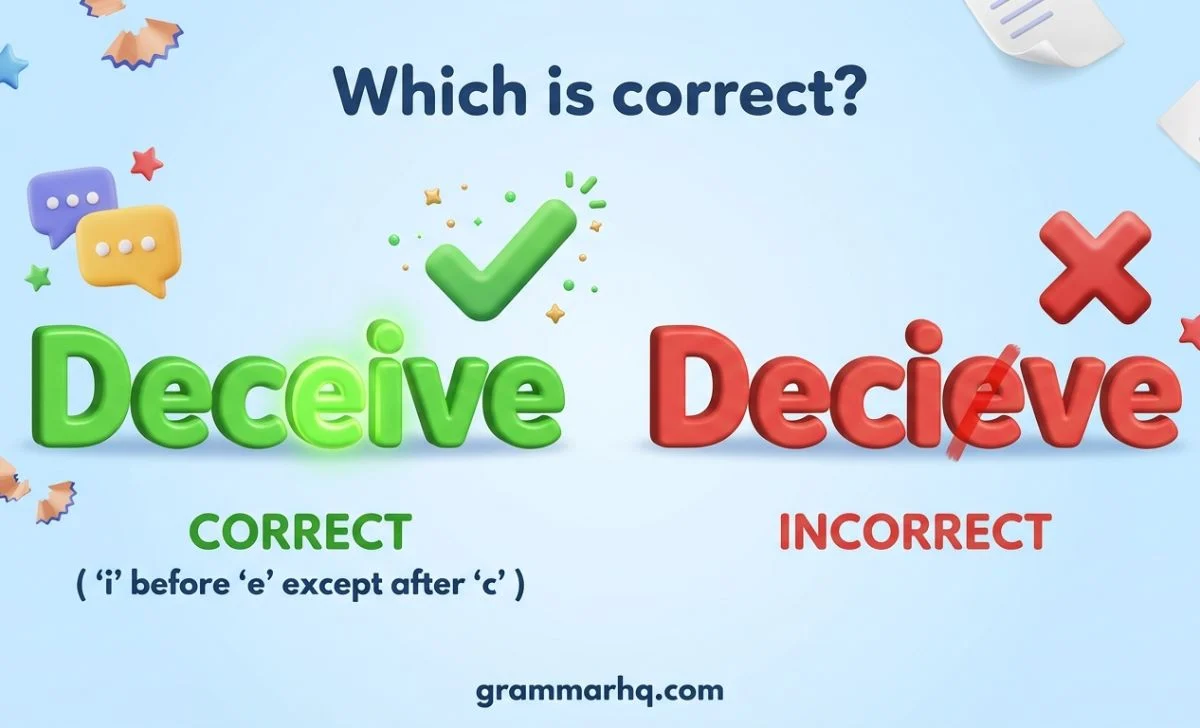
Deceive vs Decieve: Deceive is the correct spelling, while decieve is a common spelling mistake. The word deceive means to mislead someone or make them believe something that is not true.
For example, a seller might deceive a customer by hiding a product’s defects. The confusion usually comes from mixing up the letters e and i.
Fortunately, you can remember the correct spelling by comparing it with words such as receive, perceive, and conceive.
Learning this simple spelling pattern will help you avoid the mistake in schoolwork, emails, and professional writing.
Quick Answer: Deceive vs Decieve
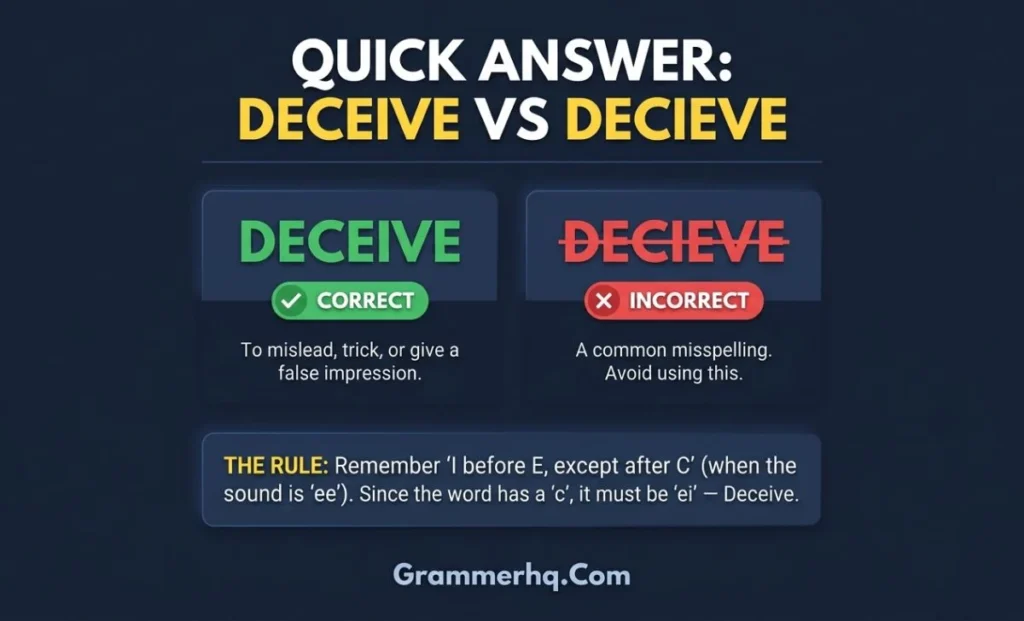
- Deceive: Correct spelling.
- Decieve: Incorrect spelling.
- Meaning: To mislead someone or cause them to believe something false.
- Example: The seller tried to deceive the buyer about the car’s condition.
Remember CEI, not CIE. This simple distinction will help you choose the correct spelling whenever you write the word.
Deceive vs Decieve: What Is the Difference?
The main difference between deceive vs decieve is that deceive is the correct spelling, while decieve is a misspelling.
The correct word means to mislead someone or make them believe something that is not true. Standard English does not recognize decieve as a separate word.
| Feature | Deceive | Decieve |
|---|---|---|
| Spelling | Correct | Incorrect |
| Standard English usage | Yes | No |
| Part of speech | Verb | — |
| Meaning | To mislead someone | No separate standard meaning |
| Example | He tried to deceive his customers. | Incorrect spelling |
Therefore, use deceive in essays, business emails, reports, and everyday messages. If you spot decieve while proofreading, correct it before sharing your writing.
Why Is Deceive the Correct Spelling?
The correct spelling follows this letter sequence: D-E-C-E-I-V-E. In decieve, the letters i and e appear in the wrong order.
To remember the correct pattern, connect deceive with these familiar words:
- Receive
- Perceive
- Conceive
- Deceive
All four words share the -ceive ending. As a result, learning them together can make the spelling easier to remember.
However, English spelling does not follow one universal rule for i and e. For instance, believe and friend use different letter patterns. Instead of relying entirely on the saying “i before e,” memorize the spelling of deceive and its related words.
How to Remember the Spelling of Deceive
Try this simple memory trick: “Don’t deceive yourself—remember CEI.”
When proofreading, check the letters after dec. If you wrote decieve, rearrange the i and e to form deceive. With practice, you will recognize the correct pattern more quickly.
What Does Deceive Mean?
Deceive means to lead someone to believe something that is not true. People may deceive others by lying, hiding important information, or creating a misleading impression.
For example, imagine someone selling a used laptop. The seller knows that the battery no longer works but tells the buyer that the laptop functions perfectly. In this situation, the seller tries to deceive the buyer by concealing an important fact.
The words mislead, trick, and fool have similar meanings. However, they do not always communicate exactly the same idea. Deceive often suggests dishonesty or deliberate concealment, while mislead can also describe giving someone incorrect information without intending to lie.
Deceive in Real-Life Example Sentences
- At school: The student tried to deceive the teacher by inventing an excuse for missing the assignment.
- While shopping: The advertisement could deceive customers by exaggerating the product’s benefits.
- In a relationship: She felt betrayed when she discovered that her friend had deceived her.
- At work: Businesses should never deceive customers about additional fees.
- In everyday life: Appearances can be deceptive, so check the facts before making an important decision.
These examples show how deceive works in different situations while retaining the same basic meaning.
Deceive, Deceived, and Deceiving: What Is the Difference?
The verb changes form according to the sentence. Learning these forms also helps you avoid related spelling errors.
| Word | Usage | Example |
|---|---|---|
| Deceive | Base verb | Never deceive your customers. |
| Deceives | Present tense with he, she, or it | He deceives people with false promises. |
| Deceived | Past tense | The advertisement deceived several buyers. |
| Deceived | Past participle | They were deceived by the false claim. |
| Deceiving | Present participle | The seller is deceiving customers. |
Watch out for these common mistakes:
- Decieve → Deceive
- Decieved → Deceived
- Decieving → Deceiving
Notice that the correct past-tense spelling is deceived, while the -ing form is deceiving. Once you learn the base spelling, you can recognize these related forms more easily.
What Are the Related Words of Deceive?
Several words share the same root but serve different grammatical purposes.
| Word | Part of speech | Meaning |
|---|---|---|
| Deception | Noun | The act or practice of misleading someone |
| Deceptive | Adjective | Giving a false or misleading impression |
| Deceiver | Noun | A person who deceives others |
| Deceitful | Adjective | Dishonest or intended to mislead |
| Deceit | Noun | Dishonest behavior |
For example, consider this sentence: “The company deceived its customers, and the deception damaged its reputation.”
Here, deceived describes the action, while deception names that action. Understanding this distinction will help you select the right word when writing.
FAQs
Is decieve ever correct?
No. Standard English uses deceive. The spelling decieve is incorrect, even though writers sometimes use it by mistake.
How do you spell deceive correctly?
Spell it D-E-C-E-I-V-E. Remember the -ceive pattern shared by receive, perceive, and conceive.
What is the past tense of deceive?
The past tense is deceived. For example, “The dishonest seller deceived the customer.”
How do you pronounce deceive?
The pronunciation is /dɪˈsiːv/, with stress on the second syllable. The final sound rhymes with leave.
What are some synonyms for deceive?
Common synonyms include mislead, trick, fool, dupe, and delude. However, choose the word that best fits your context because each has a slightly different meaning.
What is the opposite of deceive?
Depending on the context, possible opposites include tell the truth, be honest, and inform. These expressions describe truthful communication rather than misleading someone.
Conclusion
When comparing deceive vs decieve, remember to use deceive with the –ceive letter pattern. This simple spelling tip will help you avoid the mistake in everyday and professional writing.
Ultimately, using the correct spelling and word forms will make your writing clearer and more accurate.
Read More Blogs
- Emasculate vs Demasculate: Which Word Is Correct?
- Nosey or Nosy: Which Spelling Is Correct?
- Camouflage Vs Camoflage: Which Spelling Is Correct?
- Diverse vs Divers: Meaning, Difference, and Correct Usage

Hi, I’m Amelia Parker, a grammar enthusiast and writer at GrammarHQ.com. I specialize in explaining spelling differences, confusing words, and common English mistakes through simple, practical, and easy-to-understand guides.