Hola and ola can look almost identical, but they are not interchangeable. If you are trying to say “hello” in Spanish, the correct word is hola. The h is silent, so hola is pronounced roughly like “OH-lah.”
Ola is a different Spanish word. It means “wave,” as in a wave in the ocean. In English, ola can also appear in other languages or contexts, but it is not the standard Spanish spelling of “hello.”
Quick Answer
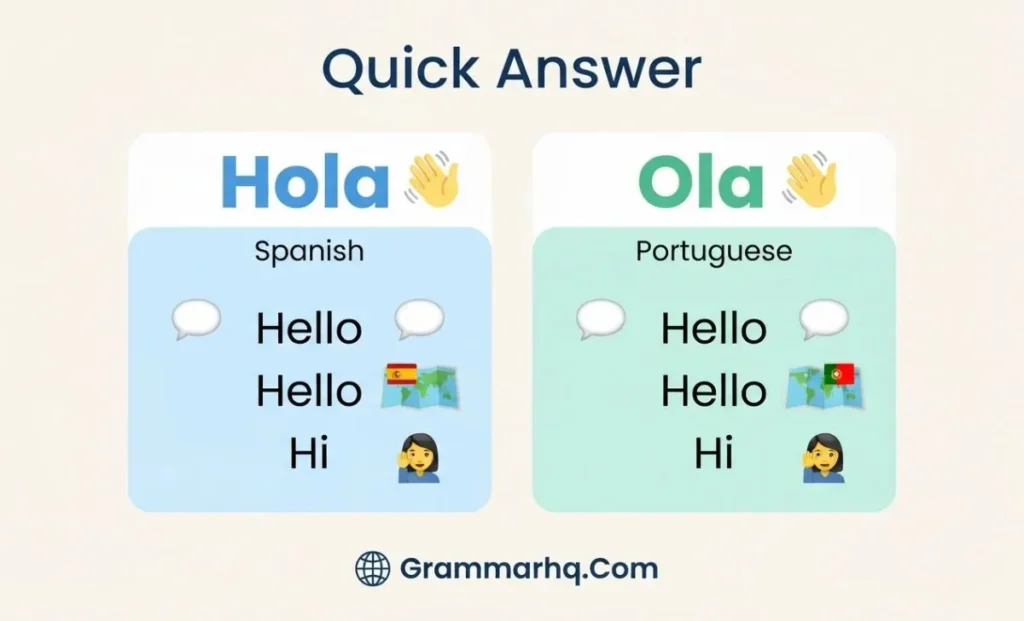
- Hola = “hello” or “hi” in Spanish.
- Ola = “wave” in Spanish.
- Hola is pronounced like “OH-lah” because the Spanish h is silent.
- If you are greeting someone in Spanish, use hola, not ola.
So, if you want to write “Hello!” in Spanish, write:
¡Hola!
What Does “Hola” Mean?
Hola is the common Spanish word for “hello” or “hi.” It is used as a greeting when you meet someone, start a conversation, answer someone informally, or address a group of people.
For example:
- ¡Hola! ¿Cómo estás? — Hello! How are you?
- Hola, Ana. — Hi, Ana.
- ¡Hola a todos! — Hello, everyone.
It is a very common and flexible Spanish greeting.
Is the H Pronounced in “Hola”?
No. The h in Spanish is silent.
That means hola is not pronounced with an English-style “h” sound. It sounds approximately like:
OH-lah
This silent h is one reason English speakers may sometimes write ola instead of hola.
However, pronunciation does not change the spelling. When you mean the Spanish greeting, the standard spelling is still hola.
What Does “Ola” Mean?
In Spanish, ola is a noun meaning “wave.”
It can refer to a wave in the sea or another type of wave-like movement.
For example:
- La ola es muy grande. — The wave is very big.
- Una ola golpeó el barco. — A wave hit the boat.
So although ola sounds the same as hola, it has a completely different meaning.
Why Does “Ola” Sound Like “Hola”?
Because the h is silent in Spanish, the words are pronounced the same:
hola → OH-lah
ola → OH-lah
This makes them homophones: words that sound alike but have different spellings and meanings.
Hola vs. Ola: The Main Difference
The easiest way to remember the difference is:
| Word | Meaning | Use |
|---|---|---|
| hola | hello / hi | Greeting someone |
| ola | wave | Talking about a wave |
The missing h completely changes the meaning.
Example
If you are greeting a Spanish-speaking friend, write:
¡Hola, Carlos!
If you are talking about an ocean wave, write:
La ola era enorme.
Writing ola when you mean “hello” is therefore a spelling mistake in Spanish.
Why Do People Write “Ola” Instead of “Hola”?
The most common reason is simple: Spanish h is silent.
Someone who hears hola pronounced as “OH-lah” may reasonably assume that the word starts with o rather than ho.
This can be especially confusing for English speakers because English h is normally pronounced in words such as hello, house, and happy.
But Spanish works differently. The h is silent, so the sound alone does not tell you that the word contains an h.
There is also a second possibility: ola is a real Spanish word, but it means “wave,” not “hello.” That makes the spelling difference especially important.
Is “Ola” Ever Correct?
Yes. Ola is a correctly spelled Spanish word when you mean “wave.”
It is not correct as the standard spelling of the Spanish greeting.
Compare:
¡Hola! = Hello!
La ola es alta. = The wave is high.
So it would be incorrect to say that ola is always wrong. Its correctness depends on what you are trying to say.
Hola or Ola: Which One Should You Use as a Greeting?
Use hola.
If your intended meaning is “hello,” “hi,” or a similar greeting in Spanish, the correct spelling is:
¡Hola!
Not:
¡Ola!
The word ola should be used when you mean “wave.”
Is “Hola” Formal or Informal?
Hola is a general Spanish greeting and can be used in many everyday situations. It is common in casual conversations, but it can also be used when greeting someone in a more polite or professional setting.
The level of formality usually comes from the rest of the greeting and the situation, rather than from hola itself.
For example:
- Hola, ¿cómo estás? — Hi, how are you?
- Hola, señor García. — Hello, Mr. García.
- Hola a todos. — Hello, everyone.
For more formal situations, Spanish speakers may choose a more specific greeting depending on the time of day, such as buenos días (“good morning”) or buenas tardes (“good afternoon”).
How Do You Remember Hola vs. Ola?
A simple memory trick is:
H = Hello → Hola
When you are greeting someone, remember the H in hello and the H in hola.
For ola, think:
Ola = Ocean wave
This is not a linguistic rule; it is simply an easy memory aid.
Common Mistake: “Ola” for “Hello”
A person may write:
Ola, ¿cómo estás?
when they intend to write:
Hola, ¿cómo estás?
The problem is not pronunciation. Both words are pronounced similarly. The problem is meaning and spelling.
If you mean “hello,” use hola.
If you mean “wave,” use ola.
Examples of Hola and Ola
Using “Hola”
¡Hola! Me alegra verte.
Hello! I’m glad to see you.
Hola, ¿cómo te va?
Hi, how are you doing?
Hola a todos.
Hello, everyone.
Using “Ola”
La ola llegó hasta la playa.
The wave reached the beach.
Una ola enorme golpeó la costa.
A huge wave hit the coast.
Los niños jugaron con las olas.
The children played in the waves.
These examples show why the h matters even though it is not pronounced.
FAQs
Is “hola” or “ola” correct for hello?
Hola is correct. It means “hello” or “hi” in Spanish. Ola means “wave.”
Are hola and ola pronounced the same?
Yes. In standard Spanish pronunciation, the h in hola is silent, so hola and ola are pronounced alike.
Why does hola have an H if the H is silent?
The h is part of the standard spelling of the Spanish word hola, even though Spanish h is not pronounced.
Can “ola” mean hello in Spanish?
No. Standard Spanish uses hola for “hello.” Ola means “wave.”
Is “ola” a Spanish word?
Yes. Ola is a Spanish noun meaning “wave.”
How do you spell hello in Spanish?
The standard spelling is hola.
Conclusion
Hola and ola sound the same in Spanish, but they have different meanings and spellings.
Use hola when you want to say “hello” or “hi.” Use ola when you mean a wave.
The key point is simple:
Hola = hello
Ola = wave
The silent h is what makes this pair confusing, but once you connect hola with a greeting and ola with a wave, the difference is easy to remember.
Read More Blogs
- Dammit vs. Damnit: Which Spelling Is Correct?
- Girlie or Girly: What’s the Difference?
- Send vs. Sent: What’s the Difference and When Should You Use Each?

Hi, I’m Amelia Parker, a grammar enthusiast and writer at GrammarHQ.com. I specialize in explaining spelling differences, confusing words, and common English mistakes through simple, practical, and easy-to-understand guides.