Quick Answer: Dammit is the standard spelling. Damnit is a common variant spelling, but it is generally considered nonstandard.
Both forms represent the same exclamation, used to express anger, frustration, annoyance, or disappointment.
If you want the safer and more widely accepted spelling in edited English, choose dammit.The word comes from the expression “damn it,” which is often written as the single word “dammit.”
Because the pronunciation can make the ending sound like -nit, some people spell it damnit. That explains the confusion, but it does not make the two spellings equally standard.
Dammit vs. Damnit: The Main Difference
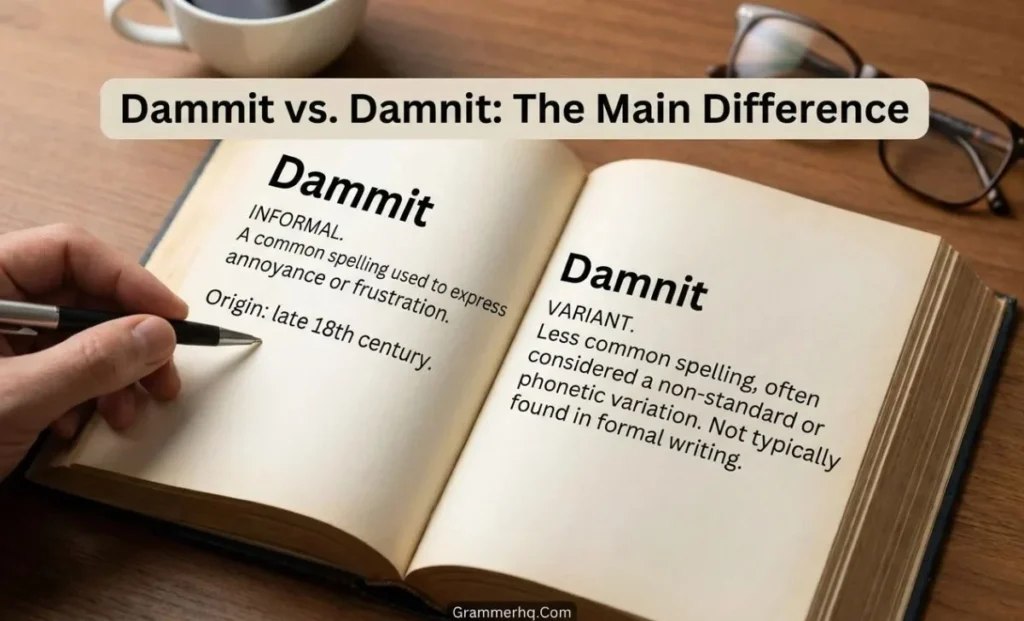
The main difference is spelling, not meaning.
| Spelling | Status | Meaning |
|---|---|---|
| dammit | Standard spelling | An exclamation showing anger, frustration, annoyance, or emphasis |
| damnit | Nonstandard variant | The same meaning, but less preferred in edited writing |
So, if you are wondering “Is it dammit or damnit?”, use dammit.
Is “damnit” wrong?
Damnit is not usually treated as the preferred standard spelling. You may see it in texts, social media posts, informal writing, and other casual contexts, but dammit is the better choice when you want conventional spelling.
That does not mean a reader will fail to understand damnit. It is recognizable because people use it as a spelling variation of dammit. However, recognition and standard usage are not the same thing.
What Does “Dammit” Mean?
Dammit is an informal exclamation used to show a strong negative reaction.
Depending on the situation, it can express:
- anger
- frustration
- annoyance
- disappointment
- irritation
- emphasis after something goes wrong
For example:
- Dammit, I forgot my keys.
- Dammit! We missed the train.
- I told you to be careful, dammit.
- Dammit, that was my last chance.
The exact emotion depends on the context and tone.
Why Is It Spelled “Dammit”?
Dammit developed from the expression “damn it.”
“Damn” is an exclamation that can express anger or frustration, while “it” refers to the situation, object, or circumstance causing the reaction.
Over time, the expression became commonly written as one word:
damn it → dammit
The spelling dammit reflects this established written form. The pronunciation can make some speakers hear or produce something closer to damnit, which likely helps explain why the alternative spelling appears.
Dammit or Damn It: Are Both Correct?
Yes, but they are used somewhat differently in writing.
“Damn it” is the original two-word expression and remains completely understandable and usable:
Damn it, I left my phone at home.
“Dammit” is the established one-word form:
Dammit, I left my phone at home.
When the expression functions as a single exclamation, dammit is a natural choice.
If your goal is to use the standard one-word spelling, choose dammit, not damnit.
Dammit vs. Damnit in a Sentence
Here are some natural examples showing the difference:
Preferred:
Dammit, I made the same mistake again.
Nonstandard variant:
Damnit, I made the same mistake again.
The meaning is essentially the same, but dammit is the preferred spelling in standard edited English.
Another example:
Dammit! The computer stopped working.
Here, the word expresses frustration about an unexpected problem.
You can also place it inside a sentence:
I tried to fix it, dammit, but nothing worked.
In this use, the exclamation adds emotional emphasis.
Is “Dammit” a Bad Word?
Dammit is generally considered a mild profanity or swear-word expression. It is stronger and less polite than a neutral expression such as “oh no” or “that’s frustrating.”
Its offensiveness depends on the audience and situation.
It may be heard in:
- casual conversations
- movies and television
- informal writing
- online conversations
- situations involving frustration or anger
However, it is usually better to avoid it in formal, professional, academic, or highly polite communication.
For example, instead of:
Dammit, I missed the deadline.
a professional email would be better with:
Unfortunately, I missed the deadline.
The second version communicates the situation without using profanity.
Can You Use “Dammit” in Formal Writing?
Generally, no—unless you are intentionally reproducing someone’s speech or writing dialogue for a particular effect.
For example, in a novel, a character might say:
“Dammit, we have to leave now!”
That can be appropriate because the word reflects the character’s emotion.
But in a business email, school assignment, formal report, or professional message, a neutral alternative is usually more appropriate.
Common Confusion: Dammit, Damnit, or Damn It?
These forms are easy to mix up:
- Dammit — standard one-word spelling; preferred
- Damn it — standard two-word expression; also correct
- Damnit — common nonstandard spelling
If you need the safest answer, remember:
Use “dammit” when you want the one-word form.
Why Do People Spell It “Damnit”?
The spelling damnit is understandable because it closely reflects how the word may sound when spoken.
When people hear the final part of dammit, they may perceive it as sounding like “nit.” This can lead them to write damnit instead.
Internet communication also allows informal spellings to spread quickly. Once a spelling becomes familiar, people may continue using it even when dictionaries and edited writing favor another form.
So, seeing damnit online does not necessarily mean the writer intended a different word. In most cases, they mean dammit.
Quick Examples
Here are a few examples to make the distinction easy to remember:
Correct/preferred:
- Dammit, I forgot the password.
- Dammit! That hurts.
- I was so close, dammit.
- Dammit, we need to hurry.
Common but nonstandard:
- Damnit, I forgot the password.
- Damnit! That hurts.
- I was so close, damnit.
The meaning does not substantially change. The important difference is the spelling.
What Should You Use in Everyday Writing?
If you are writing casually and want to use this expression, dammit is the safest spelling.
For formal or professional communication, however, consider replacing it with a neutral expression such as:
- Oh no
- Unfortunately
- That’s frustrating
- I’m disappointed
- This is frustrating
Your choice should depend on both the audience and the tone you want to create.
FAQs
Is dammit or damnit correct?
Dammit is the preferred standard spelling. Damnit is a common nonstandard variant that is generally understood to mean the same thing.
Is “damnit” a misspelling of “dammit”?
In standard edited English, damnit is generally treated as a nonstandard spelling of dammit. If you want the conventional spelling, use dammit.
Is “dammit” the same as “damn it”?
Yes. Dammit developed from the two-word expression “damn it” and is commonly used as its one-word form.
Is dammit a swear word?
Yes, dammit is generally considered a mild profanity or swear-word expression. It expresses anger, frustration, annoyance, or strong emphasis.
Can I use dammit in a professional email?
It is best to avoid it in professional emails. A neutral expression such as “Unfortunately” or “That’s frustrating” is usually more appropriate.
Why do people write “damnit”?
People often write damnit because it resembles how dammit may sound when spoken. It is also common in informal online writing. However, dammit remains the preferred spelling.
Which one should I use: dammit or damnit?
Use dammit. If you need a standard one-word spelling, dammit is the better choice.
Conclusion
The answer is simple: dammit is the preferred standard spelling, while damnit is a common nonstandard variant. Both are normally intended to express the same feeling of anger, frustration, annoyance, or disappointment.
The word comes from “damn it,” which explains why you may see both the two-word and one-word forms. If you are writing something informal and want to use the one-word expression, choose dammit.
For formal or professional writing, it is better to avoid the expression altogether and choose a neutral alternative.
Read More Blogs
- Seal vs Seel: Which Is Correct? Meaning, Spelling & Usage
- Tear vs Tare: What’s the Difference?
- Ran vs Run: What’s the Difference?
- Toward vs Towards: What’s the Difference?