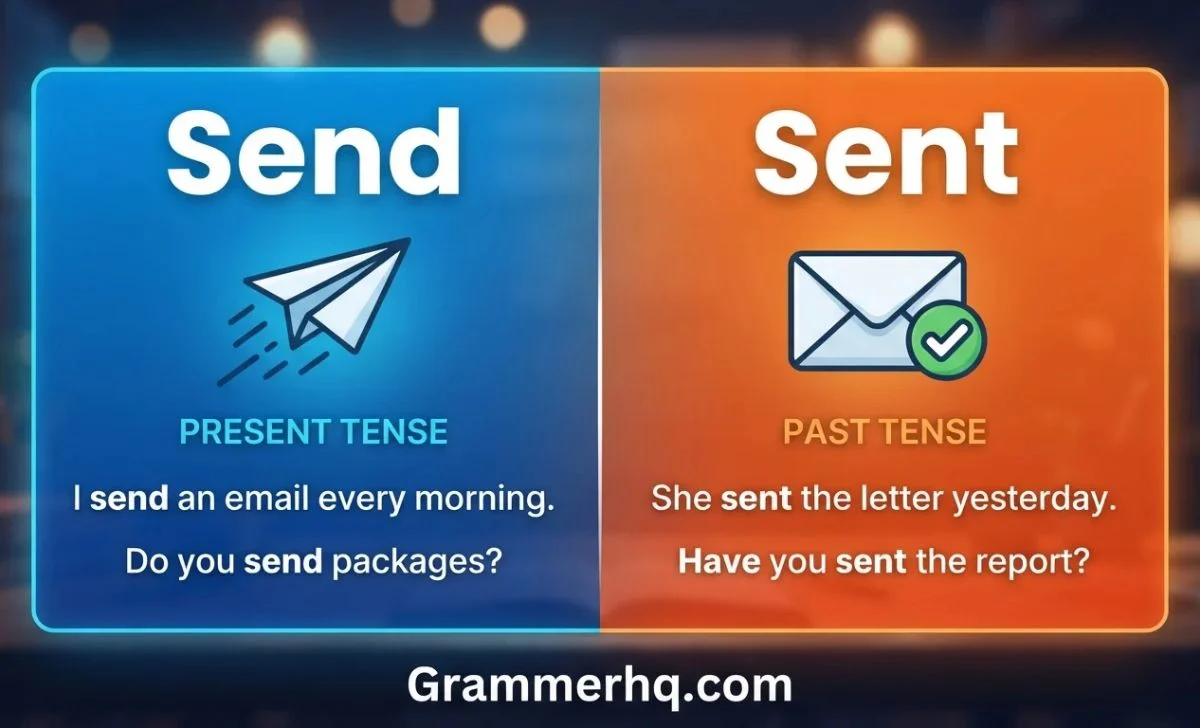
Quick Answer: Send is the base form of the verb, while sent is the past tense and past participle of send.
Use send for present actions, instructions, and after helping verbs such as will, can, and did. Use sent for an action that happened in the past or after have, has, or had.
The confusion is common because send and sent come from the same verb, but they do not work in the same grammatical situations. The key is to look at the tense and the helping verb around the word.
Send vs. Sent: The Basic Difference
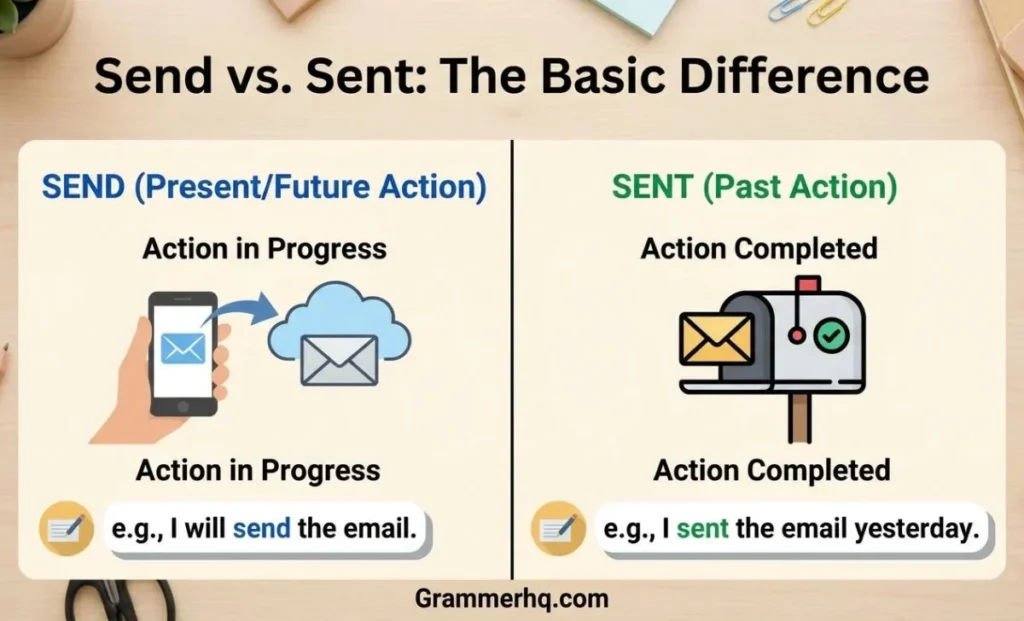
The easiest way to remember the difference is:
- Send = base form and present form
- Sent = past tense and past participle
| Word | Grammatical form | Example |
|---|---|---|
| send | Base form / present | I send emails every morning. |
| sent | Past tense | I sent the email yesterday. |
| sent | Past participle | I have sent the email. |
So, send usually refers to an action in the present, a repeated action, a future action with a helping verb, or an instruction. Sent refers to a completed past action or appears with perfect tenses.
When to Use Send
Use send when the verb is in its base form. This happens in several common situations.
1. For present or repeated actions
Use send when talking about something that happens regularly or generally.
- I send invoices every Friday.
- We send customers a confirmation email.
- They send messages through the app.
- I usually send my reports before noon.
For third-person singular subjects such as he, she, and it, use sends, not send.
- She sends me a message every morning.
- He sends the documents by email.
2. After “will,” “can,” “should,” and other modal verbs
After a modal or similar helping verb, use the base form send.
- I will send the file tonight.
- Can you send me the address?
- You should send a reply.
- We might send another email tomorrow.
Not:
- I will sent the file. ❌
- Can you sent me the address? ❌
The helping verb already establishes the grammatical structure, so the base form send follows it.
3. For instructions and requests
Use send when telling or asking someone to send something.
- Send me the details.
- Please send the document.
- Send the payment confirmation when you receive it.
- Can you send me the link?
When to Use Sent
Use sent when talking about an action that happened in the past.
1. For a completed past action
- I sent the email yesterday.
- She sent me a message last night.
- We sent the documents two hours ago.
- He sent the package on Monday.
Here, the action has already happened, so sent is the correct past-tense form.
2. After have, has, or had
Sent is also the past participle of send, so it is used with have, has, and had.
- I have sent the email.
- She has sent the documents.
- They had sent the package before noon.
Compare these:
- I sent the email yesterday. → simple past
- I have sent the email. → present perfect
- I had sent the email before he called. → past perfect
Send vs. Sent in Questions
One of the most common mistakes occurs in questions with did.
Correct:
Did you send the email?
Incorrect:
Did you sent the email? ❌
Why? Because did already marks the sentence as past tense. The main verb must return to its base form, send.
The same rule applies to other verbs:
- Did you send it?
- Did she send the message?
- Did they send the documents?
Not:
- Did you sent it? ❌
- Did she sent the message? ❌
This is an especially useful rule to remember when writing emails or text messages.
“I Send” vs. “I Sent”
The difference depends on when the action happens.
I send the report every Monday.
This describes a regular action.
I sent the report yesterday.
This describes a completed action in the past.
I will send the report tomorrow.
This describes a future action.
Notice how the time changes the correct verb form:
- Every Monday → send
- Yesterday → sent
- Tomorrow → send after will
“Have You Sent” vs. “Have You Send”
The correct phrase is:
Have you sent the email? ✅
Not:
Have you send the email? ❌
After have or has in the present perfect, use the past participle. Since sent is the past participle of send, it is required here.
Examples:
- Have you sent the invitation?
- Has she sent the file?
- Have they sent the payment?
“Send Me” vs. “Sent Me”
These phrases have different meanings because they use different forms of the verb.
Send me the file.
This is a request or instruction.
She sent me the file.
This tells us that she already sent it.
Compare:
- Send me the address. → Please send it.
- She sent me the address. → She already sent it.
- I will send you the address. → I plan to send it.
- I have sent you the address. → It has already been sent.
Common Mistakes With Send and Sent
Here are some mistakes English learners frequently make:
❌ I sent it tomorrow.
✅ I will send it tomorrow.
❌ Did you sent the email?
✅ Did you send the email?
❌ Can you sent me the link?
✅ Can you send me the link?
❌ I have send the document.
✅ I have sent the document.
❌ She send me a message yesterday.
✅ She sent me a message yesterday.
The easiest way to avoid these mistakes is to check the helping verb and the time of the action before choosing send or sent.
A Simple Way to Remember Send vs. Sent
Think of send as the basic form and sent as the form used for completed actions.
Send → present/base form
Sent → past/past participle
For example:
I send emails every day.
I sent an email yesterday.
I will send another email tomorrow.
I have sent the email already.
If you remember these four patterns, most everyday uses become easy to distinguish.
FAQ
Is “sent” the past tense of “send”?
Yes. Sent is both the simple past tense and the past participle of send.
- Present: I send.
- Past: I sent.
- Past participle: I have sent.
Is it “Did you send” or “Did you sent”?
The correct form is “Did you send?” After did, use the base form of the verb.
Is it “I sent” or “I send”?
Both are correct, but they describe different situations. Use I send for present or regular actions and I sent for a completed past action.
Is “Have you sent” correct?
Yes. Have you sent is correct because sent is the past participle used with have.
What is the past tense of send?
The past tense of send is sent.
Can “sent” be used without “have”?
Yes. Sent can work as the simple past on its own:
- I sent the message yesterday.
It can also be used as a past participle:
- I have sent the message.
Conclusion
Send and sent are forms of the same verb, but they have different grammatical roles. Use send as the base form for present actions, requests, instructions, and after helping verbs such as will, can, and did.
Use sent for completed past actions and as the past participle after have, has, or had.The most important patterns to remember are “I send,” “I sent,” “Did you send?” and “I have sent.”
Once you recognize the tense or helping verb in a sentence, choosing between send and sent becomes much easier.
Read More Blogs
- Choosing vs Chosing: Which Spelling Is Correct?
- Mei Fun vs Chow Fun: What’s the Difference?
- Genuinity or Genuity: Which Word Is Correct?
- Girlie or Girly: What’s the Difference?

Hi, I’m Amelia Parker, a grammar enthusiast and writer at GrammarHQ.com. I specialize in explaining spelling differences, confusing words, and common English mistakes through simple, practical, and easy-to-understand guides.