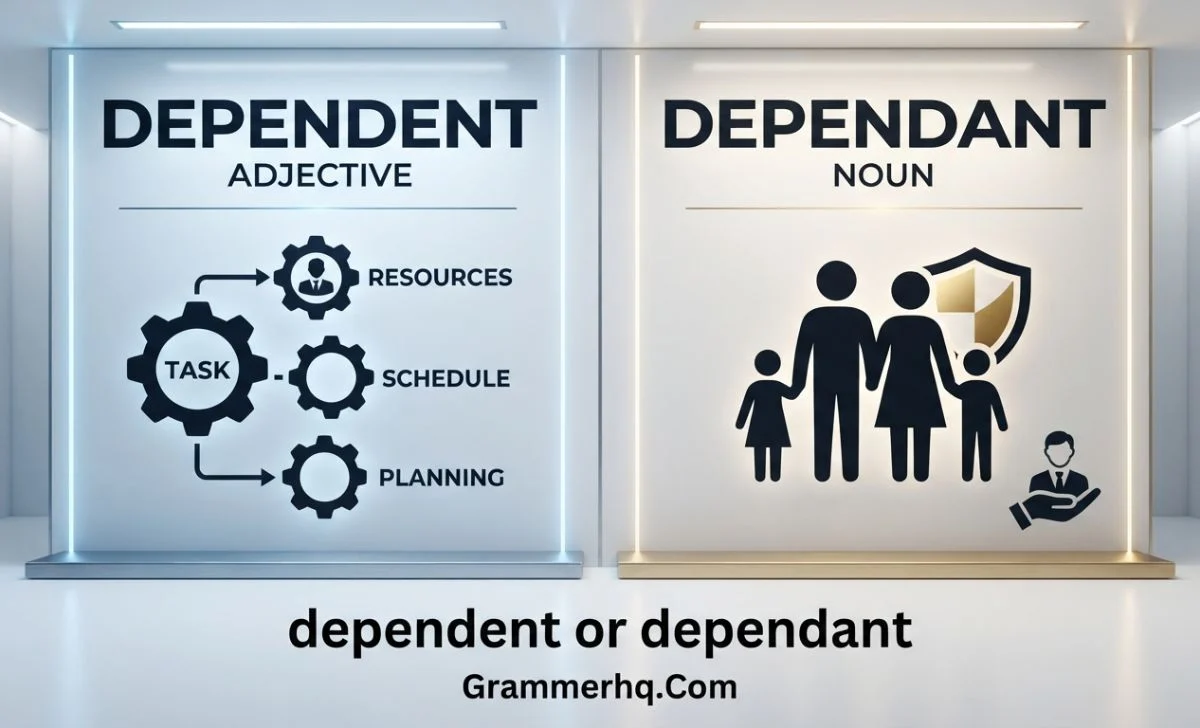
Dependent or dependant which spelling should you use? Both are correct, but the right choice depends on how the word is used and which variety of English you are writing.
In American English, dependent is used as both a noun and an adjective. In British English, dependant is a common noun spelling for someone who relies on another person for financial support, while dependent is the standard adjective.
British English also uses dependent as a noun, so the distinction is not absolute. If you are describing someone who relies on their parents or saying that a decision relies on certain conditions, dependent is the usual choice.
Quick Answer
| Usage | American English | British English |
|---|---|---|
| Describing reliance | dependent | dependent |
| A person who receives support | dependent | dependant is common |
| More than one supported person | dependents | dependants is common |
| The phrase “dependent on” | dependent on | dependent on |
The simple rule: Use dependent as the adjective in both American and British English. For a noun referring to someone who relies on another person, American English uses dependent, while British English commonly uses dependant.
What Does Dependent Mean?
Dependent means relying on someone or something for support, help, money, or the ability to continue. It can function as both an adjective and a noun.
Dependent as an adjective
As an adjective, dependent describes a person, organization, or situation that relies on something else.
Examples:
- The child is dependent on her parents for financial support.
- The business is dependent on international customers.
- Our travel plans are dependent on the weather.
- He is still financially dependent on his family.
The phrase dependent on is especially common. You may also see dependent upon, which has the same basic meaning.
Notice that the word describes a condition of reliance in each sentence. This is why dependent is the appropriate adjective in both US and UK English.
Dependent as a noun
As a noun, dependent refers to a person who relies on another person for financial or other support. This form is standard in American English.
Examples:
- She listed her son as a dependent on the form.
- The employee added two dependents to the health insurance plan.
- He provides financial support for three dependents.
The plural form is dependents. You will commonly encounter it in American tax, insurance, employment, and benefits contexts.
What Does Dependant Mean?
Dependant is chiefly a British English noun meaning someone who relies on another person for support, particularly financial support. It often refers to a child, spouse, or other family member.
Examples:
- She has two dependants.
- The employee must provide details of all dependants.
- His pension helps support his dependants.
The plural is dependants, with an a before the final n.
This spelling is especially useful when writing for a British audience or following a British organization’s style. It is not simply a misspelling of dependent.
Dependent vs Dependant in American English
In American English, dependent is the standard spelling for both the noun and the adjective.
It when describing reliance:
The child is dependent on her parents.
Use it when referring to a person receiving support:
She claimed her daughter as a dependent.
Use the plural dependents when referring to more than one person:
The insurance plan covers employees and their dependents.
For a US audience, there is usually no need to switch to dependant. Dependent is the conventional choice in both grammatical roles.
Dependent vs Dependant in British English
British English makes the distinction more noticeable, particularly in formal writing.
Use dependent as an adjective
The adjective is normally dependent, whether the sentence refers to a person, a business, or a condition.
- The child is dependent on her parents.
- The company is dependent on overseas suppliers.
- The result is dependent on the final decision.
Use dependant as a noun
When referring to a person who relies on someone else, British English commonly uses dependant.
- She has three dependants.
- The form asks whether you have any dependants.
- His children are listed as his dependants.
There is one important nuance: dependent is also recognized as a British English noun. Oxford Learner’s Dictionaries explicitly lists dependant as an alternative British form of the noun dependent.
Therefore, it is more accurate to say that dependant is a common traditional British noun spelling than to claim that it is the only correct option.
Dependent or Dependant? A Simple Rule to Remember
You can choose the right spelling by asking two questions.
1. Are you describing reliance?
Use dependent.
Her success is dependent on careful preparation.
2. Are you naming someone who relies on another person?
Choose the spelling that suits your audience.
- American English: dependent
- British English: dependant is common; dependent is also used
For example:
US: He has two dependents.
UK: He has two dependants.
This approach is more reliable than memorizing that one spelling is always right and the other is always wrong.
Dependent or Dependant in Real-Life Writing
These spellings often appear in documents and situations involving financial support, family relationships, and eligibility for benefits.
Tax and financial forms
American tax-related writing commonly uses dependent and dependents.
She entered her child as a dependent on the form.
The precise definition of a qualifying dependent depends on the applicable tax rules. The spelling alone does not determine eligibility.
Health insurance
In the United States, an employee may be asked to add eligible dependents to a health insurance plan.
Employees can review their coverage options for themselves and their dependents.
Employment benefits
A British employer may use dependants when referring to family members who rely on an employee for support.
Employees should provide the required details of their dependants.
Family and everyday situations
The adjective remains dependent in both varieties of English.
Her elderly father is financially dependent on her.
When referring to the people receiving support as a noun, the spelling may vary:
- US: She supports two dependents.
- UK: She supports two dependants.
In legal, tax, immigration, and insurance documents, follow the terminology used by the relevant organization or jurisdiction.
Common Mistakes With Dependent and Dependant
1. Assuming dependant is always wrong
Dependant is a recognized word, particularly as a noun in British English.
Incorrect assumption: Dependant is never correct.
Better understanding: Dependant is commonly used in British English for a person who relies on someone else.
2. Assuming dependent is only American
This is incorrect because dependent is the standard adjective in both varieties.
Correct:
The outcome is dependent on the evidence.
The word also functions as a noun in American English and can be used as a noun in British English.
3. Using dependant when dependent is the safer adjective
For standard formal writing, choose dependent when describing reliance.
Less suitable for general formal writing:
The outcome is dependant on the weather.
Preferred:
The outcome is dependent on the weather.
Although dependant has some adjectival use in British English, dependent is the more widely established choice for this grammatical role.
4. Forgetting the plural spelling
The noun’s plural depends on the spelling you choose:
- US: dependent → dependents
- UK: dependant → dependants
Both forms refer to people who rely on someone else for support.
Dependent vs Dependant: Examples at a Glance
| Example | Why it works |
|---|---|
| She is dependent on her parents. | Adjective describing reliance |
| The decision is dependent on the results. | Adjective describing a condition |
| He listed his son as a dependent. | US noun |
| The plan covers three dependents. | US plural noun |
| She has two dependants. | Common British noun |
| The employee declared all dependants. | Common British plural noun |
These examples show the central distinction: the adjective is normally dependent, while the noun spelling can reflect regional convention.
Related Words: Depend, Dependence, and Dependency
Understanding the related word family can also help you choose the right form.
- Depend: the verb meaning to rely on something or someone. Children depend on adults for care.
- Depending: used when an outcome varies according to a condition. Depending on the weather, we may leave early.
- Dependence: the state of relying on someone or something. Financial dependence can limit a person’s choices.
- Dependency: a state of reliance or something that depends on another factor. The project has a dependency on external funding.
- Independent: not relying on someone or something for support or control. She became financially independent.
These words are related in meaning, but they are not interchangeable. Use each according to its grammatical role and intended meaning.
FAQs
Is dependant a correct spelling?
Yes. Dependant is a correct English word, particularly as a British English noun referring to someone who relies on another person for support.
Is dependant British or American?
Dependant is chiefly associated with British English as a noun. American English normally uses dependent for the noun.
Is dependent American or British?
Both. Dependent is the standard adjective in American and British English. It is also the usual noun in American English and is recognized as a noun in British English.
Can dependent be a noun?
Yes. In American English, dependent is the standard noun for a person who relies on someone else for support. British English also recognizes this noun form.
Can dependant be an adjective?
Dependant has some adjectival use in British English, but dependent is the more widely established adjective and the safer choice in general formal writing.
Which is correct: dependents or dependants?
Both are correct plural forms. American English normally uses dependents, while British English commonly uses dependants when referring to people who rely on someone else.
Are dependent and dependant pronounced the same?
Generally, yes. The two spellings normally have the same pronunciation, so the difference is primarily one of spelling and usage.
Should I use dependent or dependant on an official form?
Follow the spelling used by the relevant form or organization. US forms commonly use dependent, while UK forms may use dependant. The applicable rules determine who qualifies as a dependent or dependant.
Final Answer
Dependent and dependant are both correct, but the best choice depends on grammar and regional usage. Use dependent when describing someone or something that relies on another person or thing.
In American English, dependent is also the standard noun for a person receiving support. In British English, dependant is a common noun spelling, although dependent is also used as a noun.
When writing for a specific audience, follow its spelling conventions and any official style requirements.
Read More Blogs

Hi, I’m Amelia Parker, a grammar enthusiast and writer at GrammarHQ.com. I specialize in explaining spelling differences, confusing words, and common English mistakes through simple, practical, and easy-to-understand guides.