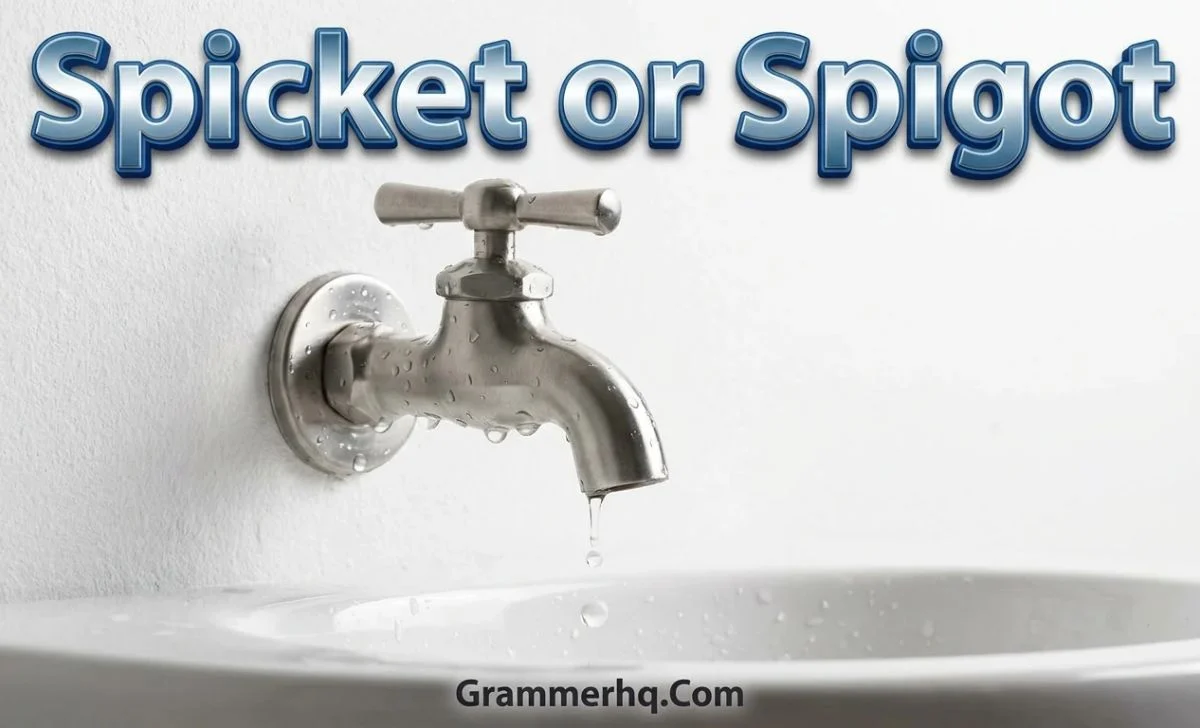
Spicket or spigot is a common spelling question when talking about an outdoor water tap. Spigot is the standard spelling in general English, while spicket is a recognized regional variant used in some dialects. Both forms can refer to a device that controls the flow of water or another liquid.
Quick Answer: Use spigot in standard writing, school assignments, professional documents, and plumbing guides.
You may hear or see spicket in regional English, particularly in parts of the southern and midland United States. The two forms usually have the same meaning when referring to a water outlet.
What Does Spigot Mean?
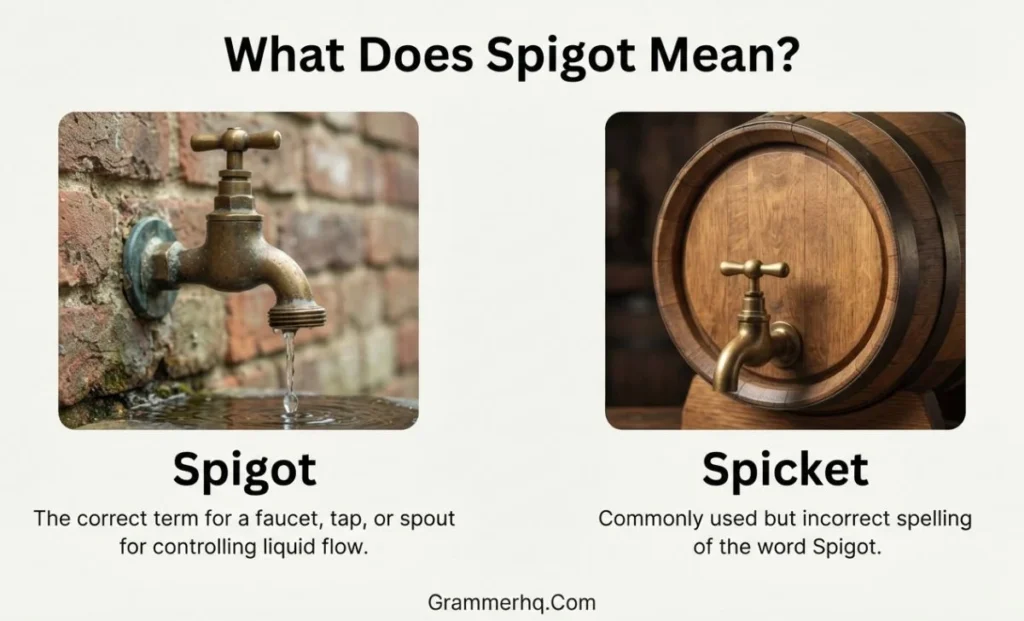
A spigot is a tap, valve, or fitting that allows liquid to flow out of a pipe or container. In everyday American English, the word commonly refers to the outdoor faucet on the side of a house where a garden hose connects.
Spigots also appear on water containers, beverage dispensers, barrels, and rainwater collection tanks. Their purpose is to control the release of liquid.
Examples:
- Please turn off the spigot after watering the garden.
- The plumber replaced the leaking outdoor spigot.
- She attached a garden hose to the spigot beside the garage.
- The lemonade dispenser has a small plastic spigot at the bottom.
The word can describe an entire water outlet in everyday conversation or a component that controls liquid flow, depending on the context.
Is Spicket a Real Word?
Yes. Spicket is a documented regional and dialectal form of spigot, not simply an invented spelling. Merriam-Webster records it as a regional form, particularly associated with the South and Midland regions of the United States.
The Dictionaries of the Scots Language also document its use for a tap or a plug that closes a barrel or cask.
The distinction is between standard spelling and regional usage. People may grow up hearing spicket at home and continue using it in everyday conversation. That does not mean they are referring to a different object.
However, spigot is the better choice for general written English because it is the widely accepted standard form.
Spicket vs Spigot: Main Differences
The difference is mainly one of spelling and regional usage, rather than meaning.
| Feature | Spigot | Spicket |
|---|---|---|
| Standard spelling | Yes | Regional variant |
| Basic meaning | Tap, valve, or liquid outlet | Usually the same |
| Regional use | Widely recognized | Associated with particular dialects |
| Formal writing | Recommended | Generally avoid |
| Outdoor water tap | Yes | Yes, in relevant regional usage |
| Dictionary recognition | Standard headword | Documented variant |
For example, a homeowner might say, “The spicket is leaking,” while a plumbing guide uses, “The outdoor spigot is leaking.” In this context, both sentences describe the same problem.
Why Do Some People Say Spicket?
People often learn words through conversation before encountering them in writing. Regional accents, family vocabulary, and local speech patterns can influence how a word sounds and how people choose to spell it.
The form spicket has a documented history in English dialects. It is also recorded in Scots, where it can refer to an outdoor tap or a plug used to close a barrel.
This history explains why dismissing the word as meaningless would be inaccurate. Nevertheless, regional recognition does not make both spellings equally suitable for every audience.
If you are writing for readers from different English-speaking regions, spigot is the clearest choice.
Spigot in American and British English
English speakers use different words for some everyday plumbing fixtures, so the intended meaning and audience matter.
American English
In the United States, spigot commonly refers to an outdoor faucet used to supply water to a garden hose. The regional form spicket may also be heard, especially in parts of the South and Midland.
Example: “Turn off the spigot before disconnecting the hose.”
British English
In British English, tap is a common everyday term for a water outlet. Spigot is also an established English word, although it may be less familiar in ordinary household conversation when referring to an outdoor tap.
Example: “Turn off the outdoor tap before putting the hose away.”
The important point is that regional vocabulary varies. Do not assume that every British speaker avoids spigot or that every American speaker uses spicket.
Spigot vs Faucet vs Tap
These words overlap, but their typical uses differ.
- Spigot: Often refers to an outdoor water outlet or a fitting that controls liquid flow.
- Faucet: Common in American English for a fixture that releases water, especially one attached to a sink.
- Tap: Common in British English for a water outlet and also widely understood in American English.
- Hose bib: A plumbing term for an outdoor faucet designed for attaching a garden hose.
- Sillcock: A term for a type of outdoor faucet that passes through a building wall.
For instance, you might turn on a kitchen faucet to wash dishes, connect a hose to an outdoor spigot to water plants, or close a barrel’s spigot to stop liquid from flowing.
These terms are related, but they are not interchangeable in every technical context.
Example Sentences With Spigot
Here are practical examples showing how the standard spelling works in everyday situations.
- The garden hose is connected to the spigot behind the house.
- Water dripped from the old metal spigot all night.
- We installed a new outdoor spigot before summer.
- He turned the spigot slowly to fill the watering can.
- The rain barrel has a small spigot near its base.
- Please check that the spigot is completely closed.
- The plumber inspected the pipe and replaced the damaged fitting.
- She opened the dispenser’s spigot to pour a glass of lemonade.
These examples cover household plumbing, gardening, water storage, and liquid dispensers without changing the word’s basic meaning.
FAQs
1. Is it spicket or spigot?
Spigot is the standard spelling in general English. Spicket is a documented regional variant, so it is not accurate to describe it as an entirely nonexistent word.
2. What does spicket mean?
Spicket generally refers to a spigot: a tap, valve, or fitting used to release liquid. In some dialects, it specifically refers to an outdoor water tap or a plug for a barrel.
3. Is spicket an American word?
It is documented as a regional form in parts of the United States, particularly the South and Midland. It also appears in Scottish and English dialect records, so its history is not limited to American English.
4. How do you pronounce spigot?
A common pronunciation is SPIG-uht, with the stress on the first syllable. Pronunciation can vary, and regional speech may use a sound closer to spicket.
5. What is the plural of spigot?
The plural is spigots.
Example: “The maintenance team checked all the outdoor spigots.”
6. Is a spigot the same as a faucet?
In everyday American English, a spigot often means an outdoor faucet. More broadly, it can refer to a fitting or valve that controls liquid flow. The exact distinction depends on the context.
7. Should I use spicket in formal writing?
Use spigot for schoolwork, professional writing, product descriptions, and general-purpose articles. Use spicket when you specifically need to preserve regional speech or discuss the dialectal form.
Conclusion
When choosing between these spellings, spigot is the safest option for standard written English. It commonly describes an outdoor water faucet or a device that controls liquid flow.
Spicket is a genuine regional and dialectal variant, usually carrying the same meaning in this context. Understanding both forms helps you recognize everyday speech while choosing the spelling most readers will expect.
For clear, professional writing, choose spigot.
Read More Blogs

Hi, I’m Amelia Parker, a grammar enthusiast and writer at GrammarHQ.com. I specialize in explaining spelling differences, confusing words, and common English mistakes through simple, practical, and easy-to-understand guides.