“Striping” vs.”stripping” are two completely different words whose meanings depend entirely on that single extra letter “p.”
Here is the quick breakdown to help you keep them straight:
- Striping (one ‘p’) refers to creating lines or bands (stripes) on a surface.
- Stripping (two ‘p’s) means removing a layer, covering, or clothing.
Striping vs. Stripping: Meaning and Usage
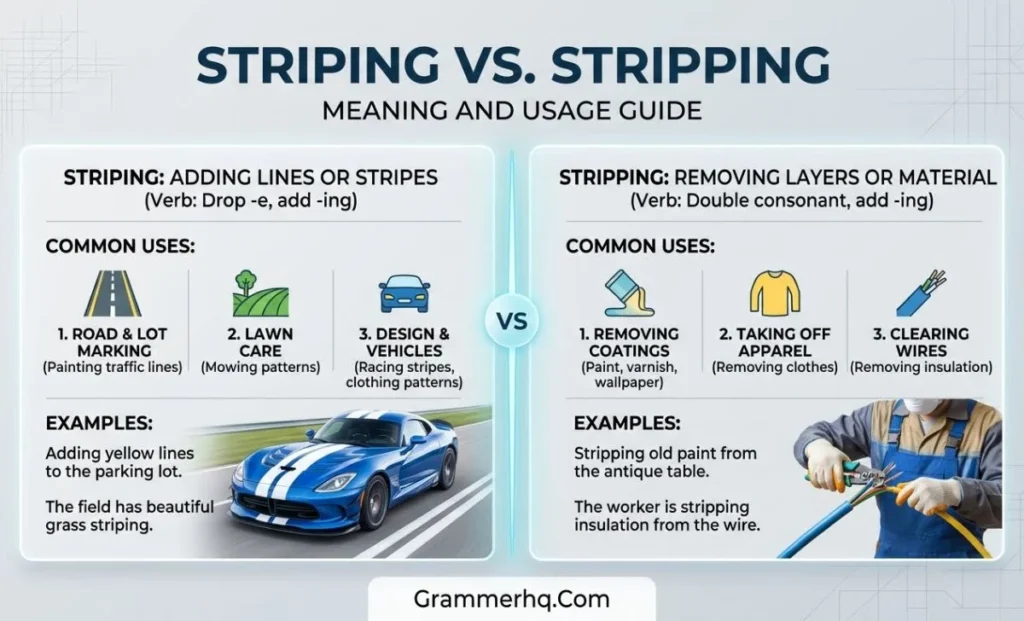
Striping means adding stripes, lines, or decorative markings to a surface. It is commonly used when painting road markings, creating parking spaces, or adding patterns to vehicles and other objects.
The word comes from the verb stripe. When adding the suffix -ing, the silent e at the end is dropped.
Examples:
- Parking lot striping: Painting lines to mark parking spaces, arrows, and traffic directions.
- Road striping: Adding lane dividers and other traffic markings to roads.
- Vehicle striping: Applying decorative stripes to a car or truck.
- Decorative striping: Creating lines or patterns on furniture and other surfaces.
Stripping (Removing Something)
In contrast, stripping means removing something, such as a layer, coating, covering, or material. Depending on the context, it can also describe taking off clothing or removing items from something.
Unlike striping, this word comes from the verb strip. Its final consonant p is doubled before adding -ing.
Examples:
- Paint stripping: Removing old paint or varnish from wooden furniture.
- Wallpaper stripping: Taking old wallpaper off walls during a renovation.
- Floor stripping: Removing an old finish or coating from a floor.
- Bed stripping: Taking off sheets and other bedding.
- Wire stripping: Removing the outer insulation from an electrical wire.
What Does Striping Mean?
Striping is the -ing form of the verb stripe. It refers to adding, creating, or marking something with stripes, lines, or bands of color.
Generally, a stripe is a long, narrow band that differs in color or appearance from the surrounding surface. For this reason, the term is commonly used in road construction, parking areas, sports facilities, clothing, and decorative designs.
Common Uses of Striping
Here are some everyday situations where you may encounter this word:
- Road striping: Painting white or yellow lines on roads to separate traffic lanes and guide drivers.
- Parking lot striping: Marking parking spaces, driving lanes, and directional areas.
- Sports field striping: Creating visible lines and patterns on football, soccer, and other playing fields.
- Fabric striping: Adding or creating striped patterns on clothing and textiles.
- Decorative striping: Applying colored lines or bands to vehicles, furniture, and other surfaces.
- Animal striping: Describing the natural striped patterns found on animals such as zebras and tigers.
Striping Examples in Sentences
To understand how the word works in everyday writing, consider these examples:
- The workers are striping the parking lot with fresh white paint.
- The city hired a contractor to complete the road striping.
- Before the match, the groundskeepers finished striping the soccer field.
- The designer added decorative striping to the sides of the car.
- This fabric features attractive blue and white striping.
In each example, striping refers to creating or describing lines and patterns rather than removing something.
What Does Stripping Mean?
Stripping is the -ing form of the verb strip. It generally means removing, taking off, or separating something from an object or surface.
However, its exact meaning can vary depending on the situation. For instance, stripping paint means removing an old layer of paint, while wire stripping involves taking the outer insulation off an electrical wire.
Common Uses of Stripping
The word stripping appears in several industries and everyday activities, including:
- Paint stripping: Removing old paint from walls, furniture, doors, or metal surfaces.
- Wire stripping: Taking off protective insulation from an electrical wire to expose its conductor.
- Wallpaper stripping: Removing old wallpaper before decorating or repainting.
- Floor stripping: Taking away old wax, polish, or other floor coatings.
- Metal stripping: Removing paint, rust, or other coatings from metal surfaces.
- Asset stripping: Selling or disposing of a company’s assets, often to extract their financial value.
- Clothing removal: Taking clothes off, depending on the context.
Stripping Examples in Sentences
The following examples show how stripping is used in different situations:
- The workers are stripping the old paint from the wooden door.
- Before making the connection, the electrician is stripping the wire.
- We spent the afternoon stripping wallpaper from the bedroom walls.
- The restoration team is stripping the old finish from the furniture.
- Following the company’s acquisition, the report raised concerns about asset stripping.
As these examples demonstrate, stripping describes removing something rather than adding a pattern or marking.
Striping vs. Stripping: Key Differences
Although these words look similar, their meanings, base verbs, and spelling patterns are different.
| Feature | Striping | Stripping |
|---|---|---|
| Base verb | Stripe | Strip |
| Main meaning | Adding stripes or lines | Removing something |
| Spelling | One p | Two p’s |
| Pronunciation | STRY-ping | STRIP-ing |
| Grammar | Verb form and noun | Verb form and noun |
| Common use | Roads and patterns | Paint and insulation |
| Example | Striping the road | Stripping the paint |
The easiest way to distinguish them is to focus on the action. If something is being marked with lines or patterns, use striping. Conversely, when something is being removed, the correct choice is stripping.
Why Are Striping and Stripping Spelled Differently?

The difference comes from two common English spelling rules. These rules explain what happens when the suffix -ing is added to each base verb.
1. Striping: Drop the Silent E
The word striping comes from stripe. When a verb ends in a silent e, that final letter is generally dropped before adding -ing.
Here is how the spelling changes:
- Stripe → Striping
- Bake → Baking
- Hope → Hoping
- Write → Writing
Therefore, striping has only one p. The silent e disappears, but the final consonant is not doubled.
2. Stripping: Double the Final Consonant
Unlike stripe, the verb strip follows the consonant-vowel-consonant (CVC) spelling pattern. When a one-syllable verb ends in this pattern with a short vowel sound, its final consonant is generally doubled before adding -ing.
For example:
- Strip → Stripping
- Run → Running
- Sit → Sitting
- Plan → Planning
As a result, the final p in strip becomes double when the suffix is added.
This is why stripping is the correct spelling when you mean removing something, not striping.
How to Use Striping and Stripping in Real Life
Understanding the spelling rules is helpful, but seeing these words in practical situations makes the difference even clearer.
1. Road and Parking Lot Striping
Road striping involves applying painted lines and markings to road surfaces. These markings help drivers identify traffic lanes, pedestrian crossings, and road boundaries.
Similarly, parking lot striping identifies individual parking spaces, driving lanes, and areas for vehicle movement.
Example: The contractor is striping the new parking lot before it opens.
2. Paint and Surface Stripping
Paint stripping refers to removing an existing layer of paint from wood, metal, or another surface. This process is often necessary during furniture restoration, home improvement, and surface preparation.
For example, someone renovating an old wooden cabinet may need to remove its damaged paint before applying a fresh finish.
Example: The carpenter is stripping the old paint from the cabinet.
3. Wire Stripping
Wire stripping is a common electrical task that involves removing the outer insulation from a wire to expose the conductive metal underneath.
Electricians use appropriate wire-stripping tools to prepare wires for electrical connections. Therefore, the term describes removal rather than adding lines or patterns.
Example: The electrician is stripping the wire before installing the new outlet.
4. Sports Field Striping
Sports field striping involves creating visible lines and patterns on grass or artificial playing surfaces. These markings help players, officials, and spectators identify boundaries and playing areas.
Example: The grounds crew is striping the football field before the tournament.
5. Wallpaper and Floor Stripping
During home renovations, old wallpaper, floor wax, and protective coatings often need to be removed before new materials can be applied.
These activities are commonly described as wallpaper stripping or floor stripping.
Example: The renovation team is stripping the old wallpaper before painting the room.
Common Mistakes to Avoid
Since both words are correctly spelled, spell-checking software may not identify every mistake. Instead, you need to consider the meaning and context of your sentence.
1: Using Stripping When You Mean Adding Road Lines
Incorrect: The workers are stripping the road with white paint.
Correct: The workers are striping the road with white paint.
Why? The workers are adding road markings, not removing anything. Therefore, striping is the correct word.
2: Using Striping When You Mean Removing Paint
Incorrect: The carpenter is striping the old paint from the door.
Correct: The carpenter is stripping the old paint from the door.
Why? In this situation, the carpenter is removing an existing layer of paint. As a result, stripping is the appropriate choice.
3: Confusing Wire Stripping With Wire Striping
Incorrect: The electrician is striping the wire before connecting it.
Correct: The electrician is stripping the wire before connecting it.
Why? Removing insulation from an electrical wire is called wire stripping. Although the spellings are similar, their meanings are not interchangeable.
One important detail: In some situations, stripping a parking lot can also be correct if someone is removing old paint or surface markings. Ultimately, the intended action determines which word you should use.
How to Remember the Difference
A simple memory trick can help you choose the correct spelling without looking it up.
- Striping = Stripe = Adding lines. Think of a road with freshly painted white stripes.
- Stripping = Strip = Removing something. Picture a worker removing old paint from a wooden door.
You can also remember the spelling patterns:
- Stripe + ing = Striping
- Strip + ing = Stripping
Once you understand the difference between stripe and strip, choosing the correct -ing form becomes much easier.
FAQs
1. Is it striping or stripping?
Both are correct English spellings, but they have different meanings. Use striping when adding or creating stripes, lines, or patterns. In contrast, stripping means removing something, such as paint, wallpaper, or wire insulation.
2. What does striping mean?
Striping means adding or creating stripes, lines, or bands on a surface. It is commonly used when discussing road markings, parking spaces, sports fields, and decorative designs.
3. What does stripping mean?
Stripping means removing something from an object, surface, or place. For example, it can describe removing old paint from furniture, taking wallpaper off a wall, or removing insulation from electrical wires.
4. Why does stripping have two P’s?
Stripping has two p’s because it comes from the base verb strip. Under the consonant-doubling spelling rule, the final p is doubled before adding -ing. The same pattern appears in words such as running and sitting.
5. Why does striping have only one P?
Striping comes from stripe, not strip. When adding -ing, the silent e is removed, but the final p is not doubled. Consequently, the correct spelling is striping.
6. Is parking lot striping or stripping correct?
Parking lot striping is correct when workers paint lines to mark parking spaces, driving lanes, and boundaries. However, parking lot stripping can also be correct when referring to the removal of old paint or surface coatings.
7. What is the difference between strip and stripe?
Strip generally means removing a covering, layer, or part of something. On the other hand, stripe refers to a long, narrow band of color or marking. It can also describe the action of adding such a band to a surface.
8. Are striping and stripping verbs or nouns?
Both words can function as verbs and nouns. As verb forms, they are present participles of stripe and strip. Meanwhile, as nouns, they can describe the activity or process of creating stripes or removing something.
Final Answer
Although striping and stripping differ by only one letter, they describe two very different actions. Striping means adding lines, stripes, or patterns, whereas stripping means removing something from a surface or object.
Remember this simple distinction: striping adds; stripping removes.
Once you understand their base verbs and spelling rules, you can use both words confidently in everyday writing, professional communication, and technical contexts.
Discover More Blogs:
- Suing or Sueing: Which Spelling Is Correct?
- Paid vs. Payed: Meaning, Difference, and Correct Usage
- Fiesty or Feisty: Correct Spelling, Meaning & Usage?
- Journies or Journeys: Which Is Correct?