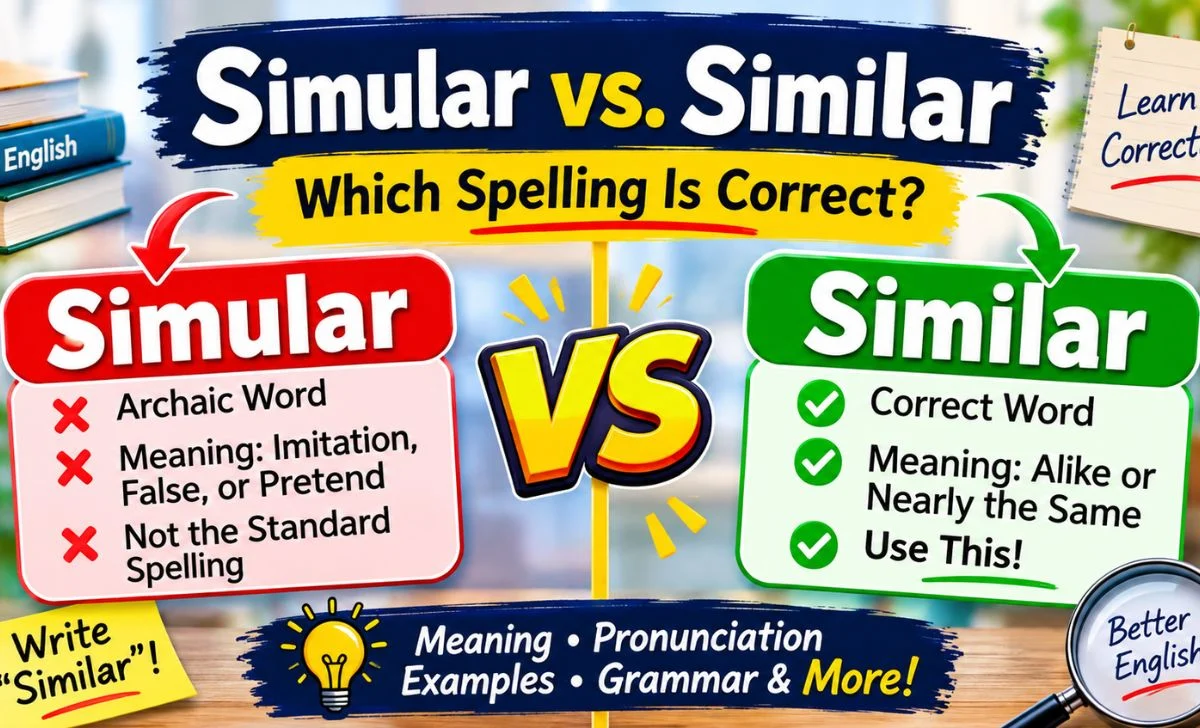
Simular vs. Similar is a common spelling confusion for English learners, students, and writers. The correct modern word is similar, which means alike or nearly the same.
Although simular is recorded as an archaic English word, it is not the correct spelling when comparing two people, objects, ideas, or experiences. Both American and British English use similar with the same spelling and meaning.
For example, you should write, “These two phones have similar features,” not “These two phones have simular features.”
What Is the Difference Between Simular and Similar?

In the simular vs. similar comparison, similar is the standard adjective used to describe things that share common qualities.
Simular is an old-fashioned word associated with imitation, pretence, or something false.
| Word | Correct usage | Meaning |
|---|---|---|
| Similar | Modern English | Alike or nearly the same |
| Simular | Archaic English | Simulated, fake, or someone who imitates |
Examples:
- Correct: My brother and I have similar interests.
- Incorrect: My brother and I have simular interests.
- Correct: These two houses look similar.
- Incorrect: These two houses look simular.
Quick rule: Use similar when describing things that share characteristics but are not necessarily identical.
What Does Similar Mean?
Similar is an adjective that describes two or more things that have nearly the same appearance, qualities, features, or characteristics.
In simple English, it means alike, resembling, nearly the same, or comparable.
Examples from everyday life:
- Shopping: These shoes are similar in design, but their prices are different.
- Education: Both students have similar learning abilities.
- Technology: My new laptop has features similar to my old one.
- Family: The sisters have similar facial features.
- Work: Our teams are working on similar projects.
These examples show that two things can be similar without being exactly the same.
Is Simular a Real English Word?
“Understanding simular vs. similar also helps explain why an archaic word should not replace a modern spelling.”
Historical dictionaries record simular as a noun meaning a person or thing that imitates or pretends. As an adjective, it can mean simulated, false, counterfeit, or imitative.
The word dates back to approximately 1520–1530 and has connections to the Latin verb simulare, meaning to imitate or pretend.
Historical meaning examples:
- The writer described the dishonest man as a simular.
- His behaviour was considered simular because he pretended to possess qualities he did not have.
These are illustrative sentences showing the historical sense, not recommended everyday expressions.
Therefore, the historical existence of this word does not make it an alternative spelling of similar.
For modern writing, choose the standard adjective when describing things that are alike.
How Do You Pronounce Similar?
The pronunciation differs slightly between American and British English. However, the spelling remains unchanged.
| English variety | IPA pronunciation | Easy pronunciation |
|---|---|---|
| American English | /ˈsɪm.ə.lɚ/ | SIM-uh-ler |
| British English | /ˈsɪm.ɪ.lə(r)/ | SIM-i-luh |
The first syllable receives the main stress in both accents.
Pronunciation breakdown:
- SIM: The first and stressed syllable.
- Uh or i: The middle vowel sound varies by accent.
- Ler or luh: The final syllable.
For English learners, practising the pronunciation can help with recognition, listening, and spelling.
Is Similar Different in American and British English?

“The simular vs. similar spelling difference remains the same in both American and British English.”
Both countries use similar to describe people, objects, ideas, and situations that share certain characteristics. The pronunciation is slightly different, but the meaning and spelling remain the same.
American English examples:
- These two apartments have similar layouts.
- I had a similar experience during my last vacation.
- Both phones offer similar performance.
British English examples:
- The two houses have similar designs.
- We had a similar experience at university.
- Both schools follow similar teaching methods.
These sentences demonstrate that the standard spelling is identical in both varieties.
Remember that neither American nor British writers should replace the modern spelling with simular when making comparisons.
How to Use Similar Correctly in a Sentence
Knowing the spelling is only the first step. You should also understand the common grammatical patterns used with this adjective.
1. Similar To
Use similar to when comparing one person or thing with another.
- Your writing style is similar to mine.
- This restaurant is similar to the one we visited last week.
- Her voice sounds similar to her mother’s.
2. Similar In
Use similar in when describing a particular quality or characteristic that two things share.
- The two phones are similar in appearance.
- Both students are similar in age.
- These products are similar in quality.
3. Very Similar
Use very to emphasize that two things share many characteristics.
- The two paintings are very similar.
- Their opinions are very similar.
- These dresses look very similar.
4. Similar-Looking
Use similar-looking before a noun to describe things with a comparable appearance.
- The shop sells similar-looking handbags.
- They bought two similar-looking chairs.
- The buildings have similar-looking windows.
5. Similarly
Similarly is an adverb, not an adjective. It describes something that happens in a comparable way.
- Sarah performed well, and her brother similarly impressed the judges.
- Both companies responded similarly to the changes.
Understanding these patterns will help you use the word naturally in conversations and professional writing.
Similar vs. Same vs. Alike: What Is the Difference?
These three words are related, but they do not always express the same idea.
| Word | Meaning | Example |
|---|---|---|
| Similar | Sharing certain characteristics | The bags are similar in colour. |
| Same | Exactly the same in the relevant respect | We bought the same bag. |
| Alike | Having similar qualities or appearances | The twins look alike. |
Real-life comparison:
Imagine two friends buying smartphones.
- Similar: They bought different phones with similar features.
- Same: They bought the same phone model.
- Alike: Their phones look alike.
The important distinction is that similar does not necessarily mean identical.
Common Spelling and Grammar Mistakes
English learners sometimes make spelling mistakes or use incorrect grammatical structures when writing comparisons.
Here are some common mistakes and their corrections:
| Incorrect | Correct |
|---|---|
| The two cars are simular. | The two cars are similar. |
| My idea is similar than yours. | My idea is similar to yours. |
| These phones are similer. | These phones are similar. |
| We have similair interests. | We have similar interests. |
| They are similars. | They are similar. |
Remember these simple rules:
- Write similar, not simular, for modern comparisons.
- Use similar to when comparing two things.
- Use similar in when describing a shared characteristic.
- Do not add an unnecessary -s when describing plural subjects.
- Do not confuse similar with same or identical.
Synonyms and Related Word Forms
Learning related vocabulary can help you express comparisons more clearly and avoid unnecessary repetition.
Synonyms of Similar
- Alike
- Resembling
- Comparable
- Nearly identical
- Close
- Equivalent
- Related
- Much the same
These words have related meanings, but they are not interchangeable in every sentence.
Related Word Forms
| Word | Part of speech | Meaning |
|---|---|---|
| Similar | Adjective | Sharing certain characteristics |
| Similarly | Adverb | In a comparable way |
| Similarity | Noun | The quality of being alike |
| Similarities | Plural noun | Shared characteristics |
| Dissimilar | Adjective | Different or not alike |
Examples:
- Similar: The two designs are similar.
- Similarly: Both teams performed similarly.
- Similarity: There is a strong similarity between the paintings.
- Dissimilar: The two products are completely dissimilar.
Learning these word forms can improve your vocabulary and sentence structure.
FAQs
1. Is it simular or similar?
Similar is the correct modern spelling when describing two or more things that are alike. Simular is an archaic English word and is not the standard spelling for everyday comparisons.
2. Is simular a misspelling or a real word?
It is a genuine historical English word, but it is archaic. Older dictionary records describe it as a noun and adjective associated with imitation, pretence, or something counterfeit. It should not replace similar in modern writing.
3. Is similar correct in American English?
Yes. Similar is the standard spelling in American English. It describes people, objects, and ideas that share certain characteristics without being exactly the same.
4. Is similar British or American English?
It belongs to both varieties. British and American writers use the same spelling and meaning, although their pronunciation differs slightly.
5. What does similar mean in simple English?
It means alike or nearly the same. For example, two bags can have similar colours but different sizes and prices.
6. How do you pronounce similar in American and British English?
In American English, it is pronounced /ˈsɪm.ə.lɚ/. In British English, the pronunciation is /ˈsɪm.ɪ.lə(r)/. The first syllable is stressed in both accents.
7. Can I use simular in a school assignment?
Not when you mean alike or nearly the same. Use similar in school assignments, essays, examinations, and professional documents.
8. What is the difference between similar and same?
Similar describes things that share certain characteristics but may have differences. Same usually refers to exactly the same thing or something identical in the relevant respect.
9. Should I write similar to or similar with?
Similar to is the standard construction for comparing two people or things. For example, “My experience is similar to yours.” You can also use similar in to describe a shared quality, as in “The products are similar in quality.”
10. What is the noun form of similar?
Similarity is the noun form. It describes the quality or condition of being alike. For example, “There is a noticeable similarity between their writing styles.”
11. What is the opposite of similar?
Dissimilar is a common opposite. It describes people or things that do not share the same characteristics or are noticeably different.
12. Why do people confuse these two spellings?
People may confuse them because of pronunciation, typing errors, or uncertainty about English spelling patterns. The middle vowel sound can be difficult to distinguish, especially for learners who are unfamiliar with the word.
Final Verdict
The final answer to simular vs. similar is simple: similar is the correct modern spelling for everyday comparisons.
Although simular appears in historical dictionaries, its archaic meanings are different from the modern meaning of the word used for comparisons.
The easiest rule to remember: Similar means alike, but not necessarily identical. Use it in your emails, essays, schoolwork, professional documents, and everyday conversations.
Discover More Blogs:
- Loosing or Losing: Which Spelling Is Correct?
- Layed vs Laid: Which Is Correct?
- Dieing vs Dying: Which Spelling Is Correct?
- Jewelry or Jewellery: Which Spelling Is Correct?

Hi, I’m Amelia Parker, a grammar enthusiast and writer at GrammarHQ.com. I specialize in explaining spelling differences, confusing words, and common English mistakes through simple, practical, and easy-to-understand guides.