Pre and post are commonly used as prefixes to show when something happens. Pre- means “before,” while post- means “after.” For example, a pretest happens before a test or assessment, while a posttest happens afterward.
The easiest way to remember the difference is:
- Pre- = before
- Post- = after
You will see these prefixes in many everyday English words, including preseason/postseason, pregame/postgame, prenatal/postnatal, and prewar/postwar.
What Does “Pre” Mean?
Pre- means before, earlier than, or in preparation for something.
It is usually used as a prefix attached to another word.
Examples of “pre-”
- Pretest — a test given before instruction or a main test
- Pregame — happening before a game
- Preseason — the period before the regular season
- Prewar — existing or happening before a war
- Prenatal — relating to the period before birth
- Preoperative — relating to the time before surgery
For example:
Students took a pretest before starting the new lesson.
Here, pre- tells us that the test came before the lesson.
What Does “Post” Mean?
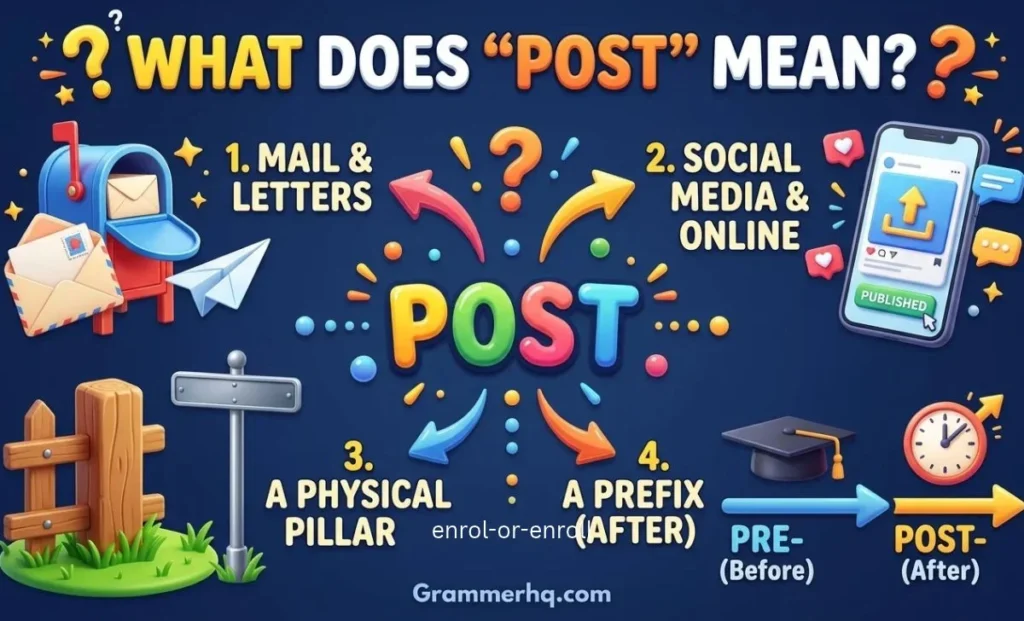
Post- means after, later than, or following something.
Like pre-, it is commonly used as a prefix to form words that describe something happening afterward.
Examples of “post-”
- Posttest — a test given after instruction
- Postgame — happening after a game
- Postseason — the period after or beyond the regular season
- Postwar — relating to the period after a war
- Postnatal — relating to the period after birth
- Postoperative — relating to the time after surgery
For example:
The students took a posttest to measure what they had learned.
Here, post- shows that the test came after the instruction.
Pre vs. Post: The Main Difference
The difference is mainly about sequence.
| Term | Meaning | Example |
|---|---|---|
| Pre- | Before | Pretest |
| Post- | After | Posttest |
| Preseason | Before the season | Preseason training |
| Postseason | After the regular season | Postseason games |
| Pregame | Before a game | Pregame show |
| Postgame | After a game | Postgame interview |
| Prenatal | Before birth | Prenatal care |
| Postnatal | After birth | Postnatal care |
A simple rule makes the distinction easy:
Pre → something comes first.
Post → something comes later.
Pre vs. Post in Real-Life English
These prefixes appear across many areas of American English, including education, sports, medicine, history, business, and everyday conversation.
1. Education
Pretest and posttest are common educational terms.
A teacher may give a pretest before teaching a topic to see what students already know. A posttest can then be given afterward to measure learning.
Example:
The class completed a pretest on Monday and a posttest at the end of the unit.
2. Sports
Sports provide some of the clearest examples.
A pregame show takes place before a game, while a postgame interview happens after it.
Example:
The network aired a pregame analysis and a postgame interview.
Similarly, preseason refers to the period before the regular season, while postseason generally refers to competition after the regular season.
3. Medicine
Medical English frequently uses these prefixes.
Prenatal refers to the period before birth, while postnatal refers to the period after birth.
Likewise:
- Preoperative = before surgery
- Postoperative = after surgery
Example:
The doctor explained the patient’s preoperative instructions and postoperative care.
4. History
The prefixes can also describe historical periods.
Prewar means before a war, while postwar means after a war.
Example:
The museum contains photographs from the prewar and postwar periods.
The exact time covered by these terms depends on the historical context.
Is “Pre” the Same as “Before”?
Not always in exactly the same grammatical way.
Before is a normal English word that can function in different ways:
We arrived before dinner.
Pre-, on the other hand, is generally a prefix used to create another word:
We made pre-dinner plans.
So, while their basic idea is related, they are not always interchangeable.
The same applies to post- and after.
We talked after the meeting.
But:
We had a post-meeting discussion.
The prefix creates a compound term with a specific meaning.
Are Pre and Post Prefixes?
Yes. In words such as pretest and posttest, pre- and post- function as prefixes.
A prefix is a letter group added to the beginning of a word or base to modify its meaning.
For example:
pre + test = pretest
The prefix changes the meaning to indicate that the test occurs before something.
Similarly:
post + test = posttest
The prefix indicates that the test occurs after something.
This is why understanding prefixes can make unfamiliar English vocabulary easier to understand.
Pre vs. Post and Hyphens
One common question is whether words beginning with pre- or post- need a hyphen.
There is no single rule that applies to every word. Many familiar words are written as one word:
- pretest
- posttest
- pregame
- postgame
- preseason
- postseason
- prewar
- postwar
However, some combinations may be hyphenated, especially when needed for clarity or according to a particular style guide.
For that reason, it is better to check the established spelling of an individual word rather than assuming every pre- or post- combination follows exactly the same pattern.
Common Pre- and Post- Word Pairs
Learning the prefixes in pairs makes their relationship much easier to remember.
Pretest vs. Posttest
- Pretest = before the main instruction or assessment
- Posttest = after the instruction or learning period
Pregame vs. Postgame
- Pregame = before a game
- Postgame = after a game
Preseason vs. Postseason
- Preseason = before the regular season
- Postseason = after the regular season
Prenatal vs. Postnatal
- Prenatal = before birth
- Postnatal = after birth
Prewar vs. Postwar
- Prewar = before a war
- Postwar = after a war
These pairs show the basic pattern very clearly: pre- points backward to what comes before; post- points forward to what comes after.
A Simple Trick to Remember Pre vs. Post
Think of a timeline:
PRE → EVENT → POST
For example:
Pre-game → Game → Post-game
Or:
Pretest → Instruction → Posttest
Or:
Prenatal → Birth → Postnatal
If you remember this three-part pattern, the meanings become much easier to recognize.
Common Mistakes With Pre and Post
Mistake 1: Reversing the meanings
A common mistake is thinking that post- means before.
It does not.
Pre- = before
Post- = after
Mistake 2: Treating every combination as a standard word
You cannot necessarily attach pre- or post- to any word and assume the result is a commonly accepted English term.
Some combinations are established words, while others may sound unusual or require a different construction.
Mistake 3: Assuming every word uses the same spelling pattern
Some prefixed words are closed compounds, some may be hyphenated, and some are normally written separately depending on the expression and style.
Always consider the established usage of the particular term.
Pre vs. Post: Which One Should You Use?
Choose pre- when you mean before something.
The students completed a pretest.
Choose post- when you mean after something.
The students completed a posttest.
If you are describing a sequence, ask yourself one simple question:
Did it happen before or after the main event?
- Before → pre-
- After → post-
That simple distinction will solve most everyday uses.
FAQs
Is pre before or after?
Pre- means before. It is commonly used as a prefix to describe something that happens or exists before another event or stage.
Is post before or after?
Post- means after. It describes something that happens or exists after another event, period, or stage.
What is the difference between pre and post?
Pre- refers to what comes before, while post- refers to what comes after. For example, a pretest happens before instruction, while a posttest happens afterward.
Are pre and post opposites?
In many contexts, yes. They express opposite positions in a sequence: pre- = before and post- = after.
Is “pre” a prefix?
Yes. Pre- is a prefix that commonly means “before.” It appears in words such as pretest, pregame, prenatal, and prewar.
Is “post” a prefix?
Yes. Post- is a prefix that commonly means “after” or “following.” Examples include posttest, postgame, postnatal, and postwar.
Can pre and post be used with the same word?
Often, yes, when both forms are established English terms. For example, pretest and posttest describe assessments that occur at different points in a learning process.
Conclusion
The difference between pre and post is simple once you connect each prefix with a point in time.
Pre- means “before,” while post- means “after.”
You can see this relationship in words such as pretest/posttest, pregame/postgame, preseason/postseason, prenatal/postnatal, and prewar/postwar.
When you encounter an unfamiliar word beginning with pre- or post-, the prefix can often give you an important clue about its meaning. Just remember:
PRE = BEFORE
POST = AFTER
Read More Blogs:
- Right or Write: What’s the Difference and Which Is Correct?
- Humor vs Humour: American vs British English Explained?
- Momma or Mama: Which Spelling Is Correct?
- Signer or Signor: Which Word Is Correct?