Genuinity and genuity are sometimes used when people mean the quality of being genuine, real, or sincere. However, neither is the standard noun you should normally choose in modern English.
The established and widely accepted word is genuineness.
If you want to describe the quality of being authentic, honest, or sincere, use genuineness. Major English dictionaries, including Cambridge, Oxford, and Collins, list genuineness as the noun formed from genuine.
Quick Answer
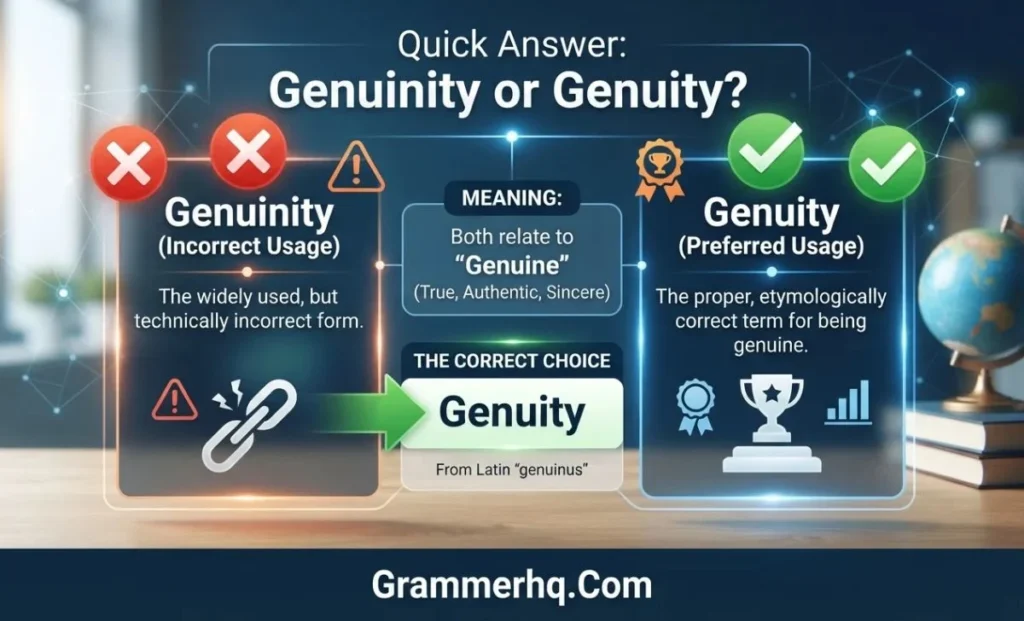
Genuineness is the standard and safest word in formal and everyday English.
- Genuineness — standard and widely accepted
- Genuinity — uncommon and not the usual standard choice
- Genuity — not the normal modern English noun for this meaning
So, instead of writing “the genuinity of his apology” or “the genuity of the product,” write “the genuineness of his apology” or “the genuineness of the product.”
What Does Genuineness Mean?
Genuineness means the quality of being real, authentic, honest, or sincere. It can describe both things and people.
For example:
- The expert confirmed the genuineness of the painting.
- Everyone appreciated the genuineness of her apology.
- The document’s genuineness was questioned during the investigation.
Cambridge defines genuineness as the quality of being honest and sincere or the quality of being real and exactly what it appears to be. Oxford gives the same general sense, describing it as the fact of being real and not artificial, as well as being sincere and honest.
Why Do People Say Genuinity?
The confusion is understandable because genuine is the adjective, and English has many nouns that end in -ity.
For example:
- genuine → genuineness
- sincere → sincerity
- authentic → authenticity
- honest → honesty
Because words such as sincerity and authenticity are common, genuinity may seem like a logical formation from genuine. It can occasionally be found in informal or nonstandard usage, but it is much less established than genuineness.
For clear writing, especially in school, business, academic, or professional contexts, genuineness is the better choice.
Is Genuity a Correct Word?
Genuity is not the standard noun used in modern English to mean the quality of being genuine.
You may encounter the word online or in informal writing, but that does not make it the preferred standard form. If your goal is natural, widely accepted English, genuineness is the safer choice.
This distinction matters because a word can appear in real-world writing without being the best choice for standard English.
Genuineness vs. Genuinity vs. Genuity
| Word | Standard modern usage | Best choice? |
|---|---|---|
| Genuineness | Common and established | Yes |
| Genuinity | Uncommon | Usually no |
| Genuity | Rare/nonstandard for this meaning | No |
Major dictionaries consistently support genuineness as the noun associated with genuine. Collins also identifies genuineness as a derived noun and uses it for the quality of being genuine or sincere.
Genuineness in a Sentence
Here are some natural examples:
For people:
Her genuineness made it easy for everyone to trust her.
For emotions:
I could sense the genuineness of his concern.
For documents:
The lawyer questioned the genuineness of the signature.
For products:
The company hired an expert to verify the genuineness of the antique.
For an apology:
His actions showed the genuineness of his apology.
In each case, genuineness clearly expresses the idea of being real, authentic, or sincere.
Genuinity or Genuity: Which Should You Use?
If you are choosing between genuinity and genuity, the best answer is actually neither for standard writing.
Use genuineness instead.
For example:
❌ The genuity of the artwork was questioned.
❌ The genuinity of her feelings was obvious.
✅ The genuineness of the artwork was questioned.
✅ The genuineness of her feelings was obvious.
This choice is especially useful when writing for a broad US or UK audience because genuineness is familiar and clearly established in major English dictionaries.
When Should You Use Genuineness?
Use genuineness when you are talking about whether something is real, authentic, sincere, or free from deception.
It works naturally with words such as:
- genuineness of a document
- genuineness of an antique
- genuineness of an apology
- genuineness of someone’s feelings
- genuineness of a person’s concern
- genuineness of a signature
- genuineness of a claim
The word can therefore describe both authenticity and sincerity, depending on the context.
Final Answer
Genuineness is the standard word to use when you mean the quality of being genuine.
Although genuinity and genuity can appear in informal or less-standard writing, they are not the preferred choices for normal modern English.
If you are writing an essay, email, report, article, application, or other formal text, choose genuineness.
Genuine → genuineness
That is the form to remember.
Read More Blogs