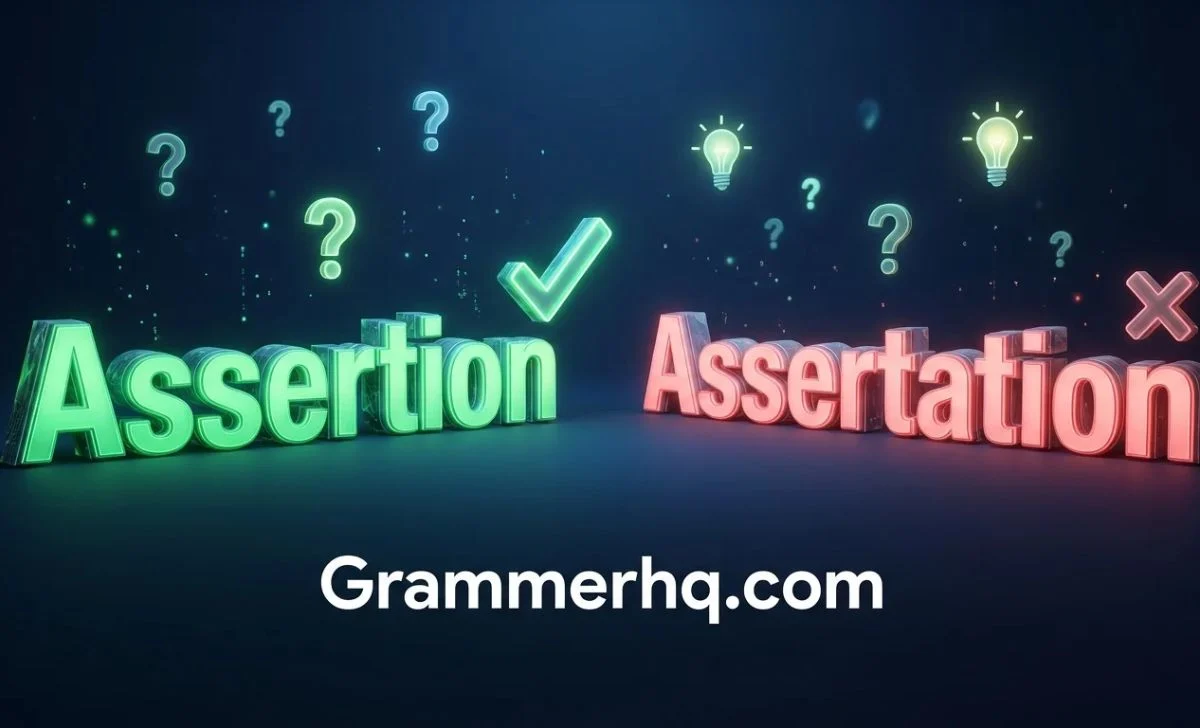
Assertion or assertation can be confusing because both forms look plausible, especially when you know the verb assert. The difference is not quite as simple as saying that one word exists and the other does not.
Assertion is the standard, widely preferred spelling, while assertation is recorded by Dictionary.com as an uncommon variant of assertion.
For everyday communication, academic assignments, professional emails, and formal documents, assertion is the safer and more natural choice.
Understanding the meaning of the word also helps you use it correctly. An assertion is a statement that someone presents as true, often with confidence.
However, making an assertion does not automatically make the statement factual or prove that it is correct. This guide explains the preferred spelling, meaning, usage, examples, and common mistakes so you can choose the right word with confidence.
Quick Answer: Assertion or Assertation?
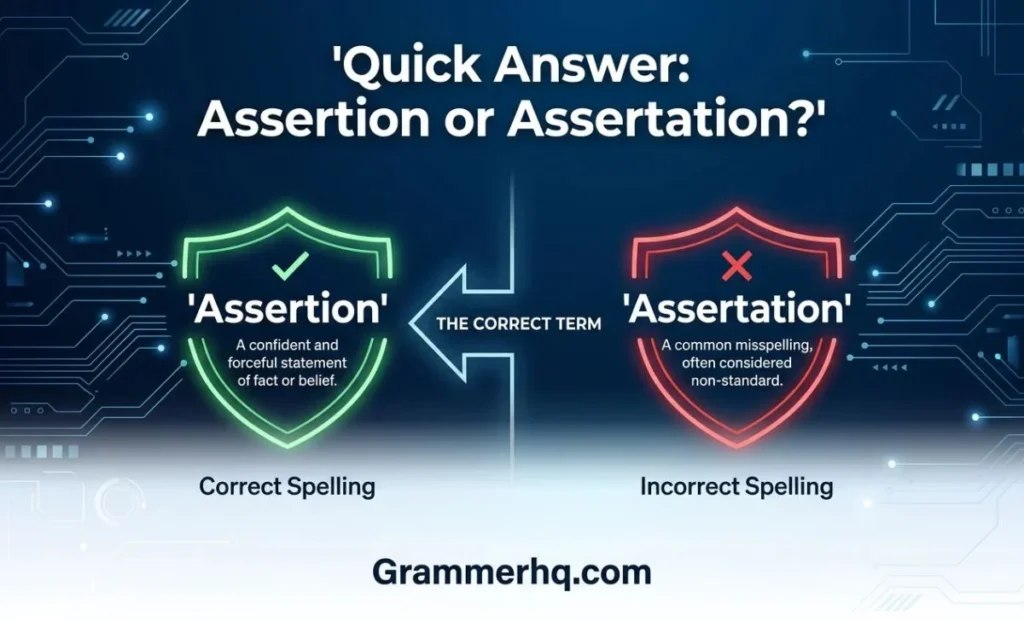
Assertion is the standard and preferred spelling in modern English. Assertation is an uncommon variant recorded in some dictionaries, but it is much less widely used. In most situations, choose assertion, particularly in formal and academic writing.
| Word | Status | Meaning or usage |
|---|---|---|
| Assertion | Standard and preferred | A statement presented as true or an act of asserting something |
| Assertation | Uncommon variant | A less frequently used alternative to assertion |
Examples:
- Correct and preferred: The report challenges his assertion that the project was completed on time.
- Less common: The report challenges his assertation that the project was completed on time.
For clear, conventional English, use assertion.
What Does Assertion Mean?
Assertion is a noun that refers to a statement someone presents as true or to the act of stating something firmly. It commonly appears in discussions, academic writing, legal arguments, workplace communication, and debates.
According to the Cambridge Dictionary, an assertion is a statement that someone strongly believes to be true.
The word can describe a claim supported by evidence, an opinion that needs further support, or a confident statement that another person disputes.
Examples of Assertion in Sentences
- The researcher questioned the assertion that the new treatment was more effective.
- Her assertion that the deadline had changed caused confusion among the team.
- The witness’s assertion was examined against the available evidence.
- The student supported his main assertion with examples from the text.
In each sentence, assertion identifies something someone has stated or maintained. It does not tell us, by itself, whether that statement is true.
Why Do People Confuse Assertion and Assertation?
The two forms look similar because they are associated with the same verb, assert. Adding familiar endings to a word can sometimes lead writers to create a form that looks reasonable but is much less common than the established alternative.
Another source of confusion is that assertation is not entirely absent from dictionaries. Its inclusion as an uncommon variant can make it difficult to determine which form readers should choose.
The practical distinction is frequency and standard usage. Assertion is the established choice in ordinary modern writing, while assertation may look unusual to readers and editors.
For example:
- Preferred: The manager rejected the assertion that costs had increased.
- Less common: The manager rejected the assertation that costs had increased.
The first sentence is the better choice for a business report or professional email.
Is Assertation a Real Word?
Yes, assertation is recorded as an uncommon variant of assertion in Dictionary.com. Therefore, describing it as a word that never exists would be too absolute.
However, dictionary recognition does not mean two forms are equally common or equally suitable in every context. Assertion remains the conventional spelling that readers are most likely to expect.
If you encounter assertation in a published text, you can understand it as a rare alternative. If you are writing your own sentence, there is usually no practical reason to choose it over assertion.
Which Form Should You Use in Formal Writing?
Use assertion in:
- School assignments and university essays
- Research papers and academic discussions
- Business reports and workplace emails
- Legal and professional documents
- Articles, blog posts, and other published content
Choosing the familiar form keeps your writing clear and avoids distracting readers with an unusual word choice.
The Difference Between Assert and Assertion
Understanding the relationship between assert and assertion makes the preferred spelling easier to remember.
Assert is a verb. It means to state something confidently or firmly.
Assertion is a noun. It refers to the statement itself or the act of asserting something.
Compare these examples:
| Word | Example | Function |
|---|---|---|
| Assert | The witness will assert that he was at home. | Verb |
| Assertion | The witness’s assertion was investigated. | Noun |
| Asserted | She asserted her right to speak. | Past-tense verb |
| Asserting | He is asserting that the figures are accurate. | Verb form |
The noun assertion is formed from assert and is the established form to use when referring to a claim or statement.
Assertion Examples in Everyday and Professional Writing
The word appears in different situations, but its central meaning stays consistent.
Everyday conversation:
“Your assertion that nobody called you is incorrect; I spoke to you yesterday.”
Academic writing:
“The essay examines the assertion that technology always improves learning.”
Workplace communication:
“The manager asked for evidence to support the assertion about declining sales.”
News and public discussion:
“The official rejected the assertion that the decision had been made without consultation.”
Legal context:
“The lawyer challenged the assertion that the agreement had been signed voluntarily.”
These examples also demonstrate an important distinction: an assertion is what someone claims, not necessarily what the evidence establishes.
Common Mistakes to Avoid
Writers sometimes use assertation because it resembles the verb assert or because they have seen it used elsewhere.
The simplest correction is to use assertion unless there is a specific reason to reproduce the uncommon variant.
| Less preferred wording | Recommended wording |
|---|---|
| Her assertation was challenged. | Her assertion was challenged. |
| He made an assertation about the results. | He made an assertion about the results. |
| The report questions that assertation. | The report questions that assertion. |
| We need evidence for this assertation. | We need evidence for this assertion. |
A related mistake is assuming that an assertion must be false or unsupported. It can be true or false, well-supported or unsubstantiated. The word describes a statement or act of asserting, not its proven accuracy.
Synonyms and Related Words
Several words can replace assertion, but their meanings are not always identical.
| Word | Meaning | Example |
|---|---|---|
| Claim | A statement presented as true | Her claim was supported by records. |
| Statement | Something expressed in words | His statement clarified the issue. |
| Allegation | A claim, often involving wrongdoing, that may not be proved | The allegation was investigated. |
| Declaration | A formal or emphatic statement | The declaration confirmed their position. |
| Affirmation | A statement or act of confirming something | Her affirmation gave the team confidence. |
Choose the word that best matches the context. For example, allegation is more suitable when discussing an accusation, while statement is more neutral and general.
Easy Way to Remember the Correct Spelling
Connect the noun directly with the verb:
Assert → Assertion
When you need a noun for a statement that someone asserts, remember the established ending in assertion. Avoid adding the extra -at- found in assertation when your goal is conventional modern usage.
You can also remember this simple sentence:
“The assertion needs evidence.”
It links the preferred spelling to a realistic situation and gives you a natural example to recall when writing.
Practice Session: Assertion or Assertation
Choose the preferred spelling to complete each sentence.
- The report challenges her ______ that the figures are accurate.
- His ______ about the deadline confused the team.
- The student supported his main ______ with evidence.
- We need to examine the ______ before accepting it.
- The lawyer questioned the witness’s ______.
- Her ______ that the policy would succeed remained unproven.
- The editor replaced the uncommon variant with the preferred ______.
- The researcher tested the ______ against the available data.
- The manager asked for proof to support the ______.
- The essay examines the author’s central ______.
Answers
- Assertion
- Assertion
- Assertion
- Assertion
- Assertion
- Assertion
- Assertion
- Assertion
- Assertion
- Assertion
Each answer uses the standard, preferred form.
FAQs
1. Which is correct: assertion or assertation?
Assertion is the standard and preferred spelling. Assertation is an uncommon variant, so assertion is the better choice in most writing.
2. Is assertation grammatically incorrect?
It is more accurate to call it an uncommon variant than to say it does not exist. Nevertheless, assertion is the conventional form expected in standard modern writing.
3. What does assertion mean in simple English?
An assertion is a statement that someone presents as true. For example, saying that a new policy will save money is an assertion, even if the result has not yet been proven.
4. What is the plural of assertion?
The plural is assertions. For example, “The report examines three assertions made during the debate.”
5. What is the difference between assert and assertion?
Assert is a verb meaning to state something firmly. Assertion is a noun referring to the statement or the act of asserting something.
6. Is assertion used in both American and British English?
Yes. Assertion is used in both American and British English, with the same general meaning. There is no standard US-versus-UK spelling distinction between the two forms.
7. Does an assertion have to be true?
No. An assertion is a statement presented as true, but it may be accurate, mistaken, disputed, or unsupported. Evidence is needed to assess its truth.
8. What are common synonyms for assertion?
Depending on the context, useful alternatives include claim, statement, declaration, affirmation, and allegation. These words have slightly different meanings, so they are not interchangeable in every sentence.
Conclusion
When choosing between assertion and assertation, assertion is the standard spelling to use in almost every ordinary writing situation.
Although assertation appears in some dictionaries as an uncommon variant, it is much less familiar to readers.
Remember the connection between assert and assertion, and use the established noun when discussing a claim, statement, or confident declaration. This simple choice will keep your writing clear, conventional, and professional.
Read More Blogs