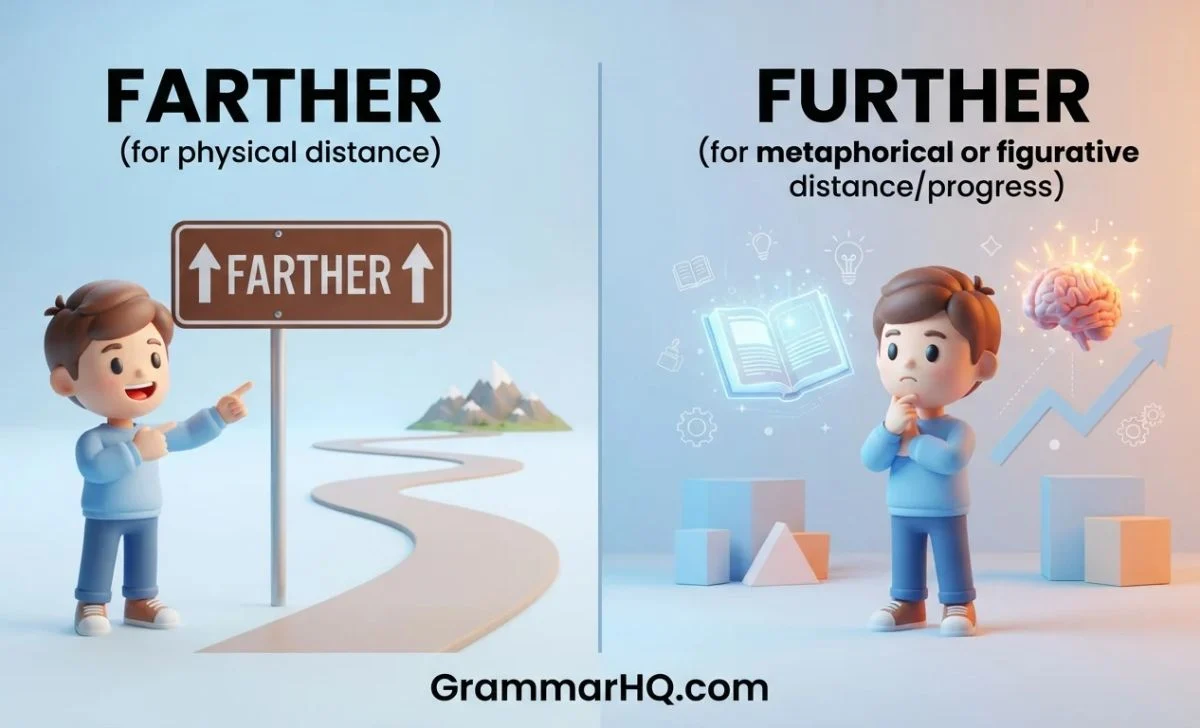
Further vs farther can be confusing because both words are comparative forms of far, and in some situations, either one may be possible. The traditional distinction is simple:
farther is commonly used for physical distance, while further usually refers to additional information, greater degree, progress, or a figurative distance.
However, modern English allows further to describe physical distance too, especially in British English.The easiest way to choose is to consider what you mean.
If you are talking about a measurable distance, farther is often the clearest choice. If you mean “more,” “additional,” or “to advance something,” further is normally the right word.
Quick Answer: Further vs Farther
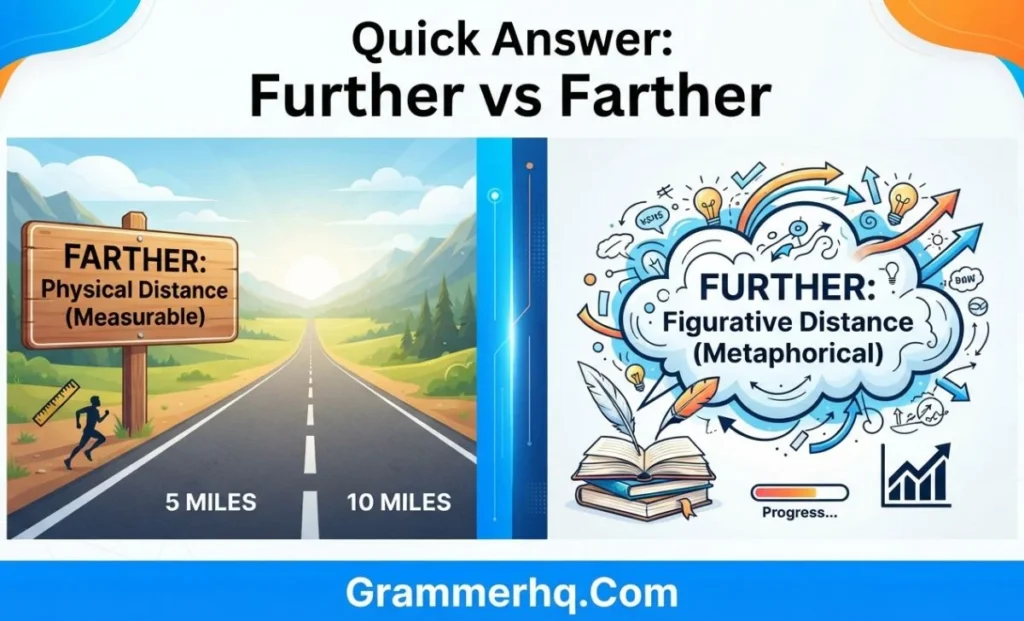
Farther traditionally refers to physical or measurable distance.
- We walked farther than we planned.
- The store is farther down the road.
- How much farther do we have to go?
Further usually means more, additional, or to a greater extent.
- We need further information.
- The issue requires further discussion.
- She wants to further her education.
There is some overlap in modern English. Further can also be used for physical distance, so sentences such as “How much further do we have to go?” are widely accepted.
What Does Farther Mean?
Farther is traditionally used when talking about physical distance or a measurable space between two points. It is especially useful when you can imagine the distance on a road, map, journey, or physical location.
For example:
- The airport is farther from the city than the station.
- We drove farther than we expected.
- The hikers went farther into the forest.
- My house is farther away from the school.
Here, the word describes movement or location in physical space.
A useful test is to ask yourself:
“Can I measure or picture the distance?”
If the answer is yes, farther is traditionally the preferred choice.
Examples of Farther
- The next town is farther north.
- We need to walk farther before we reach the lake.
- The second restaurant is farther away.
- She threw the ball farther than anyone else.
- The mountain looked farther from the road than it actually was.
What Does Further Mean?
Further has a broader range of meanings. It can mean more, additional, to a greater degree, or to advance something.
It is commonly used with ideas, information, discussion, education, research, progress, and other non-physical concepts.
For example:
- Please provide further details.
- We need further evidence.
- The matter requires further investigation.
- They had further discussions about the project.
- She decided to pursue further education.
In these examples, further does not describe physical distance. It means something like additional or more.
Further as a Verb
One important difference is that further can also work as a verb.
As a verb, it means to advance, promote, or help something develop.
For example:
- The program aims to further scientific research.
- Education can further your career.
- The campaign was created to further the organization’s goals.
- These changes could further economic development.
Farther does not normally have this verb meaning.
Further vs Farther for Physical Distance
This is where many English learners encounter conflicting advice.
The traditional guideline is:
Farther = physical distance
Further = figurative or additional meaning
For example:
We walked farther than we planned.
The distance is physical and measurable.
But modern English does not always maintain this strict separation. Further is also commonly used for physical distance:
How much further is the station?
This usage is standard and widely understood.
Therefore, it would be inaccurate to say that further can never describe physical distance.
For American English, farther remains a useful choice when you want to make physical distance especially clear. In British English, further is particularly common in expressions involving distance.
When Should You Use Farther?
Use farther when you are referring to a physical distance, especially when the distance can be measured or compared.
Use Farther for:
- walking distance
- driving distance
- travel distance
- physical locations
- geographical distance
- measurable space
- movement from one place to another
Examples
- We drove farther than expected.
- The hotel is farther from the airport.
- Which runner went farther?
- The village is farther north.
- The second building is farther away.
The word is particularly natural when the sentence involves how far someone or something physically moved.
When Should You Use Further?
Use further when you mean additional, more, greater extent, continued progress, or advancement.
Common combinations include:
- further information
- further details
- further research
- further discussion
- further investigation
- further education
- further development
- further assistance
- further consideration
- further questions
- further evidence
- further action
- further notice
For example:
Please contact us if you require further information.
Here, further means additional.
You would not normally replace it with farther.
Further vs Farther Examples
| Sentence | Best Choice | Why |
|---|---|---|
| We walked ___ than yesterday. | farther | Physical distance |
| Please provide ___ information. | further | Additional information |
| The store is ___ down the road. | farther | Physical location |
| We need ___ research. | further | Additional research |
| She wants to ___ her career. | further | Advance or promote |
| How much ___ is the airport? | farther/further | Both are used; farther emphasizes physical distance |
| Nothing could be ___ from the truth. | further | Figurative meaning |
| The discussion requires ___ consideration. | further | Additional consideration |
| They traveled ___ than expected. | farther | Physical distance |
| The project needs ___ development. | further | Continued development |
Common Expressions With Further
Some expressions strongly favor further.
Further Information
For further information, contact the office.
Here, further means additional.
Further Research
Further research is needed before a conclusion can be reached.
The meaning is additional or continued research.
Further Discussion
We can arrange further discussion next week.
This means another or additional discussion.
Until Further Notice
The road will remain closed until further notice.
This established expression means until another notice or announcement is given.
Further Education
She returned to college for further education.
Here, further means additional or advanced education.
Common Expressions With Farther
Farther is natural in expressions describing physical position or movement.
- farther away
- farther from home
- farther down the road
- farther north
- farther south
- farther east
- farther west
- farther ahead
- farther back
- farther along
For example:
The cabin is farther away than we thought.
They traveled farther north during the summer.
These expressions describe physical location or distance.
Farther vs Further in American and British English
Usage can vary between American English and British English.
American English traditionally makes a clearer distinction between the two words. Farther is often preferred for physical distance, while further is commonly used for figurative meanings and additional information.
British English is more comfortable using further for both figurative meanings and physical distance.
However, this does not mean that one variety considers the other form incorrect. English usage has changed over time, and the two words overlap in modern writing and speech.
For international readers, the safest practical approach is:
Use farther when physical distance is the main idea, and use further for additional information, degree, progress, or figurative meanings.
This distinction is easy to understand and works well in most formal writing.
Further or Farther From the Truth?
The expression “nothing could be further from the truth” is extremely common.
For example:
Nothing could be further from the truth.
The distance here is not physical. It describes a figurative difference between an idea and reality.
Although you may sometimes see farther from the truth, further from the truth is the established and very common choice.
This is a good example of why the simple rule “farther is always physical and further is always figurative” should not be treated as an absolute law.
Farthest vs Furthest
The superlative forms are farthest and furthest.
Traditionally:
- farthest = greatest physical distance
- furthest = greatest degree, extent, or figurative distance
Examples:
Which runner traveled the farthest?
This is the furthest we can go with the current plan.
Modern English also shows considerable overlap between farthest and furthest, particularly in British usage.
A Simple Trick to Remember the Difference
The difference between further vs farther depends mainly on whether you mean distance or something additional.
If you are talking about an actual journey or physical space, farther is a strong choice.
Think about further as further information.
If you mean more, additional, continued, or advanced, choose further.
Remember:
Farther → physical distance
Further → additional, degree, progress, or figurative meaning
This is a helpful guideline, not an absolute rule.
Common Mistakes With Further and Farther
Mistake 1: Using Farther for Additional Information
❌ Please send me farther information.
✅ Please send me further information.
The information is additional, not physical distance.
Mistake 2: Assuming Further Can Never Describe Distance
❌ “Further” is always wrong for physical distance.
This is too strict. Modern English commonly uses further for physical distance, especially in British English.
Mistake 3: Using Farther as a Verb
❌ The program will farther our goals.
✅ The program will further our goals.
Here, further means to advance or promote.
Mistake 4: Treating the Traditional Rule as Absolute
The traditional distinction is useful, but real-world English usage is more flexible. Good writing should recognize both the traditional guideline and modern usage.
Further vs Farther: Which One Should You Use?
If you want a simple rule, choose farther for clear physical distance and further for additional information, greater degree, progress, or figurative meanings.
For example:
- We walked farther than yesterday.
- We need further information.
- She wants to further her education.
- The house is farther down the road.
- The issue requires further discussion.
When talking about physical distance, farther is often the clearest choice. But further is also accepted in many distance expressions, so it should not automatically be considered incorrect.
The key is to focus on meaning and context, rather than memorizing a rigid rule.
FAQs
Is farther or further correct?
Both farther and further are correct words. Traditionally, farther is associated with physical distance, while further commonly means additional, more, or to a greater extent.
What is the main difference between further and farther?
Farther is traditionally used for physical distance. Further is generally used for additional information, degree, progress, or figurative meanings. Modern English also uses further for physical distance.
Is further used for physical distance?
Yes. Further can describe physical distance, particularly in British English and in common expressions such as “How much further do we have to go?”
Is farther only used for physical distance?
Farther is most strongly associated with physical or measurable distance. For figurative expressions, further is usually the more natural choice.
Is “further information” correct?
Yes. Further information is a standard expression meaning additional information.
Is “farther from the truth” correct?
It can occur, but further from the truth is the more established expression for figurative distance.
Can further be a verb?
Yes. Further can mean to advance, promote, or help something develop. For example, “Education can further your career.”
Conclusion
Further and farther are both correct English words, but they often serve different purposes. Farther is traditionally preferred for physical distance, while further usually refers to something additional, greater in degree, continued, or figurative.
Further can also function as a verb meaning to advance or promote something.The easiest guideline is to remember farther for physical distance and further for additional or figurative meanings.
However, modern English allows some overlap, so context matters more than a rigid rule.When in doubt, choose the word that best communicates your intended meaning—and remember that further is not automatically wrong when referring to physical distance.
Read More Blogs