
Both someday and some day are correct English forms, but they are not always used in the same way. The main difference is how they function in a sentence.
The one-word form usually refers to an indefinite time in the future, while the two-word form refers to a particular day that is not specified or emphasizes one day.
These expressions can sometimes communicate a similar idea, which is why writers often confuse them. However, the surrounding words and the meaning of the sentence usually make the choice clear.
Understanding this distinction will help you use both forms naturally in everyday conversation, emails, schoolwork, and professional writing.
Quick Answer
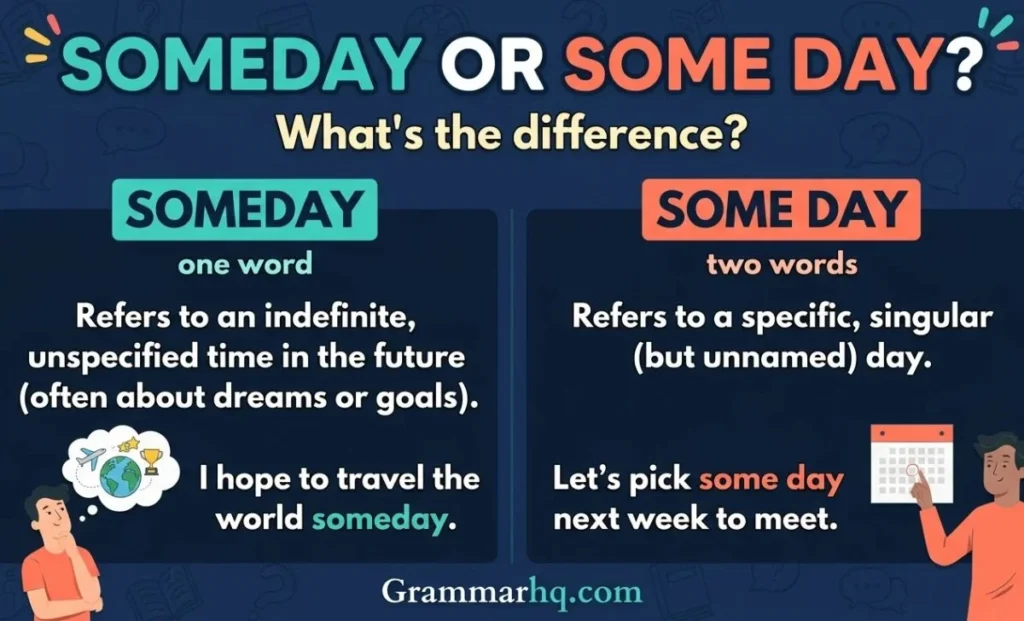
| Form | Meaning | Example |
|---|---|---|
| Someday | At an unspecified time in the future | I hope to visit London someday. |
| Some day | One unspecified or particular day | We should spend some day exploring the old town. |
Both forms are correct, and neither is exclusively American or British English.
Quick tip: Use someday when you mean “at some point in the future.” Use some day when you mean “one day” or are referring to a day as a noun.
What Does Someday Mean?
Someday is an adverb that means at an unspecified time in the future. It often expresses a hope, dream, intention, or possibility without giving an exact date.
People commonly use it when discussing something they want to do or expect to happen later.
Examples:
- I hope to publish my first book someday.
- She wants to travel around Europe someday.
- Someday, we will look back on this experience and smile.
In each sentence, the exact time is unknown. The speaker is thinking about the future rather than a particular day on the calendar.
What Does Some Day Mean?
Some day is a two-word phrase in which some modifies the noun day. It can refer to an unspecified day or emphasize one day, depending on the sentence.
Examples:
- We should choose some day next month for the meeting.
- I would like to spend some day exploring the countryside.
- Some day in the future, this building may become a museum.
The first example refers to an unspecified day for a meeting. The third identifies a possible day in the future while treating day as a noun.
In natural English, writers may prefer a more specific phrase when the intended meaning is clearer that way, such as “a day next month” or “one day in the future.”
Why Do People Confuse These Two Forms?
The confusion comes from their similar spelling, pronunciation, and meaning. Both expressions can refer to the future, and in some sentences, either form may appear plausible at first glance.
The key difference is grammatical:
- Someday works as an adverb, describing when something may happen.
- Some day contains the noun day, modified by some.
Compare these sentences:
- I will learn to play the piano someday.
- We need to set aside some day for piano lessons.
The first describes an indefinite future time. The second refers to a day that needs to be set aside.
The Grammar Rule Behind the Difference
The distinction is based on how the words function, rather than a complicated spelling rule.
English sometimes combines words into a single word when they develop a common meaning or grammatical function. Someday is conventionally written as one word when it means “at an unspecified future time.”
By contrast, some day remains two words when some describes the noun day.
Compare the pattern with these examples:
- Sometime: I will call you sometime next week.
- Some time: We need some time to finish the project.
- Sometimes: She sometimes works on weekends.
- Some times: There were some times when the journey felt difficult.
These pairs follow different grammatical patterns, so their spacing should reflect the meaning you intend.
Examples in Everyday Sentences
Here are natural examples showing how the two forms work in different contexts.
Everyday conversation
- I would love to see the Northern Lights someday.
- Let’s choose some day when everyone is free.
- Someday, you’ll understand why I made that decision.
School and professional writing
- He hopes to become a university professor someday.
- We should schedule some day for the final review.
- Someday, researchers may discover a better solution to this problem.
Texting and informal messages
- We should go on a road trip someday!
- Let’s pick some day next week to meet up.
The first form is especially common when expressing hopes and future possibilities. The second is useful when discussing a day that needs to be chosen, planned, or considered.
Common Mistakes to Avoid
| Confusing sentence | Better wording |
|---|---|
| I want to visit Japan some day in the future. | I want to visit Japan someday. |
| Let’s meet someday next Tuesday. | Let’s meet on Tuesday. |
| I need someday to finish this assignment. | I need some time to finish this assignment. |
| We should choose someday for the event. | We should choose some day for the event. |
The first example is not necessarily ungrammatical, but the one-word form is more direct when the meaning is simply “at an unspecified time in the future.” The other examples show how a more precise expression can prevent confusion.
Someday vs Some Day in American and British English
There is no standard US-versus-UK spelling difference between these forms. Both American and British English use someday and some day.
| English variety | One-word form | Two-word form |
|---|---|---|
| American English | Someday | Some day |
| British English | Someday | Some day |
The choice depends on meaning and sentence structure, not the country in which the writer lives.
Easy Way to Remember the Difference
Use this simple test: can you replace the expression with “at some point in the future”?
- If yes, someday is usually the natural choice.
- If you are referring to a day as a noun, some day may be appropriate.
For example, “I hope to own a home someday” means that you hope to own one at an unspecified future time.
However, “We need to select some day for the ceremony” means that you need to choose a day.
Practice Session: Someday or Some Day?
Choose the form that best fits each sentence.
- I hope to visit Australia ______.
- We need to choose ______ for the family reunion.
- She believes her hard work will pay off ______.
- Let’s find ______ next week when we can talk.
- ______, people may travel to Mars more easily.
- We should set aside ______ for the final preparations.
- He dreams of opening his own restaurant ______.
- Can we choose ______ in December for the celebration?
- I hope we meet again ______.
- The team needs to decide on ______ for the presentation.
Answers
- Someday
- Some day
- Someday
- Some day
- Someday
- Some day
- Someday
- Some day
- Someday
- Some day
In sentences 2, 4, 6, 8, and 10, the phrase refers to a day that needs to be selected or set aside. In the other sentences, the emphasis is on an indefinite future time.
FAQs
1. Which is correct: someday or some day?
Both are correct. Use someday for an indefinite future time and some day when referring to an unspecified day as a noun.
2. Is someday one word or two words?
Someday is one word when it means “at an unspecified time in the future.” The phrase some day is written as two words when some modifies the noun day.
3. Is someday a real word?
Yes. It is a standard English adverb used to describe an unspecified future time.
4. Do Americans write someday differently from British people?
No. Both American and British English use the same spellings. The intended meaning determines which form is appropriate.
5. Can some day refer to the future?
Yes. For example, “Some day in the future, we may find an answer.” Here, day is a noun, and the phrase refers to an unspecified future day.
6. Is someday formal or informal?
It is acceptable in both formal and informal writing. You can use it in essays, emails, conversations, and professional documents when discussing an indefinite future possibility.
7. What is the difference between someday and one day?
Both can refer to an unspecified future time. One day can also refer to a particular day or an event in the past, depending on context.
For example, “One day, she decided to leave” refers to a past event, while “She hopes to travel someday” expresses a future hope.
8. What is the difference between someday and sometime?
Someday usually refers to an indefinite future occasion. Sometime refers to an unspecified time and can be used for the past or future. For example, “I met him sometime last year” refers to the past.
Conclusion
Both forms are correct, but they serve different grammatical purposes. Use someday when talking about hopes, plans, or possibilities at an indefinite point in the future. Use some day when referring to an unspecified day as a noun.
Remember the simple distinction: someday means “at some point in the future,” while some day refers to a day.
Read More Blogs

Hi, I’m Amelia Parker, a grammar enthusiast and writer at GrammarHQ.com. I specialize in explaining spelling differences, confusing words, and common English mistakes through simple, practical, and easy-to-understand guides.