
Bearing vs baring are two different English words that sound similar but have different meanings and uses.
Bearing usually means carrying, supporting, enduring, or having a particular direction or relevance, while baring means uncovering or exposing something that was previously covered.
The main difference is that bearing relates to carrying, position, or influence, whereas baring relates to revealing or making something visible.
For example:
- Bearing: She is bearing the responsibility of supporting her family.
- Baring: He was baring his arms to show his new tattoo.
Although these words are pronounced similarly, they are not interchangeable. Choosing the correct spelling depends on the meaning you want to express.
Quick Answer: Bearing vs. Baring
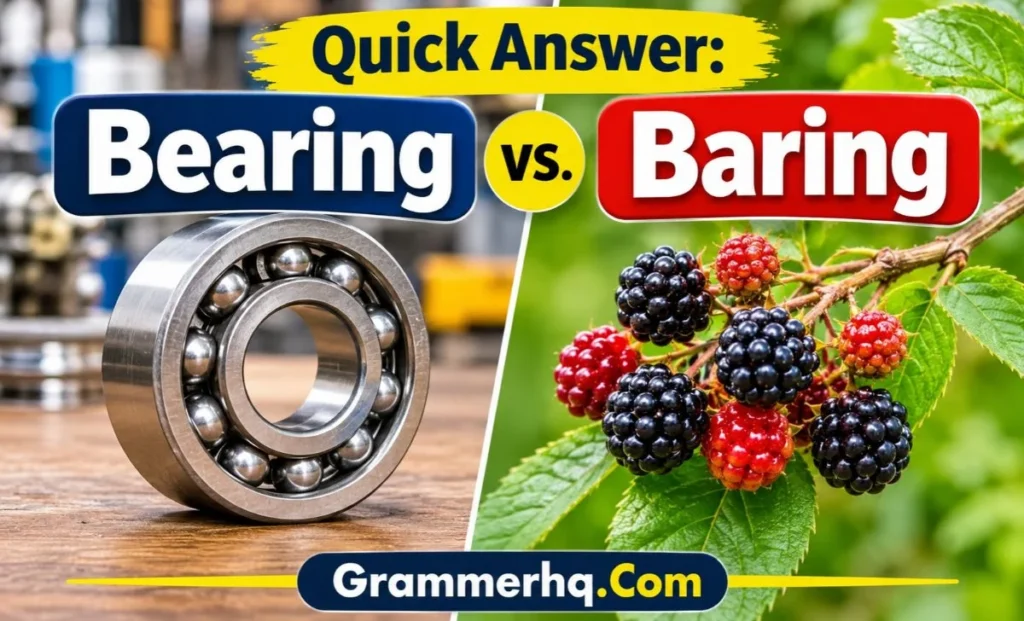
- Bearing is the correct word when talking about carrying a load, accepting responsibility, enduring difficulty, maintaining posture, or having a connection to something.
- Baring is the correct word when describing the act of uncovering, exposing, or revealing something.
Easy way to remember:
- Bearing comes from the verb bear, meaning to carry or endure.
- Baring comes from the verb bare, meaning to uncover or expose.
What Does Bearing Mean?
Bearing is the present participle of the verb bear. It means carrying, supporting, tolerating, or enduring something. As a noun, it can also describe someone’s posture, behavior, direction, or the relationship between two things.
The word has several common uses in everyday English, professional writing, and technical contexts.
Examples of bearing in sentences:
- She is bearing the responsibility of raising three children.
- The bridge is bearing the weight of several heavy trucks.
- His calm bearing impressed everyone at the meeting.
- The decision will have a significant bearing on our future.
- He is bearing the pain without complaining.
- The mechanic replaced the damaged wheel bearing.
- The captain checked the ship’s bearing before changing direction.
Common expressions with bearing:
- Have a bearing on: To influence or relate to something.
- Bear the responsibility: To accept responsibility for something.
- Get your bearings: To understand your location or situation.
- Lose your bearings: To become confused or lose your sense of direction.
- Load-bearing wall: A wall that supports the weight of a structure.
For example, Your previous experience has a strong bearing on your job application means that your experience is relevant to the application.
Bearing is particularly useful when discussing responsibilities, influence, physical support, personal conduct, and direction. English meaning – Cambridge Dictionary+2
What Does Baring Mean?
Baring is the present participle of the verb bare. It means uncovering, exposing, or revealing something that was previously hidden or covered.
It can describe physical exposure, such as showing someone’s skin, or emotional exposure, such as revealing personal feelings, secrets, or thoughts.
Examples of baring in sentences:
- She was baring her shoulders in the summer dress.
- He was baring his soul during the emotional conversation.
- The dog started baring its teeth at the stranger.
- The artist is baring the wooden surface before painting it.
- She felt uncomfortable about baring her personal feelings.
- The workers were baring the metal pipes beneath the old flooring.
- He apologized for baring his private thoughts in public.
Common expressions with baring:
- Baring your soul: Revealing your deepest thoughts and feelings.
- Baring your teeth: Showing your teeth, often as a sign of anger or aggression.
- Baring your arms: Uncovering your arms.
- Baring the truth: Revealing something that was previously hidden.
For example, She was baring her soul to her closest friend means she was openly sharing her deepest emotions.
Baring is appropriate whenever something is being uncovered, exposed, or revealed. grammar.com+2
Bearing vs. Baring: Key Differences
Understanding their grammatical forms and meanings makes it easier to choose the correct word.
| Feature | Bearing | Baring |
|---|---|---|
| Root verb | Bear | Bare |
| Part of speech | Noun, verb form, adjective in compounds | Verb form |
| Main meaning | Carrying or enduring | Uncovering or exposing |
| Common use | Responsibility, support, influence | Exposure, revelation |
| Example | Bearing the burden | Baring your soul |
Remember: Bearing is about carrying or supporting something, while baring is about removing a covering or revealing something.
When Should You Use Bearing or Baring?
The easiest way to select the correct word is to consider what you want to communicate.
Use Bearing When:
- Someone is carrying a physical or emotional burden.
- A person is accepting responsibility.
- Something is supporting weight.
- You are describing someone’s posture or manner.
- Something is relevant to a particular situation.
- You are discussing direction or mechanical parts.
Examples:
- The employee is bearing the pressure of a demanding job.
- Her professional bearing made a positive impression.
- This information has no bearing on the final decision.
Use Baring When:
- Someone is exposing part of their body.
- A person is revealing private feelings.
- Something hidden is being uncovered.
- An animal is showing its teeth.
- A covering is being removed from a surface.
Examples:
- He was baring his chest in the hot weather.
- She was baring her feelings in front of her family.
- The dog was baring its teeth at the approaching stranger.
Common Mistakes When Using Bearing and Baring
Many writers confuse these words because they sound alike. However, their meanings are different, so using the wrong spelling can change the meaning of a sentence.
Here are some common mistakes and their corrections.
| Incorrect Usage | Correct Usage |
|---|---|
| She is baring the responsibility. | She is bearing the responsibility. |
| He was bearing his teeth. | He was baring his teeth. |
| This has no baring on the decision. | This has no bearing on the decision. |
| She was baring the emotional burden. | She was bearing the emotional burden. |
| He was bearing his soul. | He was baring his soul. |
Why do these mistakes happen?
The main reason is confusion between the root verbs bear and bare. Remember that bear means to carry or endure, whereas bare means uncovered or exposed.
A simple understanding of these two root words can prevent most spelling and word-choice mistakes.
Bearing vs. Baring: Real-Life Examples
These examples show how the two words work in everyday conversations and different situations.
At work:
- Bearing: Sarah is bearing the responsibility of managing the entire project.
- Baring: The manager was baring his concerns during the meeting.
At home:
- Bearing: My father is bearing the financial burden of our household.
- Baring: My brother was baring his arms while working in the garden.
In relationships:
- Bearing: She is bearing the emotional pain of a difficult breakup.
- Baring: He was baring his true feelings to his partner.
In everyday situations:
- Bearing: The old bridge is bearing the weight of heavy vehicles.
- Baring: The dog was baring its teeth when the stranger approached.
These examples demonstrate that the correct choice depends on whether the sentence describes carrying, supporting, or enduring something, or uncovering and revealing something.
FAQs
1. Is bearing or baring the correct spelling?
Both bearing and baring are correct English spellings. Bearing comes from bear, while baring comes from bare. The correct choice depends on the intended meaning.
2. What is the difference between bearing and baring?
Bearing means carrying, supporting, enduring, or having relevance to something. Baring means uncovering, exposing, or revealing something that was previously covered or hidden.
3. Is bearing a real English word?
Yes. Bearing is a standard English word used as a noun, a present participle of bear, and in compound adjectives. It can describe responsibility, posture, direction, relevance, and mechanical support.
4. Is baring a real English word?
Yes. Baring is the present participle of bare. It describes the act of uncovering or exposing something, such as baring your arms, teeth, or soul.
5. Is it bearing in mind or baring in mind?
The correct expression is bearing in mind. It means remembering or considering something when making a decision or thinking about a situation.
Example: Bearing in mind the weather conditions, we decided to cancel the trip.
6. Is it bearing responsibility or baring responsibility?
The correct expression is bearing responsibility. It means accepting or carrying responsibility for an action, task, or situation.
Example: She is bearing responsibility for the team’s performance.
7. Is it bearing your soul or baring your soul?
The correct expression is baring your soul. It means revealing your deepest thoughts, emotions, or personal feelings to someone.
Example: He was baring his soul during the honest conversation.
8. Do bearing and baring sound the same?
Yes. In standard English pronunciation, bearing and baring are generally pronounced alike. Their different spellings and meanings make them commonly confused words.
Conclusion
Bearing vs baring are both correct English words, but they serve different purposes. Bearing refers to carrying, supporting, enduring, posture, or relevance, while baring describes uncovering, exposing, or revealing something.
The simplest way to remember the difference is to connect bearing with bear (to carry) and baring with bare (to uncover).
Understanding these root words will help you avoid common spelling mistakes and use both words accurately in everyday communication, academic writing, and professional content.
Discover More Blogs:
- Manuel vs. Manual: What’s the Difference?
- Submission vs. Submittion: Which Spelling Is Correct?
- Striping vs. Stripping: What’s the Difference? Meaning & Examples
- Other Than vs. Other Then: Correct Usage & Meaning?