Engineer or engeneere is a common spelling question, but only engineer is the correct standard English spelling.
Engeneere is a misspelling and should not be used in professional, academic, or everyday writing. The confusion often comes from the word’s vowel sequence and its -eer ending.
Which can be difficult to remember when spelling from pronunciation. Whether you are writing a résumé, school assignment, technical report, or email, using engineer keeps your writing accurate and professional.
Quick Answer: Engineer or Engeneere?
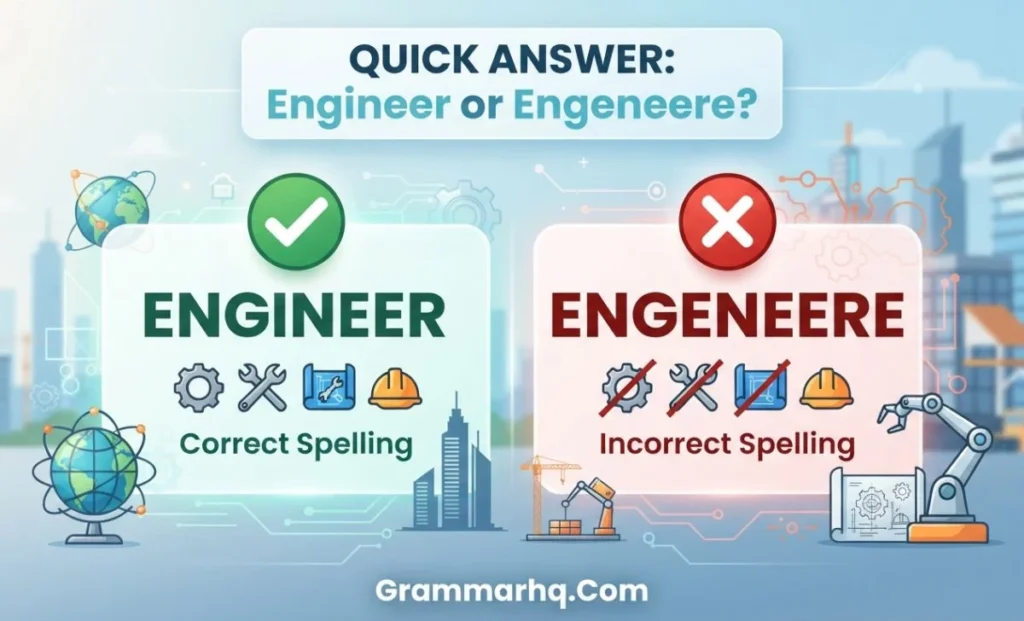
Engineer is correct, while engeneere is incorrect.
| Spelling | Status | Use |
|---|---|---|
| Engineer | ✅ Correct | Standard English word |
| Engeneere | ❌ Incorrect | Not a standard English spelling |
The correct spelling is:
E-N-G-I-N-E-E-R
A useful way to remember it is engine + eer = engineer.
Engineer vs. Engeneere: What Is the Difference?
The difference is simply that engineer follows the standard English spelling, while engeneere does not.
Engineer
Engineer is a standard English noun and verb.
As a noun, it can describe a person who works in a branch of engineering, such as civil, mechanical, electrical, or software engineering.
My sister is a civil engineer.
As a verb, engineer can mean to design, arrange, or develop something deliberately.
The team engineered a solution to the problem.
Engeneere
Engeneere is not an accepted alternative spelling of engineer. It is a misspelling.
If you see this form in a résumé, application, assignment, or professional document, it should be changed to engineer.
Why Is Engineer Often Misspelled as Engeneere?
The spelling can be tricky because the word does not look exactly the way many people expect it to sound.
The ending can cause confusion
The word ends in -eer:
engineer
It does not end in -eere.
Adding an extra e at the end creates the incorrect form engeneere.
The vowel sequence is easy to mix up
The middle and final vowels can make the word difficult to remember when writing quickly. People sometimes rearrange or add letters because they are spelling from sound rather than from memory.
Pronunciation does not always reveal spelling
English contains many words whose pronunciation does not provide a simple guide to their written form. Engineer is one of those words where learning the standard spelling is more reliable than trying to reproduce the sound letter by letter.
How to Spell Engineer Correctly
The standard spelling is:
E-N-G-I-N-E-E-R
A simple memory aid is:
engine + eer → engineer
The important point is the ending:
-eer ✅
-eere ❌
For example:
She wants to become an engineer.
Not:
She wants to become an engeneere.
Once you remember the -eer ending, the spelling becomes much easier to reproduce accurately.
What Does Engineer Mean?
Engineer has two important uses.
As a noun, it refers to a person who applies technical, scientific, and mathematical knowledge to practical problems. Engineers may design machines, structures, software, electrical systems, vehicles, or other technologies.
Different engineering fields include:
- civil engineering
- mechanical engineering
- electrical engineering
- software engineering
- structural engineering
- chemical engineering
- aerospace engineering
- biomedical engineering
- environmental engineering
- computer engineering
For example:
The structural engineer inspected the building before construction began.
The word can also refer to someone working with or maintaining technical equipment, depending on the profession and context.
Engineer as a Verb
Engineer is not limited to a job title.
It can also function as a verb meaning to design, create, arrange, or bring about something through careful planning and skill.
For example:
The developers engineered a faster payment system.
The company engineered a solution to reduce production delays.
This use is common in technical, business, and professional writing.
Engineer vs. Engineering vs. Engineers vs. Engineered
These forms are related, but they do different jobs in a sentence.
| Word | Meaning / Use | Example |
|---|---|---|
| engineer | A professional; also a verb | She is an engineer. |
| engineers | More than one engineer | The engineers tested the system. |
| engineering | The field or activity | He studied engineering. |
| engineered | Past tense or past participle | They engineered a new solution. |
Understanding these forms can help prevent spelling mistakes beyond the original word.
Common Misspellings of Engineer
Several forms can appear when someone is unsure of the spelling.
Examples include:
- engeneere ❌
- engeneer ❌
- enginer ❌
- enginner ❌
- engieneer ❌
- engineeer ❌
- engineere ❌
These are not alternative standard spellings. In normal English writing, use engineer.
The same principle applies to related forms: engineering, engineers, and engineered should retain their standard spelling.
Engineer Pronunciation: Does It Change the Spelling?
The pronunciation of engineer can vary slightly between American and British English, but the spelling remains the same.
This is an important distinction: pronunciation may vary, but the written form does not change to “engeneere.”
If you are unsure while writing, rely on the established spelling rather than trying to spell the word exactly as it sounds.
Examples of Engineer in a Sentence
Here are some natural examples from different contexts:
- My brother works as a mechanical engineer for an automobile company.
- The civil engineer reviewed the plans before construction started.
- She is studying software engineering at university.
- The electrical engineers tested the new equipment.
- The company hired an experienced engineer to improve its production system.
- The team engineered a practical solution to the software problem.
- He listed “engineer” as his profession on his job application.
These examples show how the word works in professional, academic, technical, and everyday contexts.
Why Correct Spelling Matters in Professional Writing
A spelling mistake may look small, but it can stand out when it appears in an important document.
Consider a résumé:
❌ Mechanical Engeneere
✅ Mechanical Engineer
The second version immediately looks professional and standard.
The same applies to:
- résumés and CVs
- job applications
- cover letters
- LinkedIn profiles
- professional emails
- university assignments
- technical reports
- business documents
When a job title or qualification is involved, using the accepted spelling helps your writing look careful and credible.
How to Remember the Spelling of Engineer
You do not need a complicated mnemonic. Three simple reminders are enough.
1. Start with “engine”
Think:
engine → engineer
The beginning of the word is engine, not engene.
2. Remember the ending “-eer”
The final letters are:
E-E-R
So:
engine + eer = engineer
3. Learn the word family
Remember these together:
engineer → engineers → engineering → engineered
Seeing the word in several grammatical forms makes the spelling easier to recognize and reproduce.
Quick Practice: Engineer or Engeneere?
Test yourself with these sentences.
1. She hopes to become an ______ after university.
Answer: engineer
2. The ______ designed the electrical system.
Answer: engineer
3. Several ______ inspected the bridge.
Answer: engineers
4. He is studying ______ at college.
Answer: engineering
5. The company ______ a new system for the factory.
Answer: engineered
If you can identify these forms, you can usually avoid the most common spelling confusion around the word.
FAQs
Is engineer the correct spelling?
Yes. Engineer is the standard English spelling.
Is engeneere a word?
No. Engeneere is not a standard English spelling. It is a misspelling of engineer.
How do you spell engineer?
It is spelled E-N-G-I-N-E-E-R.
Why is engineer difficult to spell?
The vowel sequence and -eer ending can make the word difficult to remember, especially when someone tries to spell it from pronunciation.
What is the plural of engineer?
The plural is engineers.
The engineers completed the project on time.
What is the difference between engineer and engineering?
Engineer normally refers to a person or can function as a verb. Engineering refers to the field, discipline, or activity.
My brother is an engineer.
My brother studied engineering.
Can engineer be used as a verb?
Yes. As a verb, engineer can mean to design, arrange, or deliberately develop something.
The team engineered a solution to the problem.
What are common misspellings of engineer?
Examples include engeneere, engeneer, enginer, enginner, engieneer, and engineeer. The standard spelling is engineer.
Conclusion
Engineer is the correct spelling, while engeneere is incorrect. The easiest way to remember the word is to recognize its structure:
engine + eer = engineer
Whether you are talking about a civil engineer, software engineer, mechanical engineer, or the engineering profession itself, the standard written form remains engineer. If you are writing a résumé, assignment, email, or technical document, use engineer with confidence.
Read More Blogs